

Part 1 settled the cost question: a comfortable single remote worker in Bangkok lands around US$1,600/month anchored on an Ari 1-BR condo at the Thai-platform price — roughly $425 above Taipei’s comfortable budget, not below it, which is the opposite of what the “Southeast Asia is cheap” reflex predicts. If you missed it: the rent moves ≈3× across the same rail network depending which station you anchor at, the foreigner-channel English sites quietly show you the wrong geographic resolution, and the real grocery moat is in fresh protein, not imported cheese.
So if Bangkok isn't the cheap option versus Taipei, the decision turns on what it does that the cost line doesn't show. That's this post. I'll start with the question every "should I move here" checklist asks and answers worst — is Bangkok actually safe? — then get into the three things that decide it: what healthcare actually costs in a medical-tourism city with no national scheme for foreigners, where residents actually eat (the English "must-eat" lists correlate poorly with it), and the visa landscape after the 2024 DTV launch — which, for the first time in a decade, makes Bangkok an easy major Asian capital to legally live in as a remote worker, with a 180-day tax trap hiding inside the good news.
A note on currency: ≈32.5 THB = US$1. THB figures are written as 25,000 THB (≈$769) throughout. Budget figures referenced here are from Part 1, the Bangkok cost-of-living breakdown.
1. Safety — and the risks that actually matter
Safety is the question every “should I move here” checklist asks, and the one the English-language internet answers worst — usually with vague unease or “just use common sense.” So let me do it the way I did the rent: with numbers, and with attention to the gap between what people fear and what actually hurts residents.
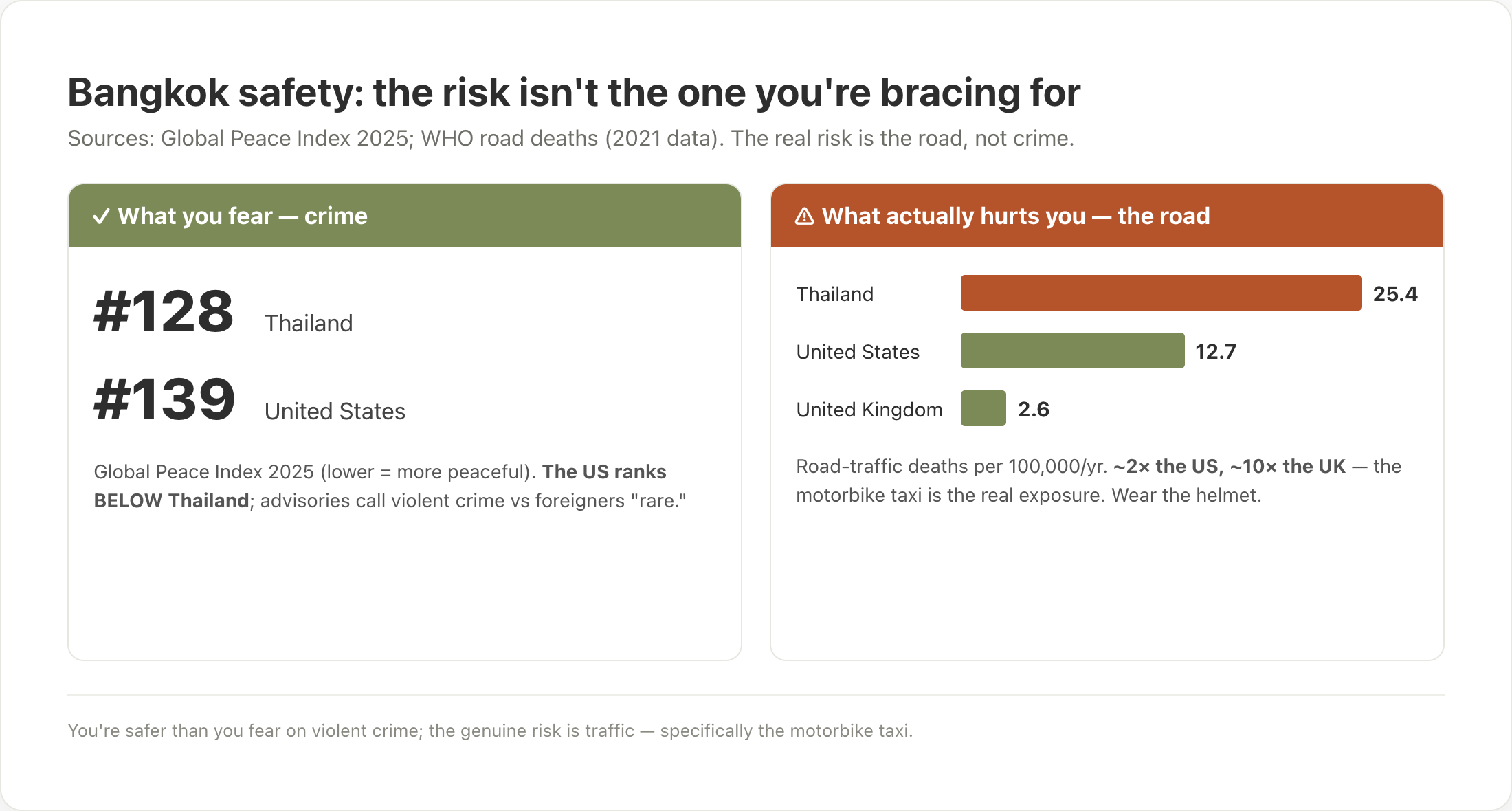
Start with the reassuring part, because it’s true and it surprises people. On the 2025 Global Peace Index, Thailand ranks #128 of 163, which sounds alarming until you notice the United States sits below it at #139. The GPI is a composite, dragged down by things that have nothing to do with your Sukhumvit soi: political instability, the deep-south insurgency, and armed clashes on the Cambodian border (flare-ups in mid- and late 2025 closed every Thailand–Cambodia land crossing; as of mid-2026 the US flags a “do not travel” zone within 50km of that border, the UK within 20km, Australia within 10km). All of that is hundreds of kilometres from Bangkok, and crucially the overall Thailand advisory levels haven’t moved: the US still rates the country Level 2 (”exercise increased caution”), Australia “a high degree of caution”, because the conflict is a localized border issue, not a Bangkok one. On the metric you actually care about (violent crime against foreign residents), all three Anglophone governments’ advisories agree: the US State Department calls it “relatively rare,” the UK’s FCDO says violent crime “rarely involves tourists.” Bangkok’s genuine day-to-day crime is opportunistic (bag-snatching, the occasional burglary) and bureaucratic (corruption indices run high). By the numbers, day to day, Bangkok is safer on violent crime than most large US cities. That’s not a sales pitch; it’s what the indices say.
Now the part the fear content gets backwards: the thing most likely to hurt you in Bangkok is the road, not a person. Thailand’s road-traffic death rate is about 25 per 100,000 people a year (WHO) — roughly double the US rate and nearly ten times the UK’s, among the worst in Southeast Asia. The dominant killer is the motorbike, and the motorbike taxi you’ll be tempted to hop on for the last kilometre to the BTS is exactly the exposure. If you take one safety habit from this entire teardown, it’s this: wear the helmet every single time, even for the two-minute motosai hop, and think hard before you rent a scooter to ride yourself in Bangkok traffic. The mugging you’re worried about is a rounding error next to the ride you’re not worried about.
Air quality is a real cost, but a seasonal one. Bangkok’s annual-average PM2.5 runs around 18 µg/m³ — roughly 3.5× the WHO guideline, bad on paper but moderate by regional standards and improving over the last decade. The misery concentrates in the burning season, roughly December to April, when agricultural burning plus a temperature inversion push the air into genuinely unhealthy territory; the rest of the year the rains scrub it clean. (If clean air ranks high for you, here’s the counterintuitive part: Bangkok beats Chiang Mai, which is materially worse in burning season.) The practical move is a Dec–Apr routine: an air purifier at home, an AQI app on your phone.
Scams: separate the tourist theatre from the resident reality. The con you’ll read about — the “Grand Palace is closed today, let me take you to a gem shop” tuk-tuk routine — is a tourist filter you age out of in week one. The scam that actually hits residents is duller and more expensive: the withheld rental deposit. Local-language tenant forums are full of it, and the FCDO formally warns of property scams. Protect yourself the way you would against any deposit dispute: everything in writing, photograph the unit on move-in, use a reputable agent. Two more worth internalising: never hand your passport over as rental collateral (for a scooter or anything else; the official advisories are explicit), and default to Grab over a flagged street taxi, which makes the whole metered-fare argument disappear.
For women specifically, the resident signal is consistently better than the Western-city baseline: low street harassment, and a rail network (BTS/MRT) that’s clean, safe, and runs to around midnight. The sourced caveats are narrow and behavioural — use app-based rides rather than street taxis late at night, and treat the nightlife sois (Nana, Patpong, Soi Cowboy) as their own risk category, where the real danger is drink-spiking and methanol-tainted alcohol, not the street outside. That’s a zone caveat, not a city one.
One honest hazard note. Bangkok floods in the rainy season, a recurring nuisance more than a danger, but real, and worth factoring into a ground-floor vs higher-floor rental choice. And the comfortable old line that Bangkok, unlike Taipei, has no earthquake risk needs updating: the magnitude-7.7 earthquake that struck Myanmar in March 2025 was felt strongly enough in Bangkok (which sits on soft river-delta clay that amplifies distant tremors) to collapse an under-construction 30-storey government tower in the Chatuchak area, killing 96 people. Bangkok isn’t on an active fault, but “immune” is no longer the right word: a smaller Myanmar quake in May 2026 again sent people out of Bangkok high-rises, so the tremors keep arriving. The collapse investigation has been substantial: Thai authorities identified structural-failure causes (sub-strength concrete, insufficient rebar) and brought criminal charges against the contractors, which is reassuring for future buildings but a reason to glance at a tower’s developer reputation when you rent high. The one genuine takeaway for a renter: this is a real, if infrequent, risk now, concentrated in tall and under-built construction, not a reason to avoid the city.
The short version: you are far safer in Bangkok than the genre of “is Bangkok safe?” content implies — provided you respect the road, watch the air from December to April, and guard your deposit and your passport. The risks here are real, but they aren’t the ones the fear content sells you.
