

Here’s the number this whole post is built around: a comfortable single month in Bangkok in 2026 runs about US$1,600 — more than the comfortable month I priced in Taipei earlier in this series, not less. I had to sit with that one. Southeast Asia is supposed to be the cheap option and East Asia the expensive one; at a genuine middle-class lifestyle tier, Bangkok is the pricier city. (Da Nang, stays the clear cheap base; it’s Bangkok-versus-Taipei specifically that flips.)
And the total isn’t the strangest thing I found. While I was pricing it, one number stopped me cold: at one premium station, the English-language rental sites quoted rent roughly 45% below what apartments there actually rent for. Below — the opposite of the familiar foreigner-markup story. And nobody was lying, either. How both of those sentences can be true at once is the key to Bangkok’s entire cost of living, and it decides whether you budget your move on a real number, or on a price that belongs to no apartment you can actually rent.
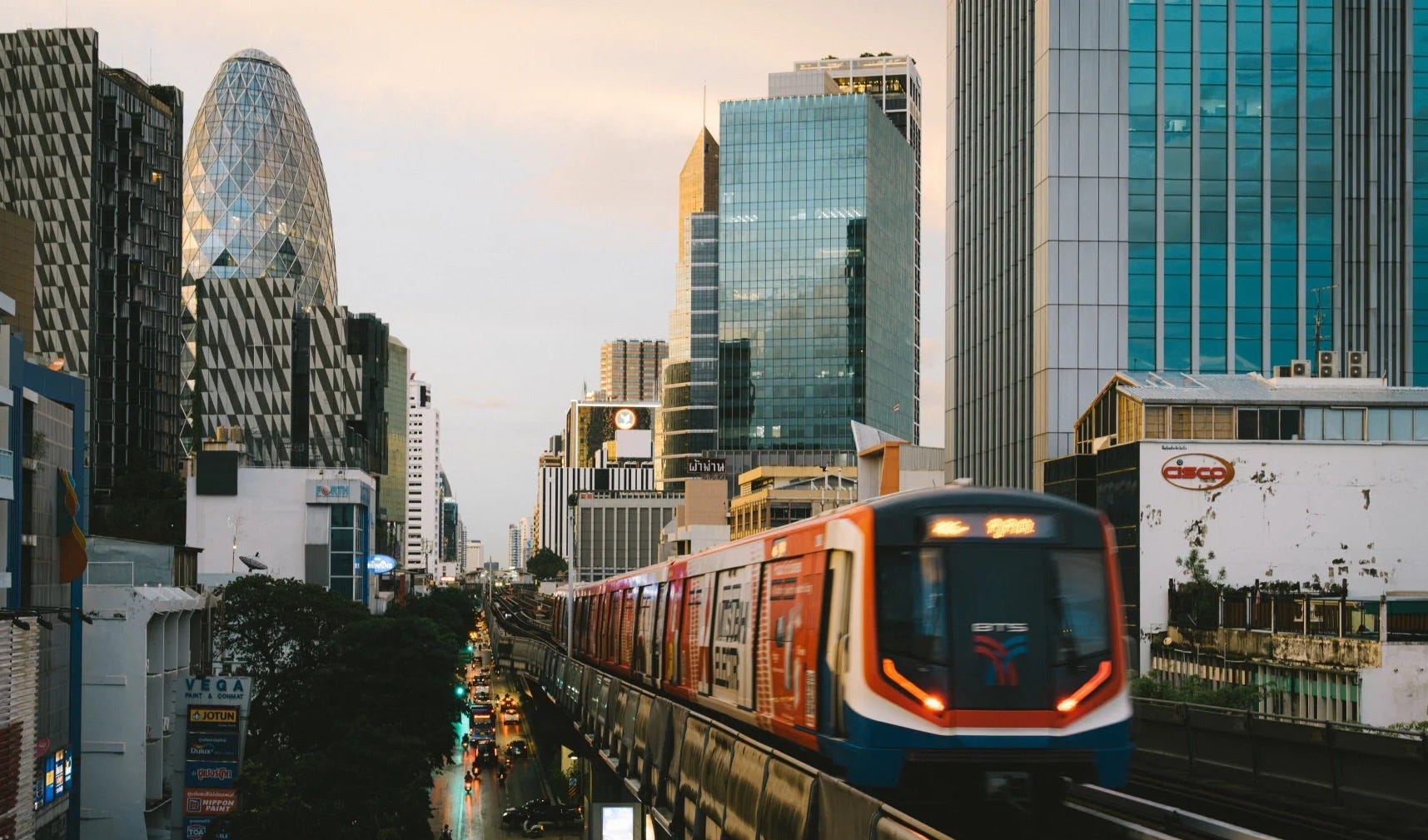
First, the part where I tell you how I know. The first thing I do when I come up out of the BTS at Asoke is look up. The skywalk wraps the intersection where the Sukhumvit line crosses the MRT, and at six in the evening it’s the whole city in one frame — commuters streaming to the turnstiles, motorbike taxis idling at the soi mouth, the heat finally starting to break. I’ve stood there enough times to trust myself on what Bangkok is. What I don’t trust myself on, not for a second, is what any of it costs in 2026. The condo market moves quarter to quarter, and pricing a city from a year-old memory is just a confident way of being wrong. So I didn’t. I rebuilt the number from current listings on the platforms residents actually use, in Thai, then checked them against the English-language sites the rest of the internet steers you to. That cross-check is where the 45% came from. It’s also why Bangkok earned a two-part teardown: this Saturday is the cost layer (the full numbers), and the Saturday after is the decision layer: safety, healthcare, the visa landscape, and the honest verdict. Today is the free preview of both.
Is Bangkok even your city?
Already have Bangkok circled? Skip ahead to the mystery of the too-cheap rent quote.
Bangkok is one of the easiest major Asian capitals to actually live in as a foreign professional, and in 2026 it’s one of the most underrated for a specific reason I’ll get to. The honest pitch: a genuine mass-transit network you can live car-free on, street food that’s both world-class and cheap, private healthcare good enough that people fly in for it, a deep international community, and — new since most “moving to Bangkok” guides were written — a remote-worker visa that finally makes living here legal and simple instead of a permanent border-run. That last one matters more than it sounds: it reframes Bangkok from “somewhere you get away with staying” to “somewhere you can build a few years of your life.” The trade-offs are just as real: brutal hot-season heat, traffic that’s among the world’s worst the moment you leave the train lines, air quality that turns genuinely bad in the burning season, and a sprawl that can feel anonymous if you land in the wrong neighborhood. Who thrives here: remote workers and professionals who’ll actually use the BTS and eat local, who want a big-city life without big-city Western rent. Who should look elsewhere: anyone who needs clean air year-round, a walkable small-city feel, or a quiet that Bangkok simply does not offer.
If you want the lived-in version — what it’s like to build a life here, neighborhood by neighborhood — that’s the part the AWA site does better than I can. Our expat’s guide to living in Bangkok, written by someone who moved there and stayed, covers the texture; and if you’re still deciding which Thai city, the best places to live in Thailand weighs Bangkok against Chiang Mai, Phuket, and the rest. This post is the numbers.
A rent quote 45% below reality — and nobody lied
Back to the number that stopped me: the premium-station rent quote sitting roughly 45% under what apartments there really go for. Before I give you the answer, try the puzzle yourself: what could produce a published figure that far below the going rate, with no one lying anywhere in the chain? The mechanism is dull, legal, and sitting in plain sight.
Here’s the mistake I made the first time, and the one nearly every foreigner makes. You open the English-language rental sites, you search “Sukhumvit,” and you get a price. The trouble is that the English sites search by Bangkok’s big administrative districts — and a district like Watthana runs from the premium heart of Sukhumvit all the way out six train stops to neighborhoods that cost half as much. The number you get back is a district average. It is not the price of any specific apartment you’ll move into; the average was quietly diluted by cheaper stock kilometres away. You think you’re pricing premium Sukhumvit; you’re pricing a statistical blur. Nobody lied. The map answered a different question than the one you asked.
Same train line, almost three times the rent
Residents don’t shop that way. In Bangkok the station is the address — people don’t say “I live in Sukhumvit,” they say “I’m Thong Lo BTS” or “I’m Ari.” And when you price the city the way residents do, station by station on the Thai-language platforms, the spread is enormous: a furnished one-bedroom condo, five to ten minutes from a train, runs nearly 3× more at the priciest station than at the cheapest — across the same rail network. That’s the single biggest lever on your Bangkok rent, and Saturday’s post puts the full station-by-station table on the page.
One neighborhood, if you take nothing else from today: Ari
If I were moving back to Bangkok on a remote income, I’d start my search at Ari — a few stops north of the Sukhumvit crush on the BTS. Low-rise streets, independent cafés and design studios, a genuinely Thai density rather than an engineered expat strip, and, crucially, it’s far enough off the foreigner-default map that the English-language sites don’t carry the markup they pin to central Sukhumvit. When I priced it, the rent residents pay and the rent the foreigner channel quotes were essentially the same in Ari, which almost never happens closer to the core. It’s the most “I could actually picture living here” neighborhood Bangkok has for a Western remote worker who’d rather live in a Thai neighborhood than an expat one. (One honest caveat I’ll detail Saturday: at Ari you’re paying for newness, not for being closer to the train — the brand-new buildings and the ten-year-old ones a longer walk away sit at almost the same rent, which tells you something useful about what you’re actually buying.)
Is Bangkok safe? Yes — and that’s not even the interesting part
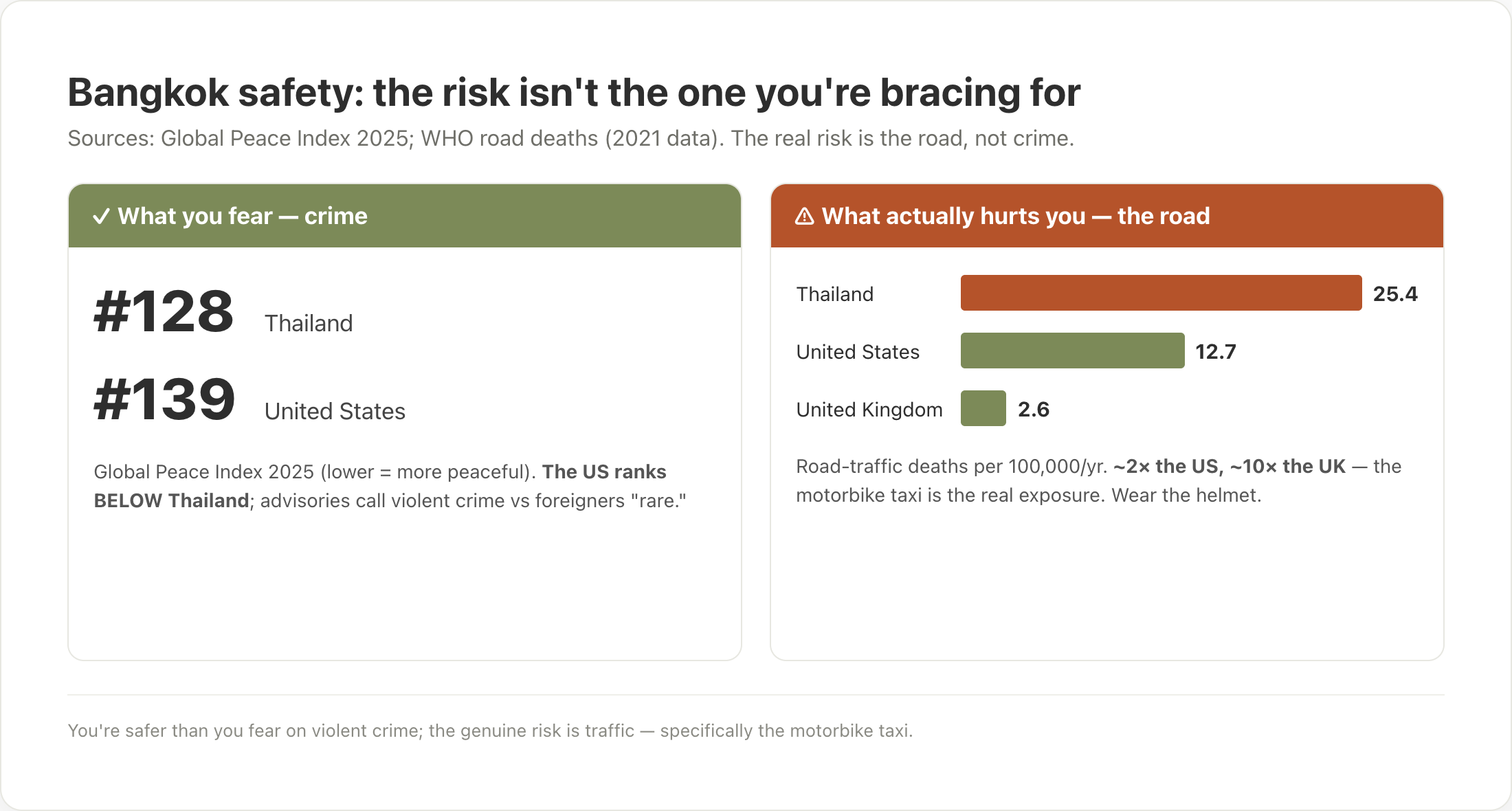
This is Part 2’s territory, but the headline belongs in the free post because it inverts the entire “is Bangkok safe?” genre. On the 2025 Global Peace Index, the United States ranks below Thailand. All three major governments’ travel advisories — the US State Department, the UK’s FCDO, Australia’s Smartraveller — describe violent crime against foreigners as “relatively rare” or say it “rarely involves tourists.” Day to day, by the numbers, Bangkok is safer on violent crime than most large US cities. (Maddie makes the same point from the resident side in the Bangkok living guide: it simply feels safe, and the data backs the feeling.)
The catch is that the genuine risk isn’t the one you’re bracing for. It’s the road. Thailand’s road-traffic death rate is around 25 per 100,000 people a year — roughly double the US rate, nearly ten times the UK’s — and the thing doing the killing is the motorbike. That motorbike taxi you’ll be tempted to hop on for the last kilometre to the BTS is, statistically, the most dangerous thing you’ll do in this city. The mugging you’re worried about is a rounding error next to the ride you’re not worried about. If you take one safety habit from this whole series: wear the helmet, every single time, even the two-minute hop.
And if something does go wrong, the healthcare is the other pleasant surprise
Thailand has no national health scheme you can lean on as a foreigner — which sounds like a strike against the place until you see what the private market actually costs. Bangkok has been a medical-tourism destination for decades, and the depth shows: an annual executive health screening at one of the famous international hospitals runs roughly what a basic cash-pay physical costs back in the US, and the smaller private hospitals residents use for a fever or a stomach bug are cheaper still — cheap enough that you pay cash and skip the insurance-claim dance entirely. The honest read I keep landing on: you do not need US-level health insurance to feel safe here. You need a catastrophic-coverage plan and the willingness to pay cash for routine care, and the routine care is genuinely good. Part 2 puts real numbers on all of it.
The visa that changed everything — and the trap inside the good news
Not many years ago, living here without a local job meant a tourist stamp and a recurring bus to the Cambodian border to reset it — I remember the Friday-night minibuses loading up on Khao San for the run, a grey-zone routine everyone did and nobody felt good about. The DTV, launched in 2024, ended that: five years of validity, 180-day stays, a real legal basis for a remote worker to live here. AWA’s guide to the Thailand Digital Nomad Visa covers the application from first-hand experience. What Part 2 adds is the strategic layer the how-to guides skip, including the trap hiding inside the good news: the visa invites you to stay 180 days at a stretch, and Thailand’s tax system makes you a tax resident the moment you’re here 180 days in a calendar year. Those two clocks interact in a way almost nobody selling “move to Bangkok, it’s easy now” mentions.
This Saturday — Part 1, the cost layer: the full station-by-station rent table, the line-by-line ~$1,600 budget, the first three-way comparison in this series (Da Nang vs Bangkok vs Taipei, and why Bangkok lands where it does), the daily-living math, and a grocery finding that genuinely changed how I’d shop here — because the place the bilingual advantage actually pays off isn’t the imported cheese aisle everyone complains about. It’s somewhere much closer to the bottom of your receipt.
Next Wednesday — Part 2, the decision layer: the complete safety breakdown (including the 2025 earthquake that quietly rewrote one comfortable old assumption about Bangkok), the medical-tourism healthcare math in full numbers, the full visa menu — the easy one, the tax-clean one, the paid one, and who each is actually for — the twelve restaurants residents send friends to (the list now includes one of Thailand’s two three-Michelin-star kitchens), and the honest verdict: who should choose Bangkok over Da Nang or Taipei, knowing it costs more than one and offers more than the other.
Bangkok isn’t the cheap option. After 2024, it might be the smart one, for the right person. The next two Saturdays are where I make that case in full.
If you’re on the ground in Bangkok and your station-anchored rent looks nothing like a “Sukhumvit average” — or the road-versus-crime framing matches your experience, or doesn’t — reply and tell me. The readers who live these cities are always my best fact-checkers.
One more thing, because the regulars will notice: I wrote this preview differently on purpose — surprise up front, the mechanism staged like a puzzle. It’s an experiment for the free posts only; the Saturday teardowns stay played dead straight. Reply and tell me whether the new format worked on you — that’s a vote I’ll actually count.
— Wei