

Here’s the finding this post is built around: there is no single cost of living in Chiang Mai. There are two, and they sit about twice as far apart as anyone tells you. A comfortable single remote worker who lives the way a Thai resident does lands around US$870 a month. The same person, living the same month inside the foreigner-facing bubble the city is famous for, lands around US$1,830 — more than I priced for a comfortable month in Bangkok. Same small city. The gap isn’t lifestyle in the obvious sense: it isn’t champagne versus instant noodles. It’s mostly which of two parallel rental markets you happen to plug into, and a handful of daily-spending defaults that follow from it. Most “Chiang Mai is dirt cheap” content is describing the lower number while quietly assuming the habits that produce it. Most newcomers pay the higher one without ever seeing the lower one exists.
As with every city in this series, I don’t trust my memory for what Chiang Mai costs in 2026: a decade of remote workers has reshaped this rental market more than most, and pricing it from an old impression is a confident way of being wrong. So I priced it the way I priced the others: from current listings on the platforms residents use, in Thai, and then a second time through the channels foreigners actually use, to size the gap between them.
This is the paid layer, and it’s the first half of a two-part Chiang Mai teardown. Part 1 (this post) is the cost layer: the two-market rent split that creates the fork, the line-by-line budget behind both numbers, the move-in cash you need before night one, the daily-living math, and (first in this series) a four-way comparison against Da Nang, Taipei, and Bangkok. Part 2, this Saturday, is the decision layer: the burning season priced three ways, safety, healthcare, the visa landscape and the tax trap inside it, the restaurants, and the honest verdict on who should choose Chiang Mai over the other three.
A note on currency: ≈33.5 THB = US$1.
1. The methodology (and why it matters here specifically)
The dominant English-language cost-of-living picture for Chiang Mai is built from three things: Numbeo aggregation, the foreigner-facing rental and relocation sites, and a long tail of “I quit my job to be a digital nomad in Chiang Mai” blogs, many of them describing 2016–2021 prices and a visa world that no longer exists. The blogs aren’t lying and the sites aren’t scamming. They’re just all standing in the same one of the city’s two markets (the foreigner one) and reporting the view from there as if it were the whole city.
Here’s what I did instead:
Rent — the Thai-channel baseline: pulled from the Thai-language property platforms (DDproperty Thailand, Hipflat, RentHub, plus the Thai monthly-rental and walk-in norms residents actually use), captured across six neighbourhood clusters: Nimman/Nimmanhaemin, Santitham, the Old City, Chang Klan/Night Bazaar/riverside, Suthep/Huay Kaew near the university, and the outer ring (Hang Dong/San Sai). These are yearly Thai leases, mostly bare or semi-furnished, deposits of two months plus a month’s advance.
Rent — the foreigner-channel comparison: a parallel pass on the channels a newcomer reaches for first: the international monthly-booking sites, English-speaking Chiang Mai agents, serviced-apartment and co-living listings, and the resident reports in the nomad housing community. Furnished, monthly, flexible, English-language, passport-only.
Utilities against the PEA (Provincial Electricity Authority) published residential tariff (Chiang Mai is on PEA, not Bangkok’s MEA, though they share the same national ERC Type 1.2 residential schedule), plus the landlord sub-meter reality (worked in §5); water against PWA; internet and mobile against current AIS-3BB / True pricing.
Groceries from the catalogue prices of the chains residents actually use: the mass-market stores (Lotus’s, Big C, Makro), the mid-tier (Tops), and Rimping, Chiang Mai’s own upmarket import chain, cross-checked against the fresh markets (Warorot, Muang Mai), priced as two baskets.
Every figure below traces to a source; where I’m uncertain, I flag it. The advantage here is bilingual sourcing, and in Chiang Mai it pays off in the most direct way it has anywhere in this series: the two markets are literally written in two languages, so the price gap is the language gap. This post does the cross-walk so you can see both, and choose which Chiang Mai you’re buying instead of defaulting into the expensive one.
2. The dual economy: why the same flat has two prices
The single most important thing to understand about money in Chiang Mai is that it runs two rental markets at once, for the same physical apartments, and they barely overlap. Get this right and you live here for half of what the city costs most foreigners. Get it wrong and you pay the bubble price for a bubble you didn’t know you were inside.
Here is the same furnished one-bedroom (same rough size, same rough quality, ~30–45 m², furnished, near the centre), priced through each channel, by neighbourhood:
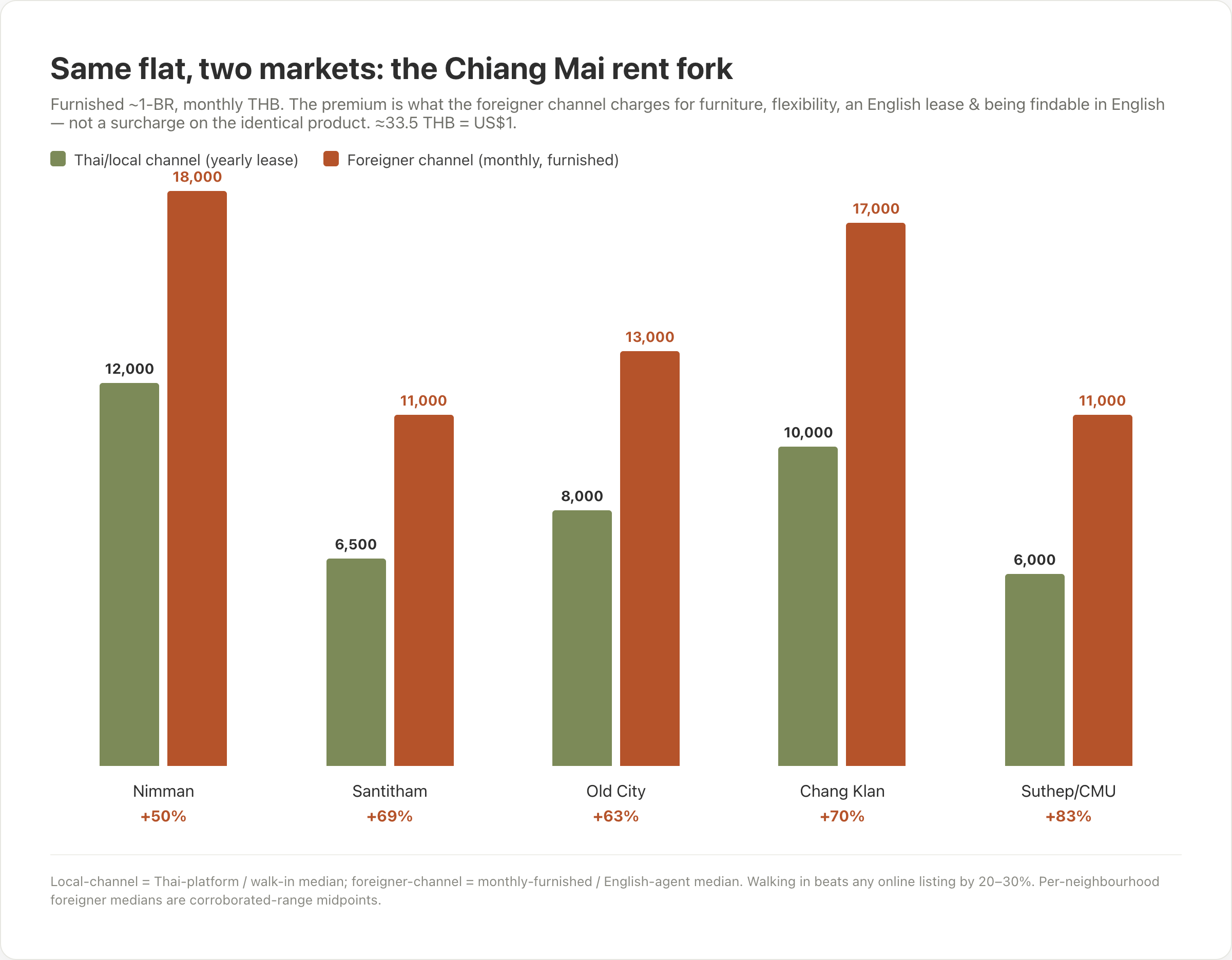
A few things that picture says, and the English Chiang Mai internet doesn’t.
The premium is real and it runs about 50–85%, not the 2–3× that the rumour mill claims and not the zero that the relocation sites imply. It’s widest where the foreigner market is thinnest relative to the local one: Santitham and the university fringe, where a bare Thai-lease room sits a short walk from a furnished monthly unit at nearly double the price. It’s narrowest, proportionally, in Nimman, where the foreigner market is so dominant that even the “local” listings have drifted upmarket.
It is not a foreigner surcharge, and it matters that you understand why. Nobody is quoting you a higher number for the identical product because of your passport. Thailand’s actual dual-pricing on rentals is small, and where the gap is large it’s because you’re buying a different product through a different channel. The foreigner price buys: a unit that’s already furnished (you can’t buy a bed for a three-month stay); a monthly lease you can walk away from when the smoke arrives in March; an English-language contract and no Thai guarantor; the wifi and sometimes the electricity folded in; and, the quiet one, the simple fact of being findable in English. The cheap Thai-lease room isn’t hidden from you out of malice. It’s hidden because it was advertised on a handwritten ให้เช่า sign and a Thai-language Facebook group, in a market you weren’t searching in. That’s an information gap, a convenience premium, and a willingness-to-pay gap stacked together — not a scam. The honest framing is “here are the two markets, and here’s how to stand in the cheaper one,” never “beat the foreigner price.”
And the gap is closeable — by anyone willing to show up. The most consistent finding across the local-language resident accounts and the long-stay foreigner reports alike: walking in beats any online listing by 20–30% for the same room. The deeper you go into the Thai channel (a yearly lease instead of monthly, a walk-in instead of a booking site, a Thai-speaking friend or agent instead of an English one), the closer you get to the lower number. The single biggest lever on your Chiang Mai rent isn’t the neighbourhood. It’s the channel, and the lease length, and whether you’re willing to do the search on foot.
The catch, and it’s a real one: the cheapest end of the local market costs you something other than money. A bare ฿5,000 room found by walking the soi means no furniture, a year’s commitment, a deposit of three months’ rent upfront (more on that below), a contract you may not be able to read, and the burning-season problem of being locked into a lease in the exact months you might want to leave. The foreigner premium is, in part, the price of optionality, and in a city you might flee for two months a year, optionality isn’t nothing. The right answer depends on how long you’re staying and how settled you are, which is the honest version of the decision and the one the relocation sites skip.
🔒 The rest of this post is for paid subscribers: the line-by-line budget behind both the $870 and the $1,830, the move-in cash you need before night one, the sensitivity bands, the four-way comparison against Da Nang, Taipei, and Bangkok, the daily-living math — including the electricity finding that matters more than your air-conditioner — and the grocery split that changes how you’d shop.
