

Here is the number this whole post is built around, except it’s two numbers. A comfortable single month in Chiang Mai in 2026 costs about US$870 if you live the way a Thai resident does — and about US$1,830 if you live inside the nomad bubble that the city is famous for. Same small city, same month, same single person. I priced it both ways and the answers came in nearly a thousand dollars apart. Chiang Mai is sold to the entire internet as one of the cheapest good lives on the planet, and that’s true; it’s just that “cheap” is one of two prices on the menu, and almost nobody tells you you’re choosing.
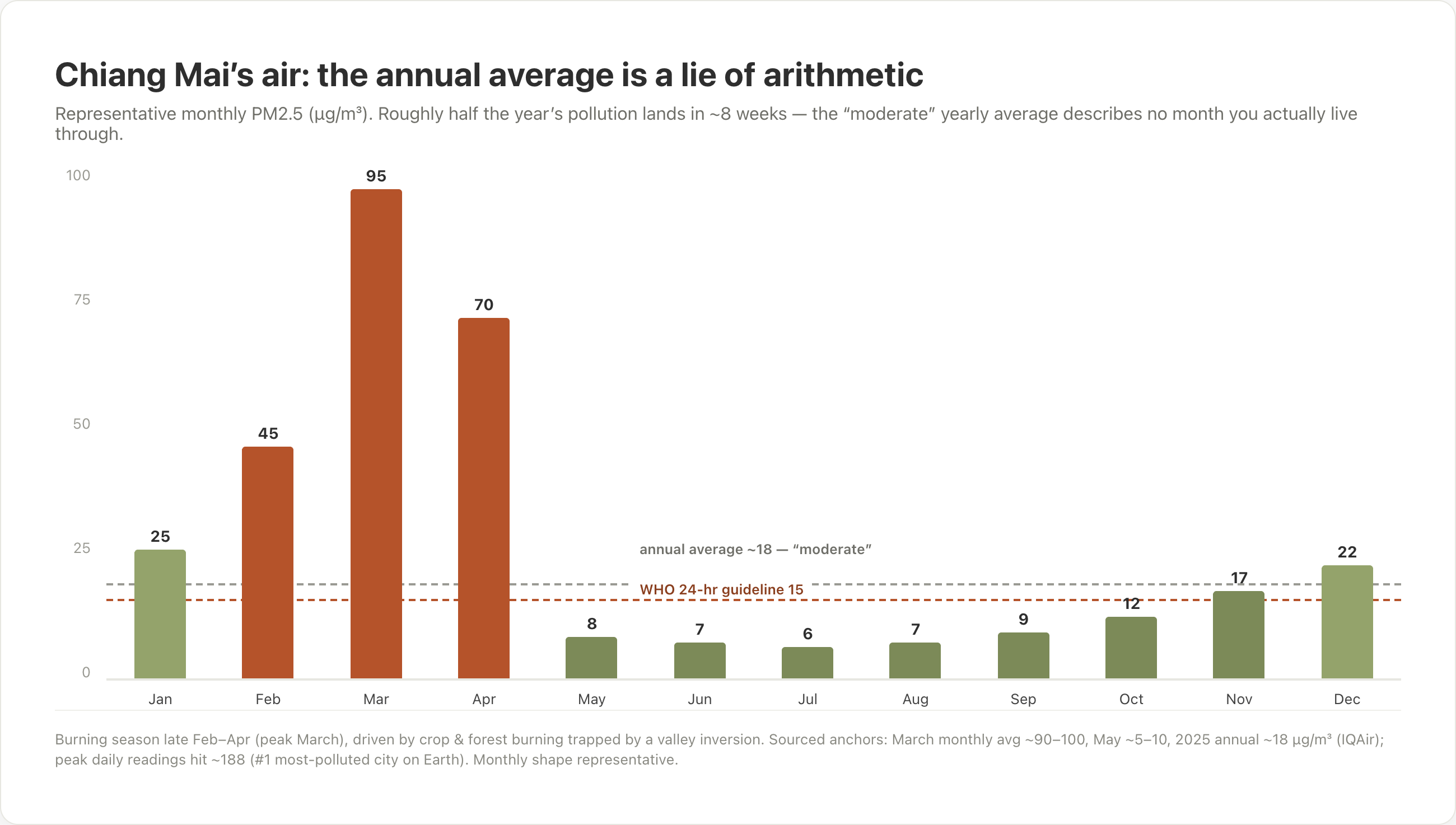
And the cheap price has a deadline. For roughly eight weeks a year, the air in Chiang Mai becomes, on the worst days, the most polluted of any major city on Earth — and the smartest financial move a lot of residents make is to pay to leave. That cost appears on no cost-of-living sheet I’ve ever seen for this city. How a place this cheap hides two of the largest line items in your actual annual budget is the whole story, and it decides whether Chiang Mai is the bargain everyone promises or a more complicated deal.
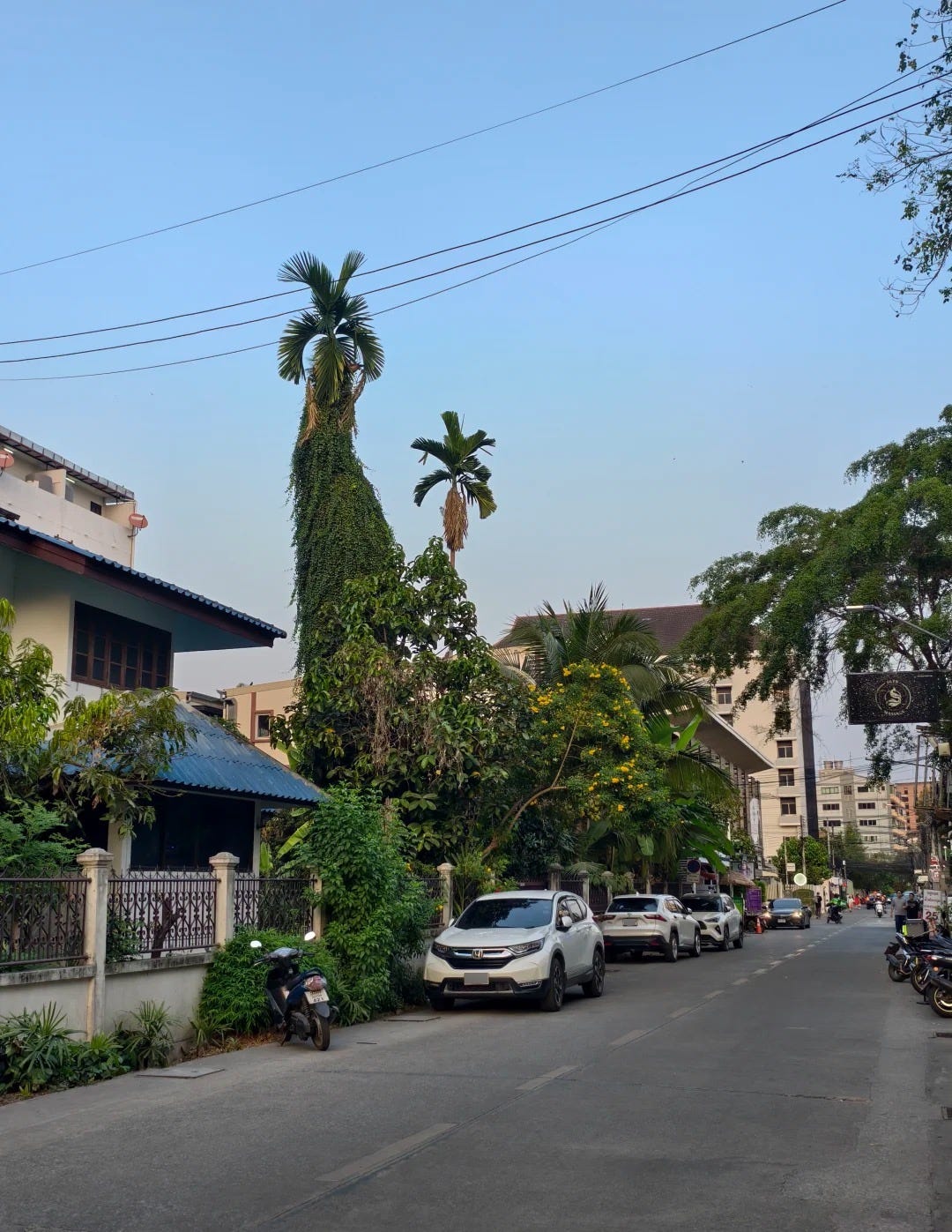
First, how I know. I was in Chiang Mai in early May 2024, and the air was fine: clear sky, nothing you’d think twice about. What I didn’t appreciate at the time is that early May is precisely when Chiang Mai stops being the story. The rains arrive, the air clears, and the season that defines this city’s year is already behind you. If I had built my sense of this place on that trip I’d have written something badly wrong. (Come in early April instead and you’ll want a PM2.5 mask.) It’s the same reason I don’t trust my memory on what anything costs in 2026: Chiang Mai’s rental market has been reshaped by a decade of remote workers, and pricing it from an old impression is just a confident way of being wrong. So I rebuilt the numbers from current listings on the platforms Thai residents actually use, in Thai, then priced the same neighbourhoods a second time through the channels foreigners actually use: the English-language agents, the monthly-rental sites, the nomad housing groups. The gap between those two passes is most of what this teardown is about. It’s also why Chiang Mai earned the full treatment: this coming Wednesday is the cost layer (the rent, the budget, the line items), and next Saturday is the decision layer: the air, safety, healthcare, the visa, and the honest verdict. Today is the free preview of both.
Is Chiang Mai even your city?
Already have Chiang Mai circled? Skip ahead to why the same flat has two prices.
Chiang Mai is the easiest place in Asia I can think of to land softly as a remote worker, and that’s not nothing. The honest pitch: a real cost floor that genuinely exists if you want it, a coworking-and-café infrastructure built over a decade specifically for people who work on laptops, a deep and unusually friendly international community, food that’s extraordinary at the bottom of the price range, a cool-season climate the rest of Thailand envies, and a compact, walkable, moated old core that makes a big move feel like settling into a small town. The trade-offs are just as real, and one of them is severe. The burning season I’ll get to is the headline downside. Underneath it: a small-city ceiling on career and nightlife and certain kinds of healthcare, a motorbike-dependence that’s the actual physical risk of living here, and the slow realisation that the “community” can feel transient when everyone you meet is leaving in three months. Who thrives here: remote workers and the self-employed who’ll happily live in a Thai neighbourhood, ride a scooter, eat at the market, and treat the cheap price as the default rather than the sacrifice. Who should look elsewhere: anyone who needs clean air year-round (read that twice), big-city infrastructure, or a community that doesn’t rotate out every season.
If you want the lived-in version (what it’s like to build a daily life here, neighbourhood by neighbourhood), that’s the part the AWA site does better than a teardown can. The site’s guide to living in Chiang Mai covers the texture; and if you’re still deciding which Thai city, the best places to live in Thailand weighs Chiang Mai against Bangkok, Phuket, and the rest. This post is the numbers.
How the same one-bedroom has two prices — with nobody lying
Back to the fork. Before I give you the mechanism, try the puzzle yourself, because it’s a good one: how can the same furnished one-bedroom, in the same neighbourhood, in a city this small, carry two prices that sit nearly two-to-one apart, without anyone, anywhere in the chain, telling a lie? It isn’t a scam, and it isn’t a foreigner surcharge in the way you’d assume. The mechanism is duller and more interesting than that.
Here’s what’s happening. Chiang Mai runs two rental markets at once, and they barely touch. There’s a Thai-language market: yearly leases, bare or semi-furnished units, deposits of two months plus a month’s advance, contracts in Thai, the kind of place you find by walking the soi and reading the ให้เช่า (”for rent”) signs taped to the gate. And there’s a foreigner market: furnished and move-in-ready, monthly and flexible, English leases, no Thai guarantor, often with the wifi and sometimes the electricity folded in, found on the international booking sites and in the housing groups. The first market sells you a flat. The second sells you a flat plus furniture you don’t have to buy, a lease you can leave when the smoke comes, a contract you can read, and the simple fact of being findable in English. That bundle is worth real money, and it’s priced accordingly. Nobody’s being ripped off. The two markets are answering two different questions, and most newcomers only ever see the second one, because the cheap Thai-lease unit, the one that would have halved the biggest line in their budget, was never written in a language they were searching in.
That’s the engine under the whole city’s cost of living, and Saturday’s post puts the actual neighbourhood-by-neighbourhood numbers on the page: what each market really charges, where the gap is widest, and the one move that closes most of it.
One neighbourhood, if you take nothing else from today: Santitham
If I were moving to Chiang Mai on a remote income and wanted the cheap price without sacrificing the good parts, I’d start my search in Santitham, the dense, local, unglamorous neighbourhood that sits a ten-minute walk from Nimman, the trendy café district everyone Instagrams. Nimman is where the foreigner market is priciest and most concentrated; Santitham is where Thai workers, students, and the residents who’ve figured the city out actually live, at Thai-market prices, close enough to walk to everything the bubble is selling. It’s the clearest arbitrage in the city: you stand in the cheaper market and reach into the more expensive one for your coffee and your coworking. It isn’t pretty, and that’s exactly why it’s still cheap. (One honest caveat I’ll detail Saturday: the cheapest Santitham rooms are bare and found on foot, not online, and the price you save is partly a price you pay in legwork.)
The two months nobody prices: the burning season
This is Part 2’s territory, but the headline belongs in the free post, because it’s the single most under-priced fact about living in Chiang Mai. From roughly late February through April, farmers across the north and the countries upwind burn their fields, forest fires add to it, and a ring of mountains traps the smoke over the city like a lid on a pot. Chiang Mai’s air, which is genuinely clean for most of the year, becomes some of the worst on the planet. On the worst days of 2026, the city topped the global rankings for the most polluted major city in the world, with fine-particulate readings more than ten times the World Health Organization’s daily guideline.
Here’s the part that explains why it never shows up in the budget. Across a whole year, Chiang Mai’s average air quality reads as merely “moderate” — and that average is a lie of arithmetic. Roughly half the year’s fine-particle pollution comes from those weeks of burning. Ten months are clean, often beautifully so; two are brutal. The annual number launders the catastrophe through the calm, and anyone quoting you a tidy yearly figure to prove the air is “fine” is averaging a disaster with a holiday.
So the real cost of Chiang Mai isn’t twelve cheap months. It’s ten cheap months and a decision about the other two — and every version of that decision costs money. You pay to leave, which is what a lot of residents do, decamping to the islands or Vietnam and quietly paying two rents and a plane ticket for a quarter of the year. You pay to seal yourself indoors, in air purifiers and masks and a higher electricity bill. Or you pay with your lungs, which is the option that looks free and isn’t. Part 2 prices all three, properly. For now, the point is just this: a “cost of living in Chiang Mai” number that doesn’t account for March isn’t describing the city anyone actually lives in.
And the risk that actually hurts people here isn’t the air — it’s the road
While we’re on what’s genuinely dangerous: Chiang Mai is, by the numbers, very safe. On the 2025 Global Peace Index, Thailand ranks well above the United States: Thailand sits around 86th of 163 countries and the US around 128th (a national composite, not a street-crime score). The major governments’ travel advisories all describe violent crime against foreigners as relatively rare, and Chiang Mai is consistently the Thai city solo travellers and solo women name as where they first felt comfortable being on their own. The thing most likely to actually harm you here is the one you’ll be most relaxed about: the scooter. Thailand has among the deadliest roads in the world: roughly 25 traffic deaths per 100,000 people a year, the overwhelming majority of them on motorbikes. And Chiang Mai is a city you’ll almost certainly end up riding in, on mountain roads that are exactly where inexperienced foreigners come off their bikes. The full safety picture is Part 2. The one habit to take from the free post: wear the helmet, every single time.
The good news that changed, and the trap inside it
One genuinely new thing since most “move to Chiang Mai” guides were written: in 2024 Thailand launched the DTV, a five-year visa that finally gives a remote worker a legal, multi-year basis to live here instead of the old routine of tourist stamps and border runs. AWA’s guide to the Thailand Digital Nomad Visa covers the application. What Part 2 adds is the strategic layer the how-to guides skip, including the trap hiding inside the good news: the visa invites you to stay long enough that Thailand’s tax system starts to consider you a resident, and those two clocks interact in a way almost nobody mentions. Chiang Mai is also the country’s capital of the education visa, the Thai-language-school route a lot of long-stayers use, and that one is under a crackdown worth understanding before you bank on it.
Wednesday, then Saturday.
This coming Wednesday — Part 1, the cost layer: the full neighbourhood-by-neighbourhood rent picture across both markets, the line-by-line budget behind both the ~$870 and the ~$1,830, the move-in cash you’ll need before you sleep there one night, the first comparison of Chiang Mai against Da Nang, Bangkok, and Taipei in this series, and a grocery finding that changed how I’d shop here, because the place the local advantage pays off isn’t the imported-cheese aisle everyone complains about.
Next Saturday — Part 2, the decision layer: the burning season priced three ways (leave, seal in, or absorb it), the safety breakdown in full, the healthcare math in a city with no national scheme a remote worker can join but unusually cheap private care, the visa menu (the DTV, the education route and its crackdown, the long-stay options) with the tax trap drawn out, the restaurants residents actually eat at, and the honest verdict: who should choose Chiang Mai over the other cities in this series, knowing it can be the cheapest of them or one of the priciest depending on how you live.
Chiang Mai is the cheap dream the internet sells you. It’s also a more interesting deal than that, with two of its biggest costs hidden in plain sight. This Wednesday and next Saturday are where I lay both out in full.
If you’re on the ground in Chiang Mai and your rent looks nothing like the foreigner-channel quote, or your last March was better or worse than I’m making it sound, reply and tell me. The readers who live these cities are always my best fact-checkers, and this one came onto the schedule because a Chiang Mai resident asked for it.
One more thing, because the regulars will notice: I wrote this preview differently on purpose — surprise up front, the mechanism staged like a puzzle. It’s an experiment for the free posts only; the paid teardowns stay played dead straight. Reply and tell me whether the new format worked on you — that’s a vote I’ll actually count.
— Wei