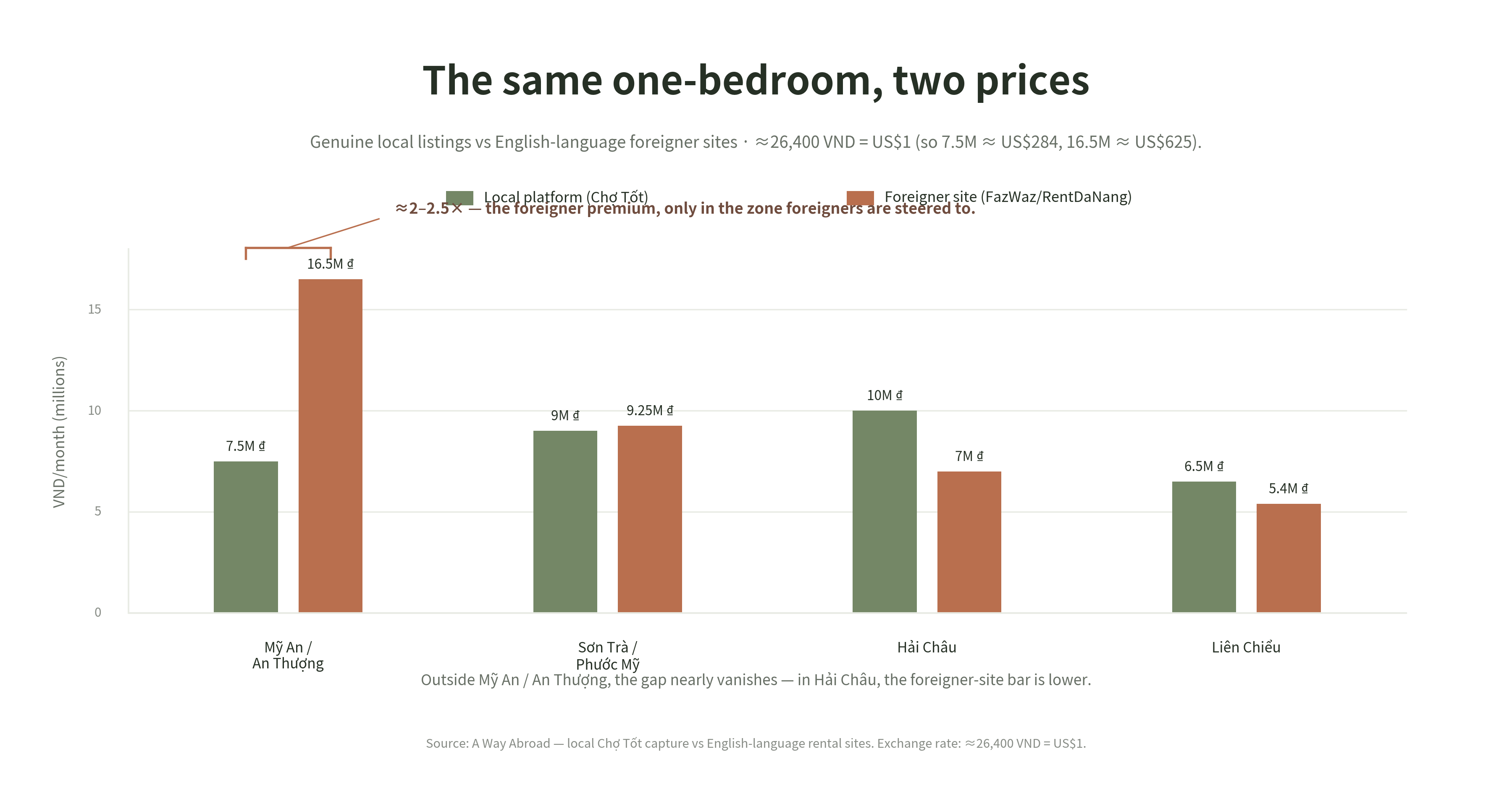
If you read Wednesday’s free post, you saw the headline: Da Nang can be a comfortable US$750–900/month city for a single remote worker — if you rent the way locals do, and not the way the English-language sites will try to rent to you.
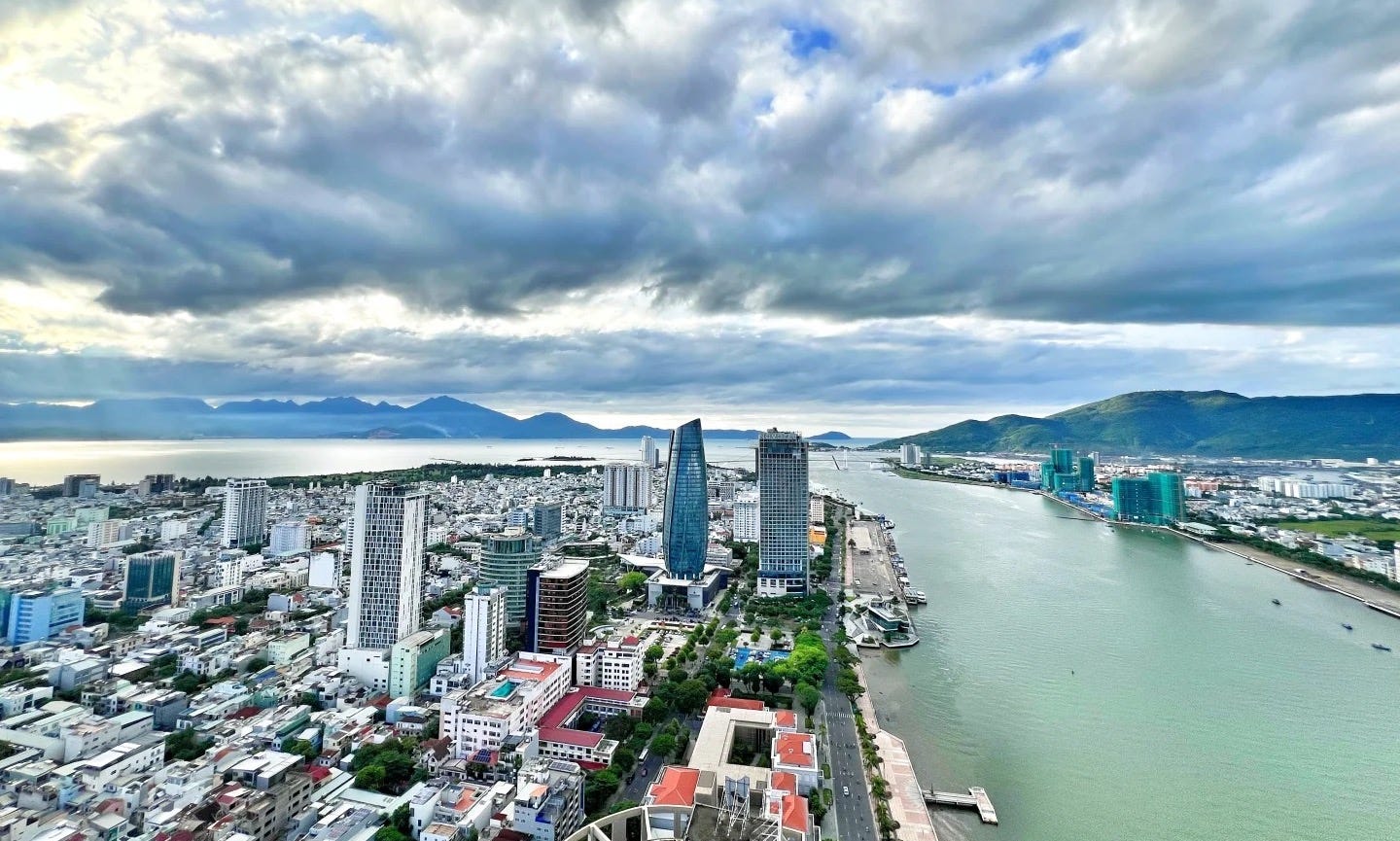
I have a soft spot for Da Nang. I spent time there two or three years ago, and I remember why people fall for it: the beach pull of Mỹ An and An Thượng, the Hàn River splitting the visitor version of the city from the more local one, the sense that it’s easier to breathe than the bigger Vietnamese capitals. But that’s the honest limit of what that memory is good for: the shape of the city, not its 2026 prices. Two or three years is long enough for a rental market to move more than I’d trust myself to guess at, so I treated my own experience as a starting point, not as evidence.
This is the paid layer: the area-level math underneath that number, the foreigner-price gap that the rest of the internet quietly passes along to you, and the first direct cost comparison in this series — Da Nang against Taipei, line by line.
So I didn’t write this from memory. I rebuilt it from current listings on the platforms locals actually use, cross-checked against Vietnamese-language sources, and priced every line against an official source where one exists. Where I’m relying on something dated or thin, I say so. Here’s what I did: I pulled live rental listings off Chợ Tốt (Vietnam’s biggest landlord-direct classifieds) across five Da Nang areas, sorted the genuine local stock from the short-stay and serviced inventory, and then pulled a matching sample off the English-language foreigner rental sites to measure the gap between the two. I priced electricity against EVN’s official tariff, internet and mobile against current provider pricing, healthcare against a private-hospital price list, and the visa against the official immigration portal. I cross-checked Vietnamese-language local-recommendation sources to find the twelve places residents actually eat, not the ones the tour groups queue for. Then I assembled all of it into one worked monthly budget for a realistic single remote worker.
The result is more specific than “Da Nang is cheap” and sharper than the foreigner-site bands: where the local price really sits, how much of the gap to Taipei is just rent, and the two line items where Da Nang quietly costs more than Taipei.
A note on currency: ≈26,400 VND = US$1 (publish day). VND figures are large, so I’ll write them as 8M VND (~$303) throughout.
1. The methodology (and why it matters)
The dominant English-language source for Da Nang cost-of-living is a mix of Numbeo aggregation and foreigner-facing rental sites, and for this city both are actively misleading in the same direction: up.
Here’s what I did instead:
· Rent data — the local baseline: pulled live from Chợ Tốt / Nhà Tốt (www.nhatot.com), the landlord-and-local-broker classifieds that are Vietnam's closest thing to a real market grid. I captured listings across five areas and excluded the stock that distorts the median: short-stay/serviced units in branded buildings (Mường Thanh, Panoma and similar) priced monthly for foreigners, whole-house "nhà nguyên căn" leases mislabeled as apartments, and unfurnished shells (the nomad-relevant unit here is furnished). One real limit: Chợ Tốt's cards rarely show the electricity rate, beach distance, or whether utilities are bundled — that detail lives in the free-text page, in Vietnamese, and only sometimes. So some figures are sized from the genuine sample plus local-language listing detail, not a clean structured field.
· Rent data — the foreigner channel: I pulled a matching sample of comparable furnished units off the English-language sites (FazWaz, RentDaNang) to measure the premium. That gap is one of the most useful findings in this post.
· Utilities: electricity against EVN’s official retail tariff (Decision 1279/QĐ-BCT); internet and mobile against current Viettel / FPT / VNPT pricing.
· Healthcare: a private-hospital published price list, plus the expat-insurance reality (there is no national scheme you can lean on here; more in §6).
· Visa: the official Vietnam e-Visa portal, plus the 2025 Talent Visa decree.
· Restaurants: Vietnamese-language local-recommendation sources, cross-verified against the Michelin Guide Vietnam 2025.
Every figure below traces to a specific source. Where I’m uncertain, I flag it.
The advantage here is bilingual sourcing, and in Da Nang it pays off in one specific, expensive way. The English-language rental internet and the local-language rental platforms describe two different cities at two different prices. This post does the cross-walk so you can rent at the first price, not the second.
A note on units. Da Nang apartments are advertised in square meters (m²), with no local quirk to translate, unlike Taipei’s 坪. A furnished studio runs roughly 25–35 m²; a one-bedroom 40–55 m². I’ll give m² on each unit so you can compare like for like.
2. The headline: what a furnished apartment actually rents for
Here’s the most useful comparison in this post. Genuine local-platform median rents for a furnished studio / one-bedroom, across five Da Nang areas:
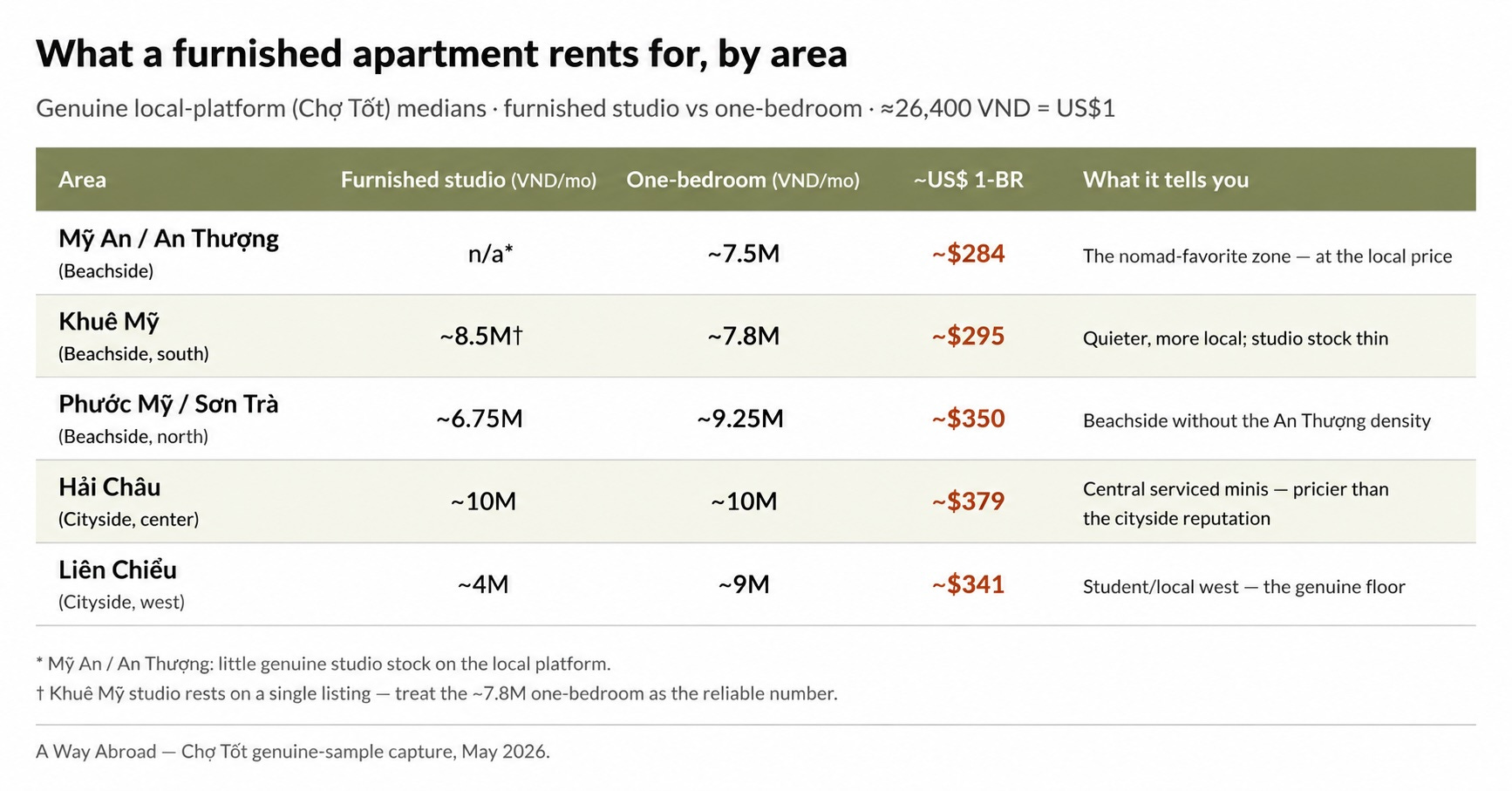
A few things in that table contradict what the English guides will tell you.
First: the local price is far below the foreigner-site price, and the gap is huge where it matters most. Here is the same furnished one-bedroom, local-platform versus English-language foreigner site, by area:
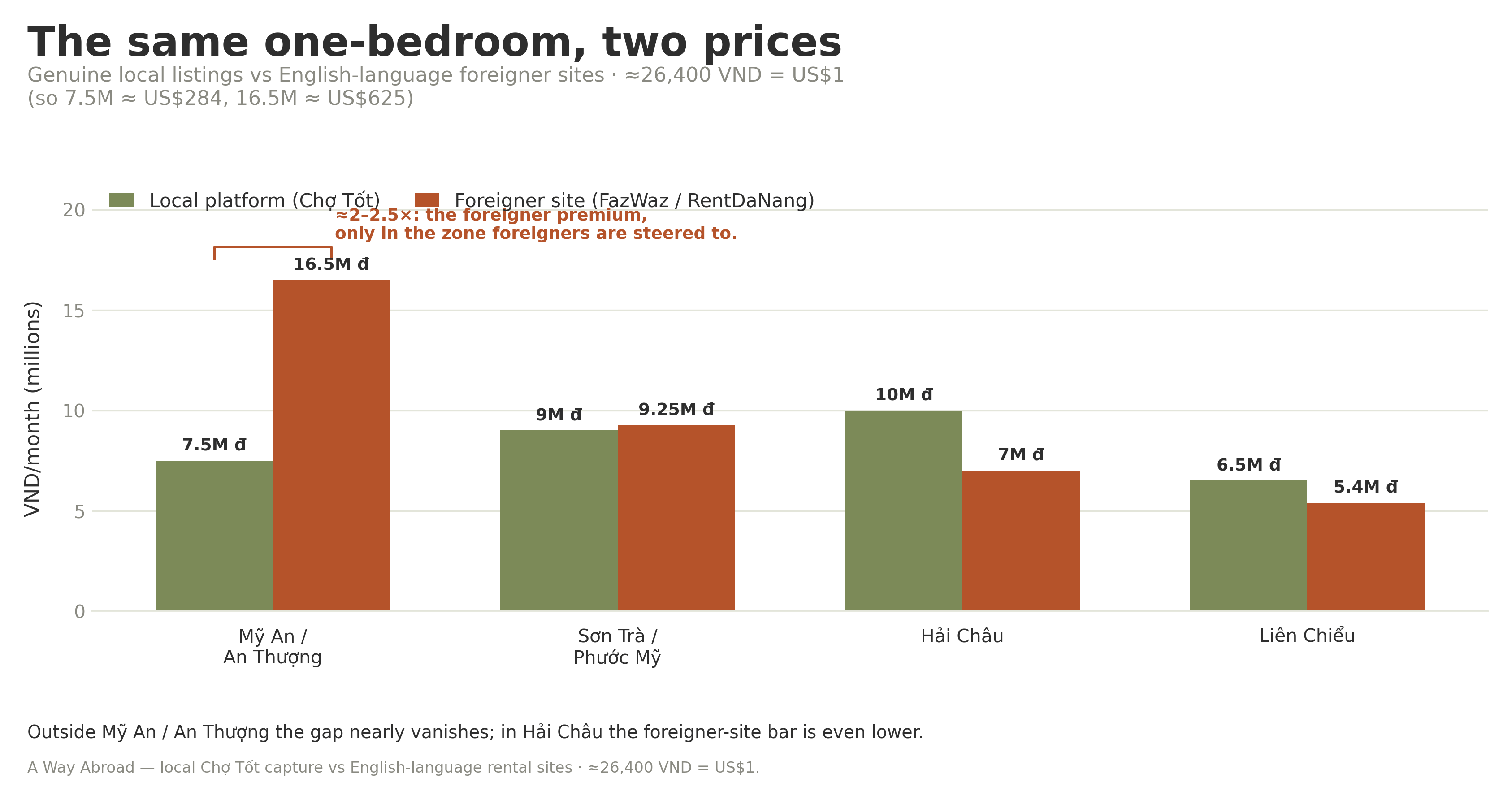
Look again at An Thượng and Mỹ An, the top pair. In the exact neighborhood foreigners are funneled toward — An Thượng and Mỹ An, the beachside expat strip — the English-language sites quote roughly double the local price for the same furnished one-bedroom. A 45 m² one-bedroom that lists around 8–9M VND (~$300–340) on Chợ Tốt shows up at ₫19.3M (~$732) on the foreigner sites. The foreigner sites themselves only cop to a “20–40% tourist markup.” The real gap in the foreigner zone is 2–2.5×.
And notice where the premium vanishes: in cityside Hải Châu and the affordable west, local and foreigner prices converge; sometimes the foreigner site is even lower. (In Hải Châu it can read cheaper, but that’s a stock mismatch, not a discount — the local platform there skews to new serviced executive minis around ~10M while the foreigner sites list older, plainer cityside stock, so you’re comparing two different products.) The premium isn’t a Da Nang-wide tax. It’s specifically the price of renting in the neighborhood the internet steers foreigners toward, through the channel it steers them through. Avoid both and you’ve cut your single biggest line item roughly in half.
Second, a wrinkle in the “cityside is cheaper” rule. Both Da Nang’s reputation and the lived-experience guides tell you the cityside (west of the Hàn River) is the cheaper, more local side, and broadly that holds: rent ordinary local stock on the cityside and you save, with the genuine cheap floor out west in Liên Chiểu (~4M VND studios), where students and longer-term locals live. The one thing the listings flagged: central Hải Châu’s modern serviced-studio stock (around the business core and Lotte) prices at ~10M VND, at or above the beachside Mỹ An genuine one-bedroom (~7.5M), because that segment is newer and amenity-loaded. So “cityside = cheap” is true for normal apartments, just not for the serviced-mini tier in the central core. (Modest sample on that last point — directional, not gospel.)
The practical takeaway: if you’re choosing where to live in Da Nang, the right question is not “cityside or beachside?” It’s “am I renting on the local platform or the foreigner one?” That choice moves your rent more than the neighborhood does.