

Da Nang is the kind of city that makes the “cheap beach base” label feel too small.
In the morning, My Khe Beach is all walkers, swimmers, scooters, and pale gold light off the water. By afternoon, the heat pushes everyone into cafés. At night, the river bridges light up, the sea air comes back in, and the whole city feels more open than its price tag suggests. It’s not just inexpensive — it’s genuinely beautiful, coastal and spacious and easy to imagine yourself settling into for a season.
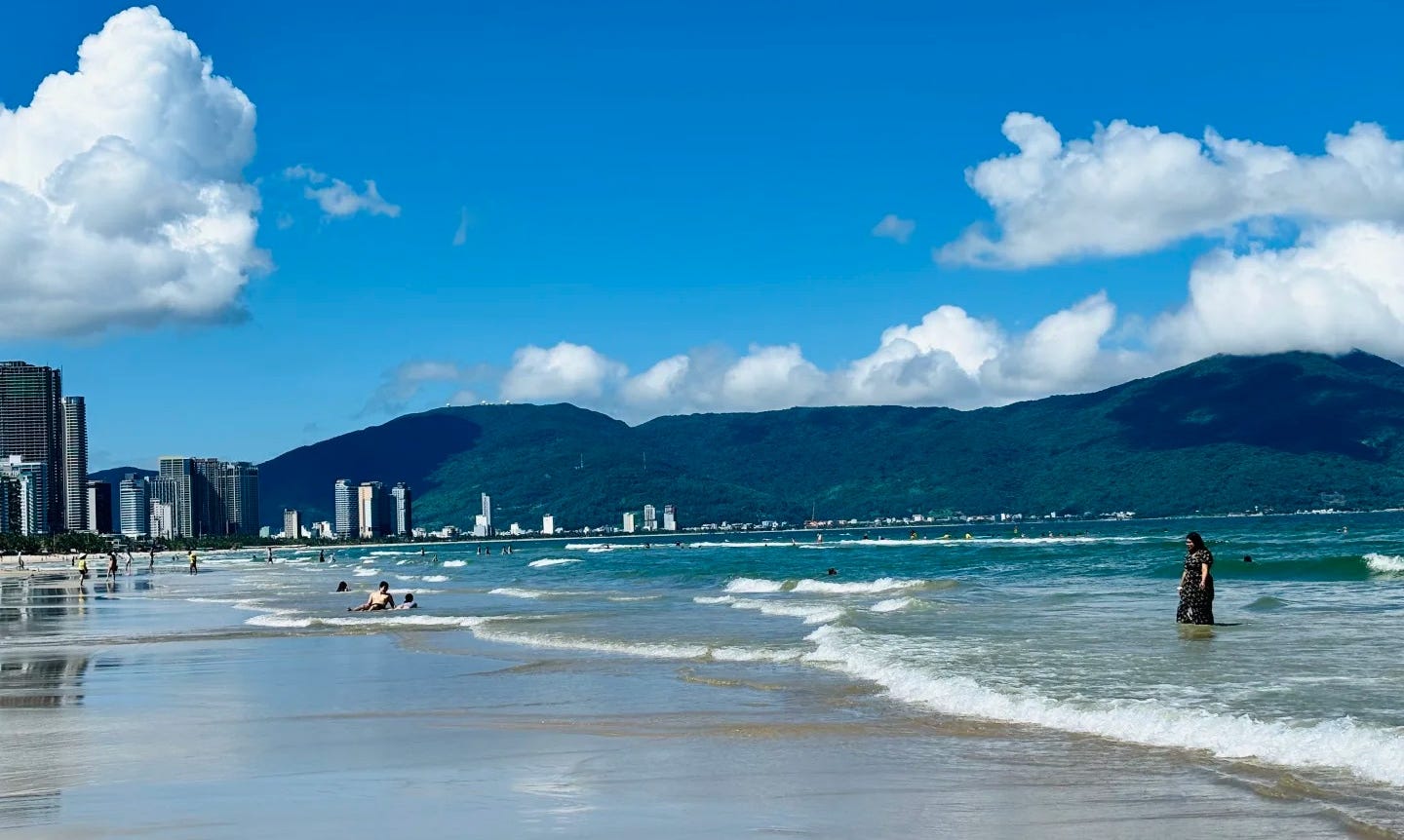
If you’ve never seriously pictured yourself in Da Nang, start here. It’s a coastal city of about a million people in the exact center of Vietnam: a long ribbon of white-sand beach on one side, green mountains and the Sơn Trà peninsula on the other, a river of lit-up bridges down the middle. The international airport puts the rest of Southeast Asia a cheap short-haul flight away, and Hội An’s lantern-lit old town is 30 minutes south. It runs at a noticeably calmer pace than Hà Nội or Hồ Chí Minh City, somehow feeling like far fewer than a million people.
What actually keeps people is the daily texture: beach mornings, an outsized café-and-coffee culture (the coconut coffee earns the hype), cheap and genuinely good food, and a small-but-real community of remote workers, English teachers, and the broader Southeast-Asia drifting class. It’s the kind of place you meet a yogi, a developer, and a dive instructor at the same coworking table. It isn’t a party town and it isn’t a glossy expat bubble; it’s a livable beach city that happens to be inexpensive. If the version of “abroad” you keep picturing is work from a café, swim before dinner, and still save money, Da Nang is one of the strongest options in Asia.
The trade-offs are real and worth saying out loud: a genuine rainy season over the cooler months from roughly October to March (heavy rain, the odd typhoon, and the mold humidity brings), scooter-everywhere traffic with no metro to fall back on, a language barrier that gets steep the moment you leave the foreigner zone, and a smaller professional and English-speaking scene than a big capital — it’s a beach city, not a business hub. Who should look elsewhere: anyone who needs a deep English-speaking professional network, a dry climate, big-city culture and nightlife, or a clear path to actually staying.
The next question is usually “can I even be there?” That part’s easier than most countries. There’s no digital-nomad visa, but you don’t need one to start: the 90-day e-Visa ($25 single-entry, $50 multiple-entry) is an online form, and people extend long stays by leaving and re-entering on a fresh one. It’s not a residency path, and there’s a real catch once you pass roughly six months (more on that below). But as a “come try the city for a season” proposition, the barrier to entry is genuinely low.
So Da Nang is easy to want and easy to get into. The harder question — the one that decides whether it’s the deal it looks like — is what it actually costs once you’re living there. And that’s where most of the English-language internet quietly gets it wrong.
Want the lived-in version first: the neighborhoods, the café scene, what daily life actually feels like? Our guide to living in Da Nang covers that side. This post is the numbers.
Here’s the number I wish I’d understood before treating Da Nang as simply “cheap”: the same furnished one-bedroom near My Khe Beach rents for about 8M VND (~$303) to a local — and roughly double that to a foreigner who finds it through an English-language website. Not 20% more. Double.
That gap is the single most useful thing I can tell you about Da Nang’s cost of living, and it’s the thread running through Saturday’s full teardown. Today, the preview, and the one neighborhood call that matters most.
A quick word on where this comes from. I spent time in Da Nang two to three years ago, long enough to remember the shape of the city, the beach-side rhythm, and the way the place opens out toward the water, but nowhere near recent enough to price 2026 rent from memory. So I didn’t. I rebuilt it from live listings on the platforms locals actually use, cross-checked against Vietnamese-language sources, and then measured those against the English-language foreigner rental sites. The distance between the two prices is the story.
The counterintuitive part
You’d assume the foreigner premium is a flat tourist tax: pay 20% more everywhere, the cost of not speaking the language. It isn’t. It’s concentrated almost entirely in one place: the beachside foreigner zone of An Thượng and Mỹ An, where the English rental sites quote 14–19M VND for a one-bedroom that lists at 7–9M on the Vietnamese platforms. That’s not a markup; it’s a different price for the same apartment.
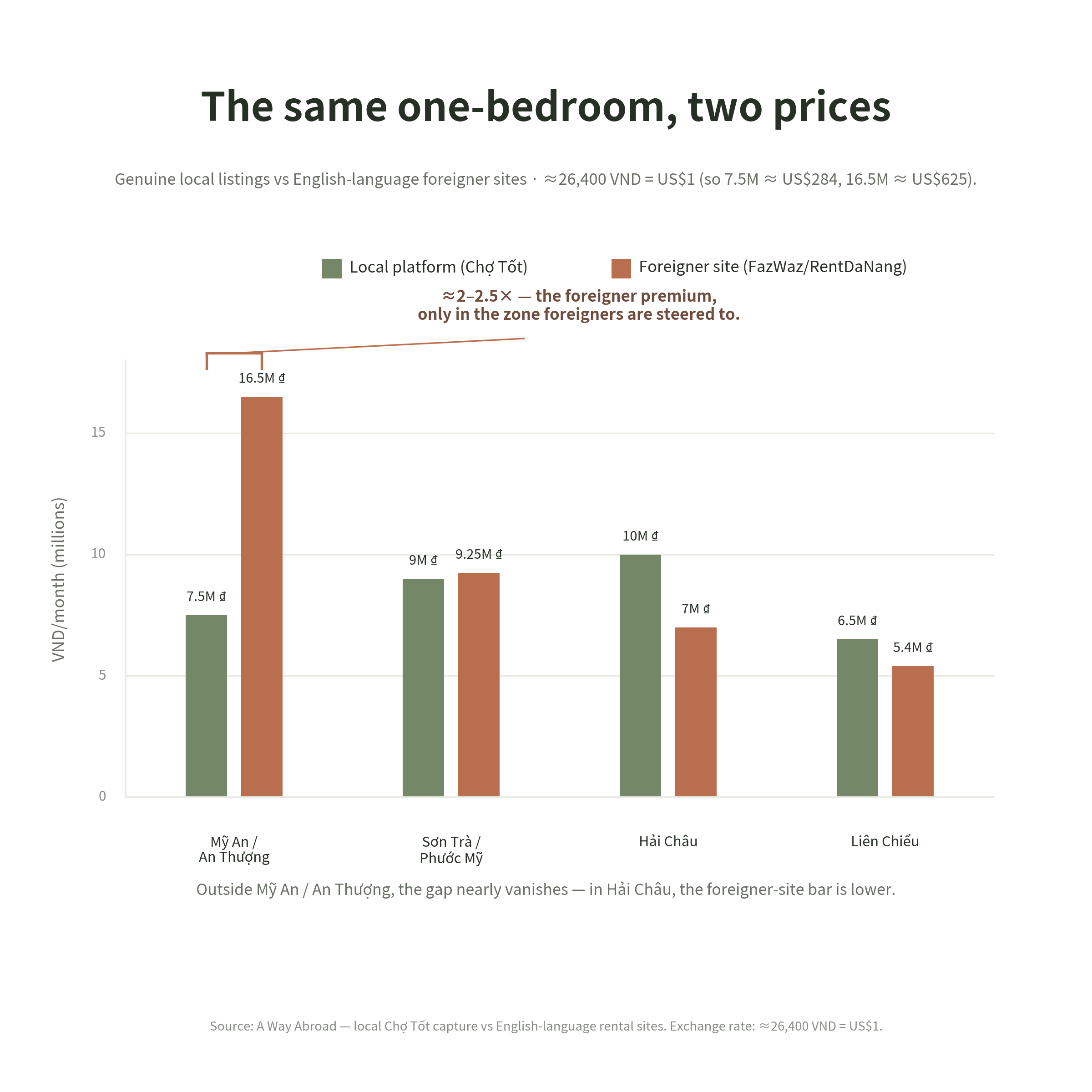
And here’s the tell: move to the city center, or the cheaper west of the city, and the two prices converge. Sometimes the foreigner site is even lower. So you don’t actually pay a premium for living in Da Nang. You pay it for living in the one neighborhood the internet steers foreigners toward, through the one channel it steers them through. Avoid both and you’ve roughly halved your single biggest monthly expense before you’ve done anything else.
This is the part that gets lost in the “Vietnam is cheap” content. Da Nang is cheap, yes, but the better story is that it gives you a beautiful coastal life at ordinary prices if you don’t let the English-language rental market define the city for you.
One neighborhood: Mỹ An
If you take one practical thing from this preview, take this. An Thượng, the grid of bar-and-café streets named An Thượng 1, 2, 3 off the beach, is where you’ll want to be: the coworking, the flat whites, the smoothie shops, the easy international dinners, the ten-minute walk from laptop café to sand. It is the part of Da Nang where the foreigner infrastructure is obvious, and honestly, some of it is useful.
Mỹ An, a few blocks back from the bars, is where you’ll want to live: the same beach access, quieter streets, more local daily life, and on the Vietnamese platform a furnished one-bedroom runs about 7.5M VND (~$284), versus the ~15M+ the foreigner sites will quote you for the same area.
That is the practical sweet spot. You are not exiling yourself to a worse neighborhood just to save money. You are still close enough to walk to the beach, still close enough to use the cafés and coworking spaces, still close enough to get dinner without planning your whole evening around a Grab ride. You are just renting the good neighborhood the local way: on Chợ Tốt, or through a Vietnamese-speaking agent, instead of the first English page that loads.
If you want to feel out the areas before you pick (Sơn Trà, the cityside, which one actually fits you), our Da Nang neighborhoods guide is the lived-in map. Saturday’s post is the rent-by-area math.
So what does a month in Da Nang actually cost?
Renting the local way, a comfortable single month in Da Nang lands around ~$810: a furnished studio or one-bedroom in a quiet-but-near-beach area, a motorbike, health insurance, groceries, and eating out for about half your meals. That’s roughly 70% of what the same comfortable month costs in Taipei, the first city in this series. And the part that genuinely surprised me: almost the entire gap is rent.
On nearly everything else the two cities are closer than the stereotypes suggest. And on two lines, getting around (Da Nang has no metro) and healthcare (no national scheme), Da Nang quietly costs more. The full line-by-line comparison is in Saturday’s post.
If $800 sounds spartan, it shouldn’t. It is a floor, not a ceiling. Most people reading this on a Western salary can spend more, and in Da Nang “more” buys a startling amount: a 70–100 m² oceanview apartment with a pool and gym, weekly housekeeping, a coworking membership, eating out wherever you like, about $1,760/month, barely above Taipei’s comfortable budget and a fraction of what that life costs on any US or European coast.
That is Da Nang’s real pitch. Not “cheapest backpacker base.” Not “live on nothing.” More like: morning beach walks, a proper apartment, a motorbike, cafés you actually want to work from, seafood dinners, space, light, and still a monthly number that would barely cover rent in most Western coastal cities.
The two costs nobody puts in the brochure
Two more things Saturday’s post counts that the cheap-paradise content leaves off.
First, your electricity bill. Most landlords quietly charge foreign tenants a flat rate well above the real state tariff, and Da Nang’s heat means the AC runs. The sea breeze helps at night, but it does not cancel out a humid central Vietnam summer. Electricity is the line that ambushes people in month one.
Second, the clock — actually, two of them. There’s the 90-day visa cycle that never stops (there is no digital-nomad visa). And there’s the one with real money attached: stay past 183 days, or even just sign a lease that long, and you can become a Vietnamese tax resident, with your worldwide income technically in scope. I’ve never seen that mentioned in a “move to Da Nang” listicle.
Da Nang expat FAQs: rent, visa, language
Is Da Nang expensive for foreigners?
Cheaper than the foreigner-facing rental sites make it look, but only if you don’t rent through them. A comfortable single month runs about $810 if you rent locally. Buy that same modest lifestyle through the English-language listings and the baseline jumps to about $1,200 — a ~$400 premium, almost all of it rent, just for renting in English (and still well short of the $1,760 living-large tier). So the honest answer is “no, unless you let it be.” Against the dirt-cheap-Southeast-Asia reputation, Da Nang is cheap but not free: getting around and healthcare cost more than people expect.
What’s the cheapest legal way to live in Da Nang?
A furnished studio out west in Liên Chiểu, near the university zone, from around 4M VND (~$150). Below that are phòng trọ rooms (2–3.5M VND) listed in a different category, which most remote-worker readers aren’t after. The trade-off for the cheap floor is real: 20–30 minutes by motorbike from the beach and the An Thượng scene, and thinner English-speaking infrastructure.
Do I need to speak Vietnamese?
To rent at the local price: effectively yes, or a Vietnamese-speaking agent on your side. That one thing is the difference between the $810 month and the $1,200 one, so it pays for itself in week one. For day-to-day life inside An Thượng and Mỹ An, English gets you through; step outside the foreigner zone and it thins out fast, though Grab and translation apps smooth most of the friction.
Is there a digital-nomad visa?
No. The practical route is the 90-day e-Visa ($25 single / $50 multiple-entry), applied online. You renew by leaving and re-entering, indefinitely. The catch nobody flags: stay past 183 days (or sign a lease that long) and you can become a Vietnamese tax resident, with your worldwide income technically in scope. Saturday’s post walks the detail. For anything specific to you, talk to a Vietnam tax professional.
What does this post NOT cover yet?
Two things. (1) Families (international-school fees, larger family housing, the couple-with-kids math) aren’t modeled here; this is a single resident and a single-earner couple. (2) A structured grocery comparison (local market vs Western imports, by item) is still to come. And the natural Southeast-Asia head-to-head, Da Nang versus Bangkok, lands later in the launch sprint.
What’s in Saturday’s teardown
The paid post is the whole build: the area-by-area rent breakdown (Mỹ An, Khuê Mỹ, Sơn Trà, cityside Hải Châu, the genuinely cheap west), both worked budgets line by line, the full Da Nang-versus-Taipei table, the daily-living and healthcare math, the visa and tax detail, and the twelve places Da Nang residents actually eat, with the beachside tourist traps named and avoided.
If you’re weighing Da Nang against somewhere else, or you’re just tired of cost-of-living numbers that turn out (on arrival) to be the foreigner price, that’s the post for you. It lands Saturday.
— Wei