

Orientation — is Lisbon even for you?
(If you’ve already got Lisbon circled on a map and you’re just here for the numbers, skip to the methodology below.)
Here is the honest case for Lisbon, before the spreadsheet.
The draws are real and they are not the ones the brochures lead with. Yes, the light and the food and the trams — but what keeps people is that Lisbon is a genuinely functional European capital where a single person can live well without a car, where the public health system works once you’re in it, where the violent-crime risk is among the lowest in the world, and where you can be in the rest of Europe in three hours. For a remote worker holding a non-EU income, that combination is rare.
The trade-offs are just as real, and the locals will tell you about them louder than I will. Lisbon is in the middle of a housing crisis that its own newspapers describe in the language of displacement: average rents now run above 167% of the national minimum wage, the second-worst ratio of any EU capital. Wages are low; the bureaucracy (you will meet an agency called AIMA in post #2) is slow to the point of dysfunction; and the tax picture for new arrivals changed sharply in 2024 in ways most English-language guides haven’t caught up to. None of that makes Lisbon a bad choice. It makes it a choice you should make with real numbers in front of you, which is the entire point of these two posts.
Who thrives here: a remote worker or self-employed professional earning in a stronger currency, who wants a walkable European base, doesn’t need to maximise savings, and can absorb a slow first six months of paperwork. Who should look elsewhere: anyone who needs to live on a Portuguese salary (the math is brutal), anyone whose plan depends on the old tax-break Portugal no longer offers new arrivals, and anyone expecting “cheap Europe”: Lisbon stopped being that several years ago, and a lot of why is in the rent section below.
A note on currency: €1 ≈ US$1.17 (locked the day I built this). I’ll write euros first, dollars in parentheses: €1,200 (≈$1,404).
1. The methodology — and why it matters here specifically
The dominant English-language sources for “Lisbon cost of living” are Numbeo aggregation and the furnished-rental platforms expats book through. For this city, in this section, both are misleading in the same direction: up, and for a more interesting reason than in the Asian cities I’ve torn down so far.
Lisbon has two parallel rental markets that barely touch:
The local market: Portuguese-language platforms (Idealista.pt, Imovirtual, Casa SAPO) where residents sign 12-month unfurnished leases (arrendamento, sem mobília). Lower prices, but gated behind a wall I’ll get to.
The expat market: English-language furnished/flex platforms (Spotahome, HousingAnywhere) that quote the number the rest of the internet repeats as “Lisbon rent.” Furnished, bills-bundled, no guarantor, monthly contracts, all priced for it.
So I didn’t write this from memory or from Numbeo. I pulled 122 genuine rental listings (93 off the Portuguese-language local platforms, 29 off the furnished expat platforms) across five neighbourhood bands, kept studios and one-beds only (≤60 m²), threw out the short-stay and serviced-apartment noise, and computed medians (not averages, which luxury listings wreck) for each band on both €/month and €/m². Then I priced every other line (transit, electricity, internet, groceries) against an official or operator source, and built one worked monthly budget for a realistic single resident.
The result is sharper than “Lisbon is getting expensive.” It’s a map of exactly where the foreigner premium lives, and it is not where you’d guess.
2. The headline: rent, and the two neighbourhoods you’re overpaying for
Start with the single most useful finding, because it overturns the standard advice.
The English-language internet quotes Lisbon rent as a single scary number, somewhere around €1,300–1,500 for a furnished one-bed. That number isn’t fake. But it hides the actual structure, which is this: the gap between what locals pay and what foreigners pay is not uniform across the city. It is concentrated almost entirely in the two neighbourhoods foreigners are steered toward first — and it nearly vanishes everywhere else.
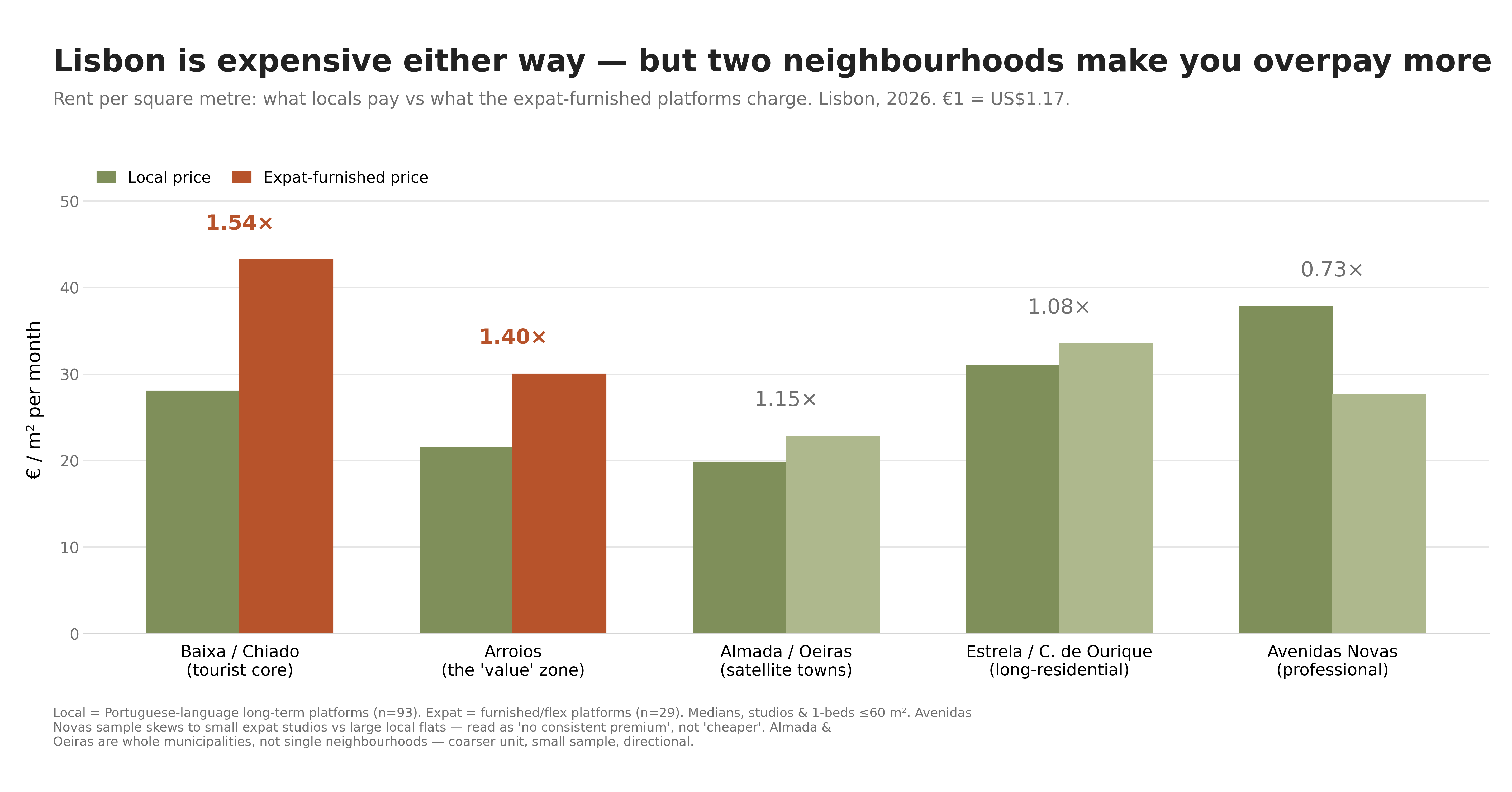
Read that top to bottom. In the historic centre, a foreigner on a furnished platform pays about 1.5× per square metre what a local pays for the equivalent space. In Arroios (the neighbourhood every "best value Lisbon" listicle now sends nomads to), it's about 1.4×. But in Estrela, where Lisbon's longer-settled foreign residents live, the two markets have converged to roughly the same price. And in the modern professional districts, there's no consistent premium at all.
The lesson is not that Lisbon is secretly cheap — it isn’t, and the worked budget below proves it at more than double the local minimum wage. The lesson is two-layered: Lisbon is expensive across the board, and on top of that, two neighbourhoods make foreigners overpay even more, and the English-language rental sites steer you straight into them. The surcharge is a geography you can largely walk out of; the expensive baseline you cannot. Walking out of the premium doesn’t make Lisbon affordable — it stops you paying extra on top of already-high.
(For the regulars who’ve seen this series: this is the same shape as the Da Nang foreigner-premium finding (concentrated in the foreigner zone, gone elsewhere) but milder, and for a different mechanical reason, which is the next section and the part worth paying for.)

So far, so free. Here’s what’s behind the line, and why the per-square-metre gap above is only half the story:
The worked monthly budget: the actual €/month a comfortable single resident spends, line by line, and the one number that reframes the whole “is Lisbon cheap” question.
The fiador wall: why the cheaper local flat is, for most new foreigners, literally unsignable, and what the workaround costs. This is why the two markets exist.
The grocery teardown: where the “Lisbon is cheap” story holds (it does, beautifully, in one aisle) and where it quietly breaks.
Daily living, costed: transit, electricity, internet, the lines you don’t check until the bill arrives.
