

*A quick note before we start.*
I'm traveling in the US for the next couple of weeks, so rather than drip Medellín out over the usual week and a half, I'm publishing the entire teardown today: this free overview, plus Part 1, the cost layer and Part 2, the decision layer.
Read them in order if you can. Part 2 builds on Part 1’s numbers. The next city lands on Wednesday, July 8 (skipping the July 4 holiday weekend).
(And if the Part 2 email reached you before this one, that was me fumbling the schedule on my way out the door. It’s all live and in order now.)
Now — Medellín.
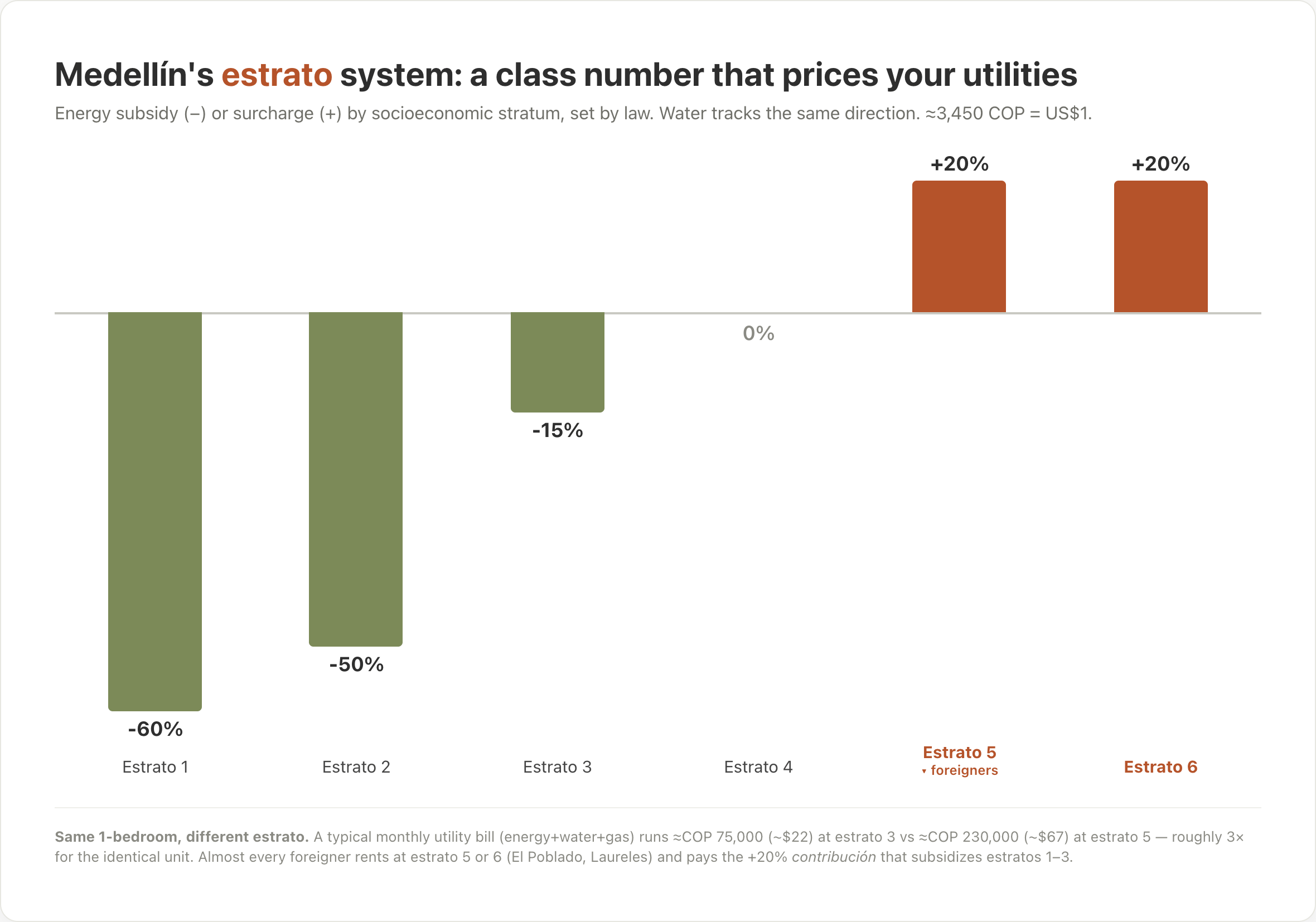
Here’s the detail that stopped me when I started pricing Medellín, and it’s the one this whole post is built around: every home in the city is filed by the government under a single number, 1 to 6, and that number is printed on your electricity bill. It’s called your estrato. A 1 is the poorest classification, a 6 the richest, and it is not a statistic somebody calculates after the fact: it is an official tier, assigned to your exact address, that sets what you pay for power and water by law. As a foreigner moving to Medellín, you will almost certainly live at a 5 or a 6. Almost no “moving to Medellín” guide in English even mentions the word.
And the number does more than label you. While I was pricing the city, I kept finding the same apartment (same size, same street, same fridge running the same hours) that would cost one tenant roughly three times as much on the monthly utility bill as another, for reasons that had nothing to do with how either of them lived. The only thing that changed was the estrato stamped on the meter. How a single digit on a power bill can do that, and why it quietly decides far more than your utilities, is the key to Medellín’s entire cost of living, and it’s what separates the number you’ll actually pay from the cheap-Colombia fantasy the internet sells you.
First, the part where I tell you how I know, because this one matters more than usual. I have not lived in Medellín. I’m not going to pretend otherwise to sell you a number: the whole point of what I do is that I don’t need to have lived somewhere to price it honestly. What I did instead is what the English-language Colombia internet mostly doesn’t: I priced the city in Spanish, from the platforms paisas use (Fincaraíz, Metrocuadrado, the local listing sites) at the neighborhood level, then cross-checked those against the English-facing, foreigner-targeted rentals to measure the gap between the two. The estrato mechanics I pulled from Colombia’s utility law and from the utility company’s own published rate tables, where the surcharge sits in black and white. And I leaned on people who do live there. That cross-check is where the real number came from. It’s also why Medellín earned a two-part teardown: this Saturday is the cost layer: the full rent table, the budget, the move-in cash you won’t see coming. And next Wednesday is the decision layer: safety, healthcare, the visa, and the verdict. Today is the free preview of both.
Is Medellín even your city?
Already have Medellín circled? Skip ahead to the mystery of the class number on the bill.
Medellín is one of the genuinely easy places in the Americas to land as a remote worker, and in 2026 it’s one of the most misread. The honest pitch: it’s the City of Eternal Spring, a valley that sits at a steady spring-like 22°C all year because of its altitude, so you never own a winter coat or an air conditioner. It has the only metro system in Colombia: clean, cheap, and a genuine point of civic pride. It has a deep, established remote-work community, some of the most neutral and learnable Spanish on the continent, and, new since most guidebooks were written, a digital-nomad visa that finally makes living here a legal, multi-year proposition instead of a perpetual border-run. The trade-offs are just as real, and I’ll be straight about them: the Escobar-era reputation is wildly out of date, but the city does have genuine risks the reputation gets wrong (more on that below); the neighborhoods foreigners love are in the middle of a real, tense conversation about whether people like you are pricing locals out; and the easy visa comes wired to a tax tripwire most people don’t see. Who thrives here: remote workers who’ll learn some Spanish, live in an actual Medellín neighborhood rather than a dollar-priced expat bubble, and treat the city as a place to live rather than a cheap party. Who should look elsewhere: anyone who needs a major metro’s job market in their own language, anyone expecting a risk-free soft landing, and anyone who wants “cheap” without thinking about whose city they’re making more expensive.
If you want the lived-in version — what it’s like to build a life there, neighborhood by neighborhood — that’s the part the AWA site does better than I can. Our expat’s guide to living in Medellín, written by someone who moved there and stayed years, covers the texture; and if you’re still deciding where in the country, the best places to visit in Colombia is the wider map. This post is the numbers.
A single digit that triples your utility bill — and it isn’t about you
Back to the number that stopped me. Before I give you the answer, sit with the puzzle for a second, because it’s a good one: what could a single class number, printed on a power bill and attached to a building rather than a person, possibly control, such that two people in identical apartments pay wildly different utility bills, and neither one is being cheated? The mechanism is dull, legal, decades old, and hiding in plain sight on every receipt in the city.
Here it is. In 1994 Colombia wrote socioeconomic stratification into law. Every residential address in the country is classified 1 to 6, not by the occupant’s income but by the physical character of the dwelling and its surroundings: the building materials, the facade, the state of the road, the neighborhood. The city assigns it. And it drives a cross-subsidy that’s unusual: estratos 1, 2, and 3 get their utilities subsidized; estrato 4 pays the true cost; estratos 5 and 6 pay a surcharge on top, by statute up to twenty percent more on energy and water, and that surcharge is exactly what funds the discount for everyone below them. It is a redistribution machine, and it runs through the electricity meter.
Now layer the foreigner onto it. Because the estrato is attached to the building, not to you, a wealthy newcomer who rents in a modest estrato-3 building pays the subsidized estrato-3 rate, and a newcomer who rents the glossy tower in the neighborhood everyone recommends pays the estrato-6 surcharge. And the neighborhoods every English-language guide steers you toward (El Poblado, the polished heart of nomad Medellín) are estrato 5 and 6, almost without exception. So the typical foreigner doesn’t just pay a higher rent. They opt, usually without ever hearing the word, into the top tier of a class system, and start subsidizing the rest of the city through their power bill. That’s the three-times utility gap: it isn’t a scam and nobody’s lying. It’s a redistribution surcharge you joined the moment you signed a lease in the wrong estrato.
One neighborhood, if you take nothing else from today: Laureles
If I were moving to Medellín on a remote income, I would not start my search in El Poblado, where most foreigners do and where the dollar-priced furnished market is hottest. I’d start in Laureles: flat, leafy, gridded around the Estadio, walkable in a city where that’s rare, and overwhelmingly estrato 5 rather than 6. It’s the neighborhood Medellín residents themselves tend to move to when they stop performing the city and start living in it, and the long-term foreigners I’d trust say the same. It’s local without being inconvenient: real panaderías and fruterías and neighborhood lunch counters instead of a strip of dollar-priced brunch. You give up some of El Poblado’s polished nightlife and its density of English-first everything, which, depending on what you want from a year abroad, is either the cost or the entire point. Saturday’s post puts the real rent number on Laureles next to El Poblado, Envigado, Sabaneta and the rest, at the price residents pay rather than the price the foreigner channel quotes.
Is Medellín safe? Yes — and you’ve been scared of the wrong thing
This is Part 2’s territory, but the headline belongs in the free post, because it inverts the entire “is Medellín safe?” genre. The reputation in your head, the one with Pablo Escobar in it, is about 35 years out of date and roughly 35 times too high. In 1991 Medellín was the most dangerous city on earth, with a homicide rate of about 416 per 100,000. In 2025 that rate was about 11.7 per 100,000: the lowest in over eighty years, below Bogotá, and below a long list of major US cities. The random cartel violence the myth sells you is, statistically, not the resident’s risk anymore.
The risk that is real is one the reputation completely hides, and it’s worth saying plainly because it has killed foreigners recently: drugging-and-robbery, run disproportionately through dating apps. The drug is scopolamine (locally burundanga), which renders a victim compliant and amnesiac, and in a large dose can kill. After eight US citizens died in Medellín across two months in late 2023, several connected to dates arranged on apps, the US Embassy issued a formal warning. The thing your mother is afraid of for you is a rounding error next to the spiked drink on the first date you’re not afraid of at all. Part 2 has the full breakdown, sourced and dated, including the rule that neutralizes most of the actual risk. The one-line version: no dar papaya, and be skeptical of the stranger who’s a little too perfect.
The other two things Part 2 settles: the doctor and the law
Two more decisions hide under the cost. Healthcare here is a third model I haven’t seen in this series yet: a contributory public system you can join as a foreign resident, sitting underneath one of Latin America’s best private-hospital markets and a serious medical-tourism industry. The numbers are genuinely good, and Part 2 works them. And the visa: the digital-nomad visa, launched recently, is the real thing that changed Medellín from “somewhere you overstay” to “somewhere you build a couple of years.” But hiding inside the good news is a trap: Colombia’s tax-residency clock and its tourist-day allowance are two different clocks, calibrated just far enough apart that the careless remote worker can trip into being taxed on their worldwide income without ever meaning to. That interaction is the single most consequential thing in the whole teardown, and it gets the room it deserves in Part 2.
Saturday, then Wednesday.
This Saturday — Part 1, the cost layer: the full rent table by neighborhood and by estrato, the line-by-line ~$1,450 comfortable budget (and where it sits against Taipei, Da Nang, Bangkok and Lisbon, where Medellín lands somewhere that surprised me), the move-in cash reality that has nothing to do with a deposit and everything to do with a thing called a fiador, and the grocery finding that changes how much your month costs, because the gap between the cheap way and the expensive way to buy the exact same food in this city is wider than almost anywhere I’ve priced.
Next Wednesday — Part 2, the decision layer: the full safety breakdown (the real risks, the real rule, the honest women’s-safety read), the healthcare math in actual numbers, the visa menu and the tax tripwire worked all the way through, where residents actually eat, and the verdict: who should choose Medellín over the other cities in this series, knowing what it costs and what it asks of you.
Medellín isn’t the cheapest city I’ve priced, and it isn’t the dangerous one the reputation promises. It’s something more interesting than either: a place where the cost of your life is wired to a number you didn’t choose, on a bill you’ll barely read. This Saturday and next Wednesday are where I make the whole case.
Stephanie, you asked for this one back in May. Thank you for the nudge; here it is. And to everyone else on the ground in Medellín: if your estrato has done something to your bills you didn’t expect, or the safety framing here matches your experience or doesn’t, reply and tell me. The readers who actually live these cities are always my best fact-checkers.
One last thing, because the regulars will notice: I wrote this preview differently on purpose: the surprise up front, the mechanism staged like a puzzle. It’s an experiment for the free posts only; the paid teardowns stay played dead straight. Reply and tell me whether the format worked on you. That’s a vote I’ll actually count.
— Wei