

A comfortable single month in Medellín in 2026 runs about US$1,450, call it COP 5,000,000. That’s cheaper than Bangkok, a little above Taipei, and well above Da Nang, which puts Medellín square in the middle of the cities I’ve priced so far. It is not the runaway bargain its reputation promises. And the reason it isn’t, the reason the same city can feel cheap to one foreigner and quietly expensive to the next in the same neighborhood, comes down to a single number the Colombian state stamps on every home in the country.

That number is your estrato, and it’s the spine of this entire post. Most English-language Medellín content never names it. It is, I’d argue, the single most important thing to understand about what living here actually costs.
I’ll say the same thing I said in the free preview, because it governs how you should read everything below: I have not lived in Medellín. I’m not going to invent a balcony and a barrio to sell you a number. What I did instead is price the city the way I price all of them: in the local language, from the platforms residents use, cross-checked against the foreigner-facing channel, and anchored to official tariff tables and named resident sources. Where I’m confident, I’ll tell you. Where the data has a real limit, I’ll flag it.
This is the paid layer, and the first half of a two-part Medellín teardown. Part 1 (this post) is the cost layer: the estrato mechanic that re-prices everything, the rent table by neighborhood and by estrato, the line-by-line budget, the move-in cash that has nothing to do with a deposit, the first five-way comparison in this series, and the grocery finding that moves your monthly number more than your rent does. Part 2, next Wednesday, is the decision layer: safety, healthcare, the visa landscape and the tax trap wired into it, and the honest verdict on who should choose Medellín over the other four cities.
A note on currency: 3,450 COP = US$1. The Colombian peso swings, so treat the dollar figures as a snapshot. COP figures are written as COP 2,500,000 (~$725) throughout.
1. The methodology (and why Spanish matters here)
The dominant English-language source for “Medellín cost of living” is a blend of Numbeo aggregation, a cohort of nomad-blog posts pricing the city from inside the El Poblado bubble, and furnished-rental sites that quote you a monthly number in US dollars. For a foreigner, all three describe a real city: just the most expensive, most foreigner-channeled version of it, and none of them mentions the one mechanic a resident takes for granted.
Here’s what I did instead:
Rent, the local-channel baseline: pulled from Fincaraíz (fincaraiz.com.co), Metrocuadrado (metrocuadrado.com), and Properati, the Spanish-language platforms paisas use, at the neighborhood level: El Poblado, Laureles/Estadio, Envigado, Sabaneta, Belén, La América, Robledo. I separated the local long-term price (mostly unfurnished, paid in pesos) from the furnished-and-foreigner-facing stock, because conflating them is exactly how the “Medellín costs $1,200 for a one-bedroom” number gets made.
Rent, the foreigner channel: the English-facing furnished and monthly-Airbnb market (the coliving operators, the expat Facebook groups, the dollar-priced listings) at the same neighborhoods, to size the gap. The gap is real, but as you’ll see it’s a furnished-and-convenience gap stacked on a channel gap, not a single villain.
The estrato data: Colombia’s Law 142 of 1994, the energy and water subsidy/surcharge schedules (CREG and CRA, the national utility regulators), and EPM’s own published rate tables. EPM (Empresas Públicas de Medellín) is the city utility, and the estrato surcharge sits right there in its January 2026 tariff sheet, which is about as close to a primary source as a cost claim gets.
Utilities, transit, groceries: EPM tariffs, the official Metro de Medellín fare table (effective 10 January 2026), and the price catalogues of the hard-discount chains (D1, Ara) against the premium chains (Carulla, Éxito).
Min wage, visa, tax, healthcare: official sources (Colombia’s 2026 wage decree, Migración Colombia, the DIAN tax authority, EPM/EPS): the highest-stakes items, carried in full in Part 2.
Every figure below traces to a source. Where I estimate, I say so.
The advantage is bilingual sourcing, and in Medellín it pays off in a specific way. The English Medellín internet doesn’t just quote higher prices — it quotes prices from inside a single channel (furnished, dollar-denominated, El Poblado-shaped) and never tells you about the class tier underneath them. The Spanish-language market shows you the other Medellín: the one residents rent in pesos, at an estrato that changes the math. This post does the cross-walk.
2. The estrato system — the mechanic that prices everything
Here is the thing to understand before any rent number means anything.
In 1994 Colombia wrote socioeconomic stratification into national law. Every residential address in the country is classified into one of six estratos, 1 (lowest) to 6 (highest). Crucially, the classification is based on the physical characteristics of the dwelling and its surroundings (building materials, facade, the state of the street, the neighborhood), not on the income of whoever lives there. The municipality assigns it; it’s printed on your utility bill and named in your lease; you can look up any address. A wealthy person in an estrato-3 building pays estrato-3 rates. A modest earner who inherited a flat in an estrato-6 tower pays the estrato-6 surcharge. The number belongs to the home, not the resident.
And it drives a cross-subsidy. The legal language is “solidaridad y redistribución de ingresos,” solidarity and income redistribution:
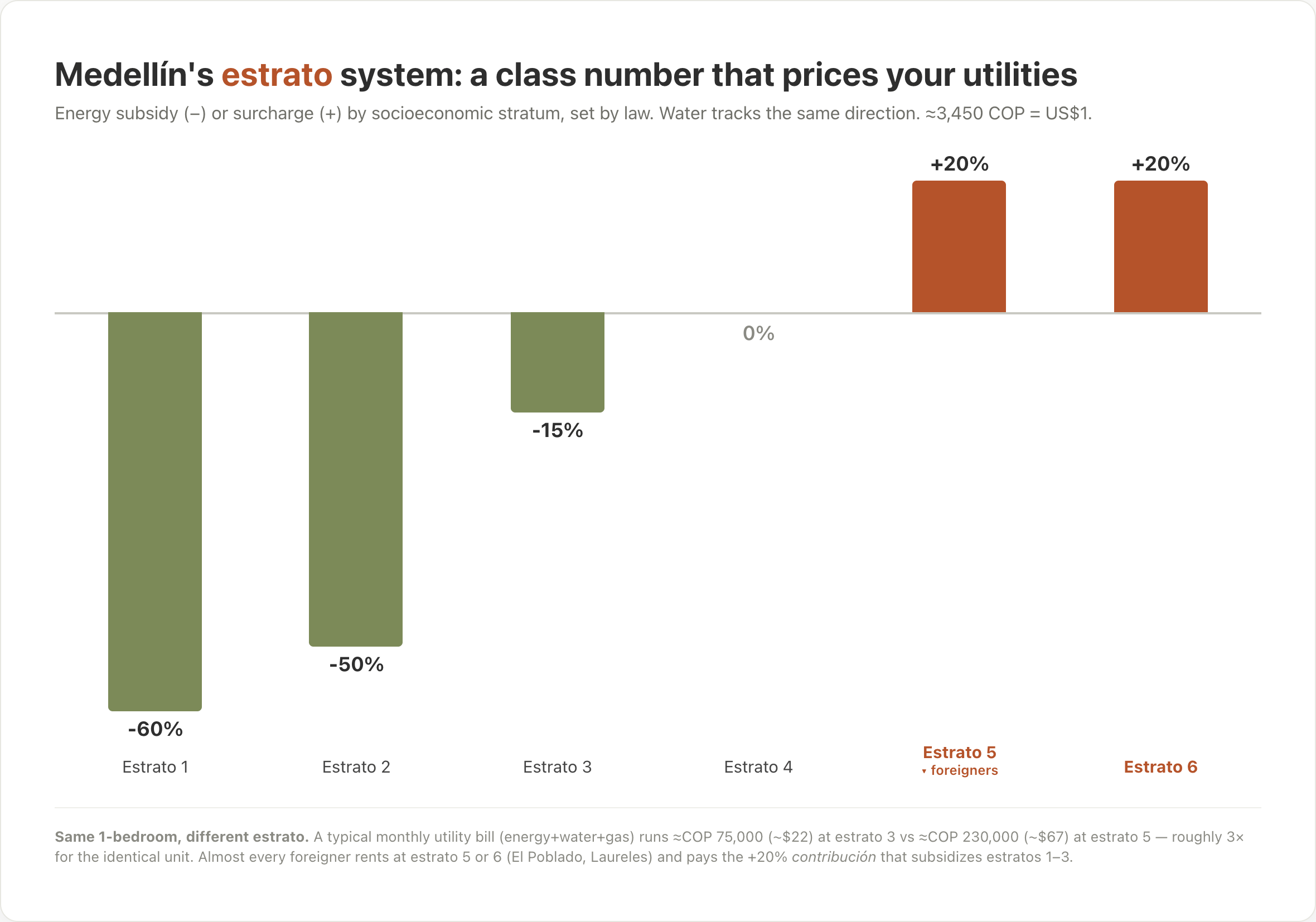
Estratos 1, 2, 3: subsidized. They pay less than the true cost of their utilities. On energy, the discounts run roughly −60% / −50% / −15%; on water and sewage, roughly −70% / −40% / −15%.
Estrato 4: neutral. Pays the real, unsubsidized cost. The reference tier.
Estratos 5, 6: surcharged. Pay a contribución of up to +20% on energy and water, and that surcharge is precisely what funds the discount for estratos 1–3.
One important nuance, so I don’t overstate it: the subsidy (and the surcharge logic) applies to the subsistence-consumption block: a basic monthly allowance of energy and water. Consumption above that block is billed at full tariff regardless of estrato. So the headline percentages overstate the saving for a heavy user. But for a normal single household, the estrato is the dominant lever on the utility bill.
You can see the surcharge with your own eyes in EPM’s tariff table. On natural gas, January 2026: an estrato 4 household pays a fixed charge of COP 4,202.80 plus COP 2,636.32 per cubic metre; an estrato 5 household pays COP 5,043.36 fixed plus COP 3,163.58 per m³: about 20% more on both lines, for the identical gas. That’s not an estimate. That’s the contribución, printed on the rate card.
The worked contrast — the same apartment, three different bills
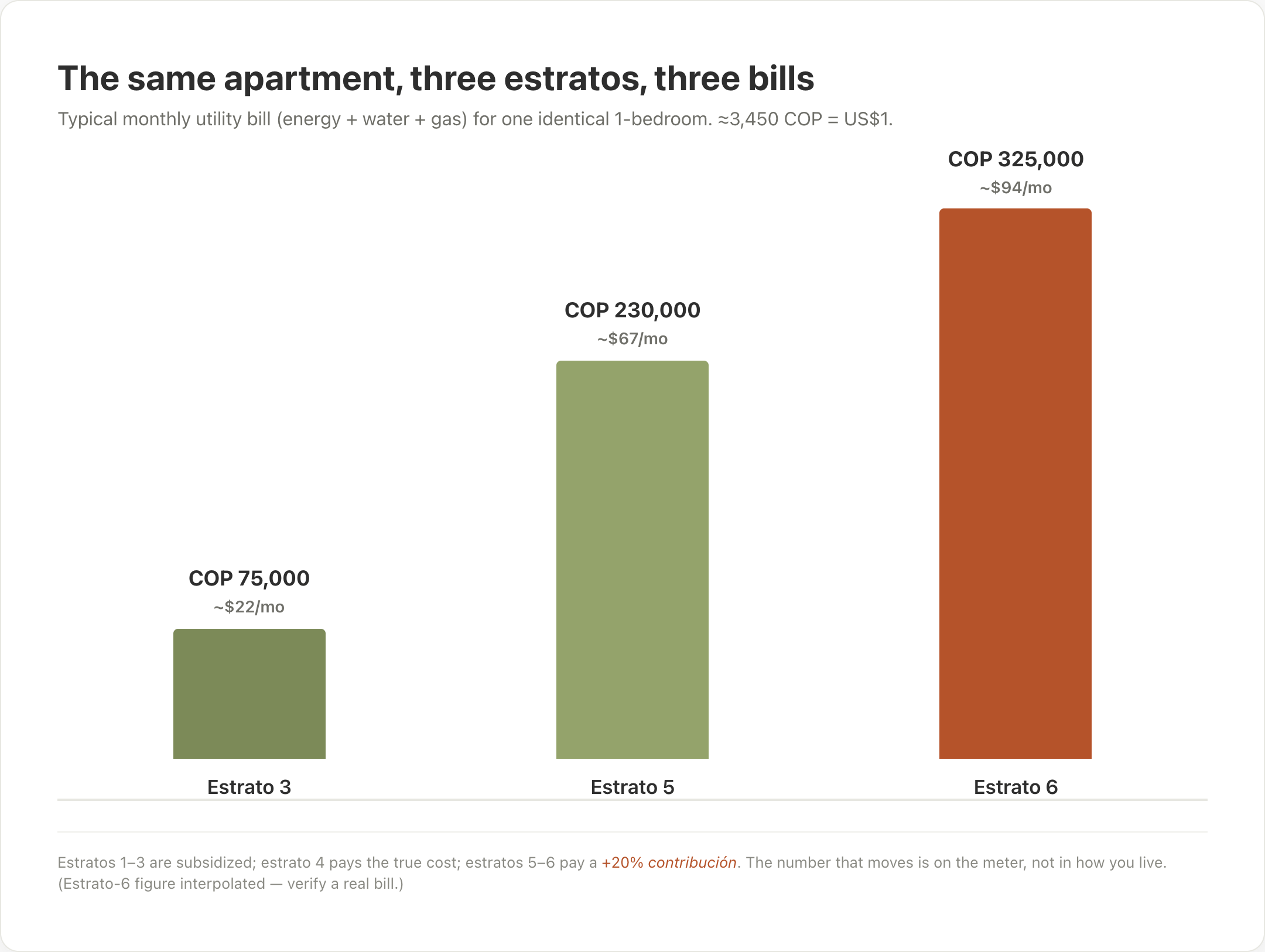
Take one ordinary one-bedroom, same size, same consumption, and change only the estrato stamped on the meter. The total monthly EPM bill (energy + water + gas) lands roughly:
Roughly three times the bill at estrato 5 vs estrato 3, for the identical unit: call it a COP 1,500,000–2,000,000 (~$435–580) difference over a year on utilities alone. (The estrato-3 and estrato-5 figures track EPM’s published rates and resident-reported bills; the estrato-6 band is an estimate — the +20% surcharge is fixed by statute, but I’m extrapolating the absolute bill from a higher-consumption unit, so treat that row as indicative rather than a sampled baseline.)
Why this is the foreigner’s story specifically
Because the estrato is attached to the building and the neighborhood, where you choose to live picks your estrato for you, and the neighborhoods every English-language guide recommends are estrato 5 and 6. El Poblado is 5–6 almost end to end. Laureles is overwhelmingly estrato 5. So the typical foreigner, following the typical advice, lands in estrato 5 or 6 and starts paying the contribución, the surcharge that subsidizes the rest of the city, usually without ever learning the word.
There’s an honest two-sidedness here worth naming, because it’s more interesting than a gotcha. The estrato surcharge is the one line in this whole teardown where the foreigner’s money flows toward local affordability rather than away from it: an estrato-6 power bill helps fund an estrato-1 household’s subsidized water. That doesn’t make El Poblado’s dollar-priced rents any less of a displacement pressure; it just means the utility surcharge, specifically, is redistribution working as designed, with you on the paying side of it. Most foreigners never know they’re part of it.
The practical takeaway: the single most consequential cost decision you make in Medellín isn’t the rent headline — it’s the estrato of the building, because it silently re-prices your utilities for as long as you live there, and it’s a strong predictor of the rent itself. An estrato-4 apartment in Envigado and an estrato-6 tower in El Poblado aren’t just a rent difference; they’re a different utility bill every month on top of it. Knowing to check the estrato line before you sign is the whole game.
