

Part 1 settled the cost question: a comfortable single month in Medellín runs about US$1,450 (COP 5,000,000), middle of this series, cheaper than Bangkok, above Taipei, and the reason it isn’t the bargain the reputation promises is the estrato, the government class number, 1 to 6, that prices your rent and utilities and that lands almost every foreigner at 5 or 6. (If you missed it: drop one estrato and you save on rent and shed a 20% utility surcharge, the move-in reality is a fiador you don’t have rather than a deposit, and the same groceries cost 81% more at Carulla than at D1.)
So if Medellín isn’t dramatically cheap, the decision turns on what it does that the cost line doesn’t show. That’s this post. Same honesty note as before: I haven’t lived here. The sections below lean on official sources, named resident voices, and cross-language verification, and I flag every place the data has a limit, which, in a post about safety, healthcare, and tax, is exactly where it matters most.
A note on currency: 3,450 COP = US$1 (June 2026). COP figures are written COP 5,252,715 (~$1,520). Budget figures reference Part 1, the Medellín cost breakdown.
1. Safety — and the risks that actually matter
Safety is the question every “should I move to Medellín” search is really asking, and it’s the one the internet answers worst: half breathless Escobar nostalgia, half “it’s totally fine now!” Both are wrong. Let me do it the way I did the rent: with numbers, and with attention to the gap between what people fear and what actually hurts residents.
Start with the inversion, because it’s true and it’s enormous. In 1991, at the height of the cartel wars, Medellín was the most dangerous city on earth: 6,349 homicides in a single year — a rate of about 416 per 100,000. In 2025 that rate was 11.7 per 100,000, the city’s lowest in over eight decades and roughly a 35× decline from the peak — one of the steepest urban-violence reductions ever recorded. Medellín’s murder rate is now below Bogotá’s (~15) and below a major US city like Chicago, which recorded about 15 per 100,000 in 2025 — though it still sits above the US national average of around 5, and the worst-hit US cities (New Orleans, St. Louis) run several times higher. One honest caveat so I don’t oversell the miracle: the recovery wasn’t perfectly linear — some sub-periods ran above the post-Escobar trough — but at the endpoints the 35× drop is real.
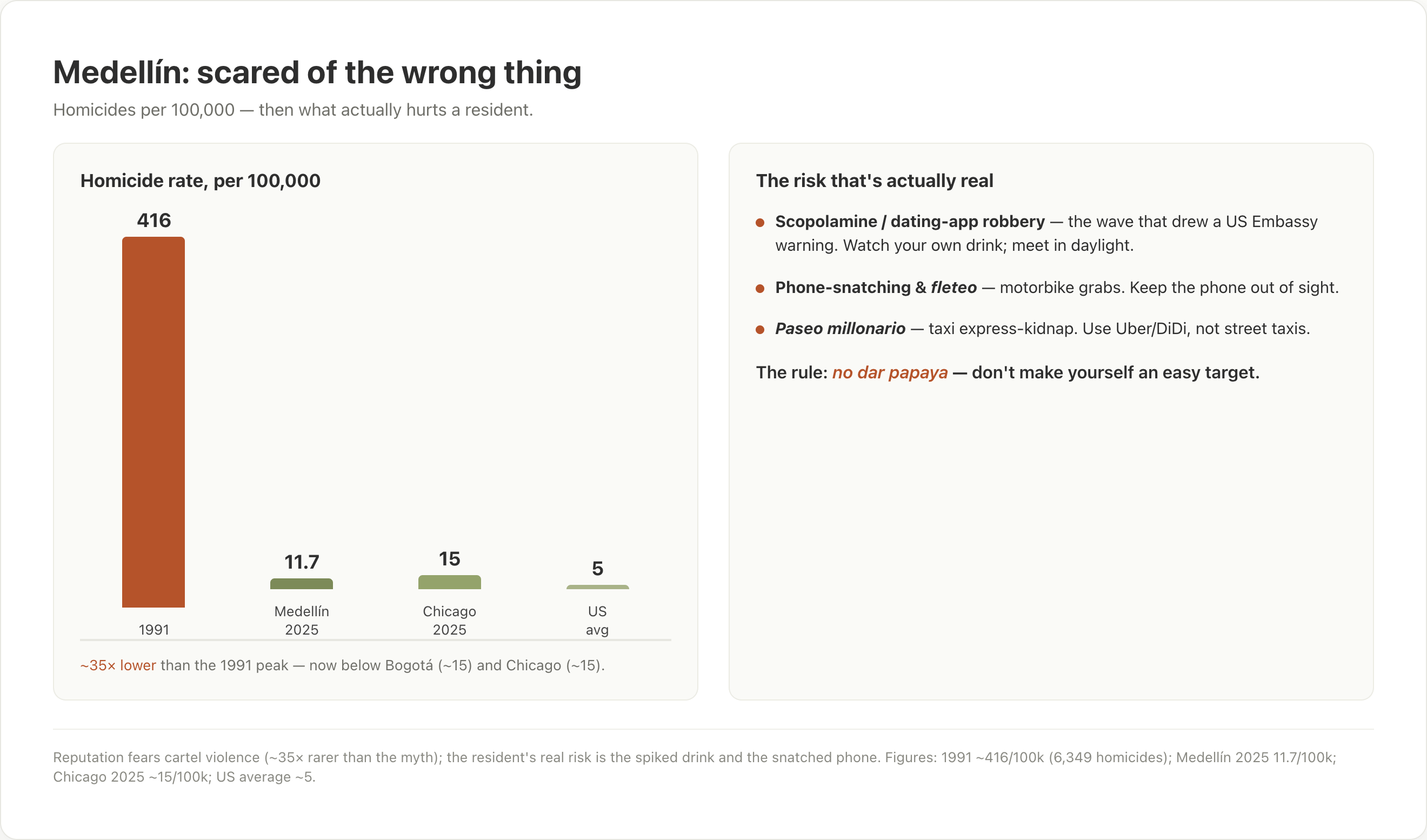
Now the part the fear content gets backwards: the thing most likely to hurt you in Medellín is not a person with a gun. It’s a drugging-and-robbery, and increasingly it runs through dating apps. The drug is scopolamine — locally burundanga, “devil’s breath” — a powerful, hard-to-detect alkaloid that induces compliance and amnesia and, in a large dose, can kill. The script: a match on Tinder, Bumble, or Grindr, a meeting at a bar or the victim’s apartment, a spiked drink, and the victim wakes up (if they wake up) hours later, robbed, with no memory. After eight US citizens died in Medellín across November and December 2023 — several of the cases tied to dating-app meetings — the US Embassy issued a formal Security Alert about exactly this. Reported thefts against foreigners in Medellín had risen around 200% year-on-year in that period.
I want to be careful with that, because it’s frightening and it’s also avoidable. The point isn’t “don’t date in Medellín.” The point is that the threat you’ve been trained to fear, random cartel violence, is statistically a rounding error, and the threat that’s killed foreigners recently is the spiked drink on the first date you’re not afraid of. Reweight accordingly.
The local safety philosophy is two words: no dar papaya, literally “don’t give papaya,” i.e. don’t make yourself an easy target. It governs the everyday risks the homicide stat doesn’t capture:
Phone-snatching and fleteo: opportunistic theft, often by two people on a motorbike, targeting the phone in your hand near the curb. The most common crime against foreigners, concentrated in the same neighborhoods foreigners love (El Poblado, Laureles). Keep the phone out of sight on the street.
Paseo millonario — the “millionaire’s ride,” an express kidnapping where a street-hailed taxi takes you on a forced ATM tour. The mitigation is simple and total: use Uber/DiDi/Cabify, not street taxis, especially at night. (This is the everyday reason the ride-hail line in Part 1’s budget is also a safety tool.)
Standard rule if you’re mugged: don’t resist. Hand it over. Phones are replaceable; the universal local advice is that resistance is what turns a robbery into something worse.
Where this matters geographically: El Poblado (the Manila side over the nightlife end), Laureles, Envigado, and Sabaneta are tourist-normal: high foot traffic, visible police, violent crime rare. The hillside comunas in the northeast (Aranjuez, Castilla, Manrique) are where you don’t wander, especially after dark; Comuna 13, now a famous tour, is fine as a daytime guided visit and a different proposition off the tourist track or after dark. The rule the UK’s advice comes down to: don’t go into unfamiliar hillside barrios without a local.
On the official advisories, the headline is scarier than the city: the US State Department rates Colombia Level 3, “Reconsider Travel” (reissued 31 March 2026), the UK FCDO flags specific other regions while leaving Medellín in its no-warning zone, and Australia rates it Level 2 overall. But the “Do Not Travel” zones that drive the alarming national rating are rural and border regions — Arauca, Cauca, Norte de Santander, the Venezuela border — not the city you’d actually move to. Medellín and Antioquia are not in those carve-outs. That gap between the national headline and the city reality is itself part of the inversion.
For women specifically, the honest read, on-brand for a women-led publication, so no sugar-coating in either direction: Medellín is manageable for an experienced solo woman who runs the no dar papaya playbook and is skeptical of the too-perfect dating match. It is not a soft-landing first-trip-abroad city. Street harassment (piropos) exists, as across much of Latin America; the larger flagged risk is the same scopolamine-via-app vector, which skews toward the drink-spike-and-rob script. The rules sources converge on: app-cars after dark not street taxis, don’t walk alone late, meet dates in busy public places in daylight, watch your own drink. Safe bases are the Manila side of El Poblado and Laureles. Several of AWA’s own contributors have lived this; the women-only expat networks here (there’s an active, supportive one) are a genuine asset.
The safety verdict, in one line: You’ve been scared of the wrong thing. The Escobar-era reputation is 35 years and 35× out of date; the random violence the myth sells you is not the resident’s risk. The real risks are a spiked drink on a dating app and a phone snatched off a motorbike, both substantially neutralized by no dar papaya, app-cars, and dating skepticism. Do that and you’ve handled most of the actual threat surface.