

Here are the key figures this entire post revolves around: To live comfortably in Mexico City in 2026, monthly expenses will be approximately $1,690, which is higher, not lower, than the roughly $1,602 I estimated for a comfortable life in Bangkok in an earlier part of this series. I had to read that sentence twice. Over the past decade, Mexico City has been the epitome of a “budget nomad” destination, the place people turn to when rent back home becomes unaffordable. But when it comes to a truly middle-class standard of living, a careful calculation reveals that living expenses here are now actually higher than in that Southeast Asian capital everyone calls expensive.
But what really made me pause wasn’t the total amount. When estimating costs, the same apartment kept sending me two conflicting messages. For remote workers earning a salary in dollars, a furnished one-bedroom in a neighborhood everyone is scrambling to move into, at about $1,450 per month, is indeed a great value, cheaper than almost any apartment in any U.S. city. (The $1,690 figure mentioned above isn’t based on that specific apartment: it assumes that a one-bedroom in Narvarte rents for about $871. That’s precisely the point of Saturday’s article.) But for someone who grew up in that neighborhood, the same apartment, at the same price, equals 2.6 times Mexico’s total monthly minimum wage, which is simply impossible, and it’s exactly why they no longer live there. One number. Whether it’s a bargain or a disaster depends on which currency you use to measure it. How both claims can be true at the same time is precisely the crux of the issue regarding the overall cost of living in Mexico City, and it’s the most unsettling story I’ve told in this series, because in other cities, it’s foreigners who pay the premium; in Mexico City, it’s foreigners who create the premium.
First, I’ll explain how I obtained this information and candidly admit what I don’t know. I have never lived in Mexico City. This series only makes sense if I state this point plainly every time I mention it. Therefore, I am not estimating prices based on a wonderful month I spent in the Roma neighborhood; rather, I’ve scoured the latest property listings on Spanish-language platforms actually used by local residents, block by block, and compared them with the English-language websites aimed at foreigners that you’re directed to elsewhere on the internet. The gap between these two sources is the main focus of this article. The other half of the evidence isn’t about numbers at all. It’s the march on July 4, 2025, when hundreds of people set out from Parque México, passing through the Condesa and Roma neighborhoods, precisely for this reason: the first of three anti-gentrification marches over the following three weeks. Twelve days later, Mayor Clara Brugada responded with Bando 1: a plan comprising fourteen actions, issued as a government proclamation rather than a legal statute. When a cost-of-living story has produced street protests and forced a policy response, there’s no need to wonder whether it’s real. This Saturday’s focus: “The Cost”: Complete data. Next Wednesday’s focus: “The Decisions”: Safety, healthcare, visas, and final conclusions. Today, we’re offering a free preview of both sections.
Is Mexico City really your city?
Already circled CDMX on your map? Then skip straight to the apartment conundrum, both a bargain and a nightmare.
For remote workers, Mexico City is one of the truly exciting metropolises, and most “Moving to CDMX” guides underestimate what makes it so appealing. A candid recommendation: From street tacos to two-Michelin-star tasting menus, the city’s culinary culture is rich and diverse, yet it never feels like you’re in a tourist trap; an elevation of 2,240 meters with a mild, spring-like climate year-round; tree-lined, walkable neighborhoods; a deep creative and international vibe; and a time zone that aligns with U.S. workdays (which is the fundamental reason why those who earn their living in U.S. dollars choose to settle here rather than in Lisbon). The corresponding drawbacks are just as real, and I’ll explore them in detail in Part Two: The city sits on an ancient lake bed in a high-risk earthquake zone; the altitude requires genuine acclimatization; air quality issues persist throughout two seasons (ozone pollution from mid-February to mid-June, and particulate matter pollution from November to February); tap water is not safe to drink; and there’s one thing tourist guides will never mention: you’re arriving in a city that openly and visibly expresses its anger toward newcomers. Who will thrive here: Remote workers willing to learn enough Spanish and choose to live in local Mexican neighborhoods rather than within the expat “bubble”; those hoping to enjoy world-class metropolitan living at a lower cost of living than in the U.S.; and those who can comfortably tolerate the discomfort that comes with being part of a controversial trend. Who should look elsewhere: Anyone who needs to breathe clean air year-round; anyone unwilling to confront the issue of “forced displacement of residents”; and anyone expecting the “$800 nomad city” promised by the internet in 2018. That city no longer exists, and the next few minutes will explore where it went.
Before we talk about money, one thing needs to be clarified: Mexico does not have a so-called “digital nomad visa,” and the old method of staying here on back-to-back six-month visitor permits (the FMM) is now quietly no longer reliable. The law never actually promised six months: it sets the maximum visitor permit at 180 consecutive days, with the exact number determined by the official at the counter. The change is that officials are now exercising this discretion; travelers who once had no trouble securing the full 180 days are now being issued permits for 30 or 60 days. Furthermore, this permit cannot be topped up: there is no extension and no renewal, so the only way to reset the count is to leave the country and re-enter. One thing to be precise about: this is a shift in enforcement, not a change in the law. INM has published no notice announcing shorter permits, so what exists is press coverage and traveler reports rather than a rule you can point to at the counter. That’s exactly what makes it hard to plan around: there’s nothing to appeal to, and nothing obliging the officer in front of you to write more than 30 days. The route most remote workers end up on is the temporary residence visa on economic-solvency grounds, and that threshold is higher than most people expect. Solvency is only one of seven qualifying routes, though: the others run through family ties to a Mexican or a Mexican resident, property in Mexico, investor status, an institutional invitation, scientific research, and international mobility instruments. Part Two walks all seven. In Part 2, I’ll detail the entire step-by-step process, as well as the tax residency timeframes hidden behind it.
If you’re interested in real-life experiences, what it’s actually like to settle in the area, including specifics about different neighborhoods, this is exactly where the AWA website excels more than I do. Our Guide to Living as an Expat in Mexico City offers a firsthand look at the details of daily life there; if you’re still hesitating about which Mexican city to choose, The 7 Best Places to Live in Mexico compares Mexico City (CDMX) with cities like Mérida and Guadalajara. This article focuses on the data, and the more complex issues behind it.
A Bargain Deal, a Disaster: The Same Apartment
Let’s return to that one-bedroom apartment that’s both cheap and virtually impossible to rent. Before I reveal the mechanism behind it, try solving this puzzle yourself: Why is the same rent figure a genuine bargain for one person, yet structurally impossible for another standing on the very same street, with no landlord overcharging anyone and no one lying? The answer isn’t a scam; it’s the exchange rate.
This is precisely what sets Mexico City apart from the other cities in this series. In Da Nang, Bangkok, and Lisbon, the markets catering to foreigners charge higher rents: a markup you can learn to avoid. Mexico City’s mechanism, however, is exactly the opposite, and even more peculiar. Remote workers aren’t being overcharged; rather, by their own income standards, the rent is set too low. When U.S. salary levels meet Mexican rent prices, the gap in purchasing power is so vast that rents, which should be a “bargain” when priced in U.S. dollars, far exceed what local wages can afford. Landlords, acting rationally, set prices based on tenants who can actually pay, and these tenants are increasingly being paid in U.S. dollars or euros. Rent increases aren’t the result of fraud, but rather the emergence of a new type of demand: one that can afford almost any price yet still feels like it’s saving money. That is the driving force. You can’t beat this market by looking for local prices; in neighborhoods where foreigners congregate, your very presence is one of the factors driving up local prices. This is precisely why the true version of this post cannot be “Here’s a trick for finding cheap apartments.” Because behind every “trick” is a real person.
This is the city that once welcomed this wave, only to later take to the streets to protest it
And here lies the second turning point: the very shift that makes Mexico City a unique story, rather than a “Spanish-speaking Lisbon.” This population displacement is not an unexpected event the city was forced to deal with. In 2022, the city government signed a cooperation agreement with Airbnb and UNESCO aimed at transforming Mexico City into a global hub for remote workers, precisely to recruit the very wave of people who, three years later, would take to the streets in protest. This announcement was made on October 26, 2022, when the city government was led by Claudia Sheinbaum, the very same person who, three years later and by then President of Mexico, condemned the xenophobic edge of the 2025 protests. The 2025 protests and the subsequent policy responses reflect a city grappling with its own past decisions. What you’re facing isn’t a simple moral drama with a clear villain. You’re stepping into a genuine, unresolved struggle that’s playing out in the open, and in Part Two, I’ll explore, in no uncertain terms, how to engage with it while avoiding becoming the worst aspect of that struggle.
If there’s one neighborhood you should remember today, it’s this: Narvarte
If I were to move to Mexico City on a remote work income, I would never start my housing search in the Roma or Condesa neighborhoods. Not only because they are now the most expensive neighborhoods in the city, but also because the focal point of this struggle lies precisely within these neighborhoods. I’d start with Narvarte: This is an authentic “chilango” neighborhood in the Benito Juárez district, rated by locals as the safest in the city (according to INEGI’s June 2026 Urban Safety Survey, 17.4% of Benito Juárez residents consider the district unsafe, while the national urban average is close to 60%), it offers convenient subway access, is home to what locals widely recognize as the city’s best everyday tacos, and has rents far below those in “foreigner-heavy neighborhoods.” This is a place where reason and conscience point in the same direction.
Now, I must offer you a frank warning, because this is precisely the moral dilemma one faces when moving to this city, and I will not turn a blind eye to it: The relocation strategy I just recommended is, in fact, a pathway for the city’s boundaries to expand. With every wave of newcomers forced out of the Roma neighborhood by rising housing prices, they “discover” the next neighboring community, and prices there inevitably follow suit. Here, no choice of neighborhood can allow you to remain uninvolved. What truly exists, and this is what Part Two will explore in detail, is the difference between coming here with your eyes wide open and becoming “the next paragraph” in some story you’re too lazy to read.
Is Mexico City Safe? Yes, and the Real Risks Aren’t What You Think
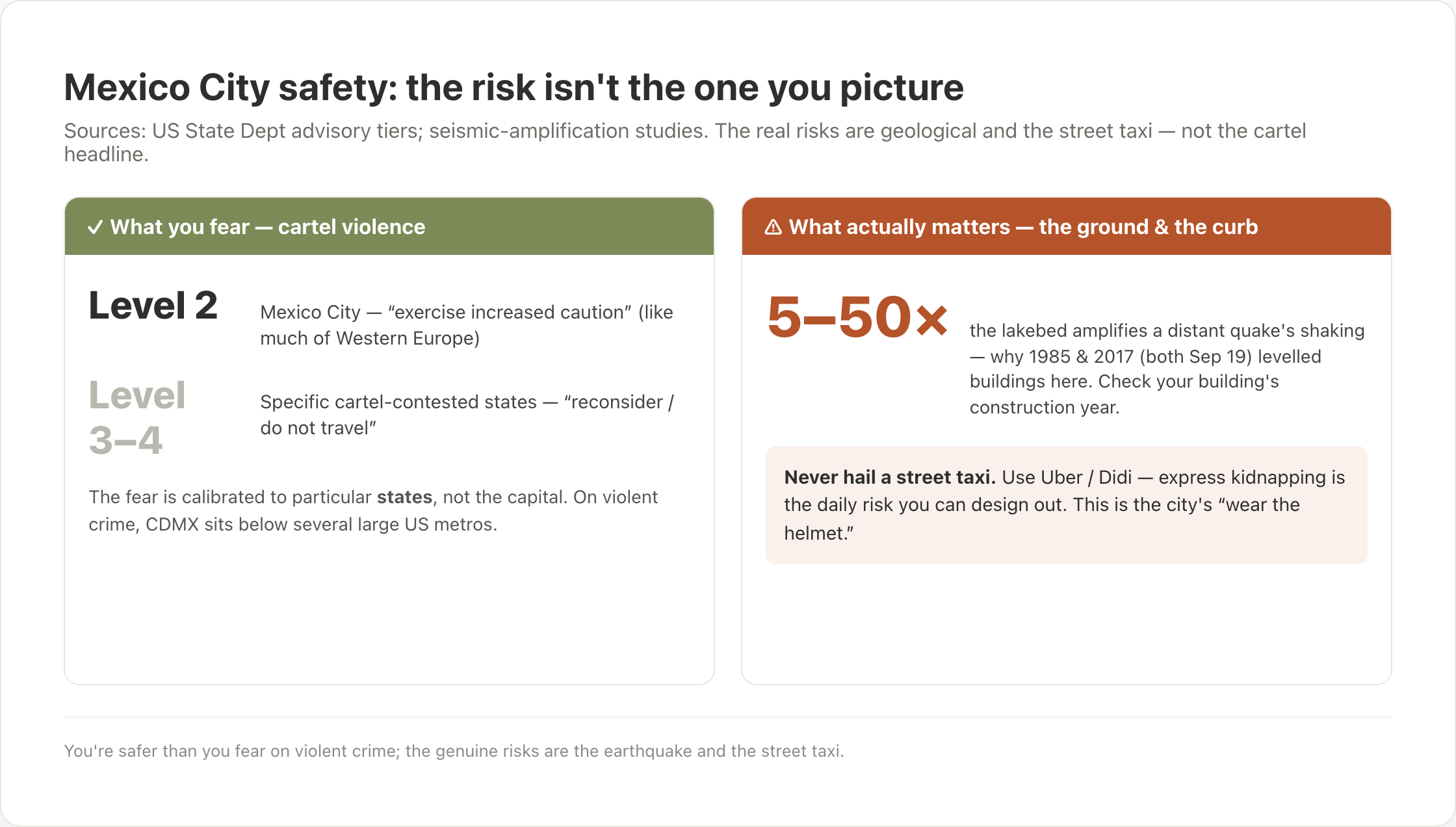
This falls under Part Two, but this headline deserves a spot in the free article because it overturns the entire established narrative surrounding the question, “Is Mexico safe?” The drug cartel violence that dominates Americans’ perception of Mexico does indeed exist, and it is highly geographically concentrated: the vast majority of incidents occur in specific states, not in the capital. In terms of the metrics that truly matter to you as a resident, Mexico City’s homicide rate in 2025 was 8.7 per 100,000 people, roughly half the national average of 17.5 and only about one-ninth of Colima State’s rate of 70-80. Taking U.S. data from the same year as a reference: this figure is lower than Chicago’s (15.6) and Philadelphia’s (14.3), but higher than Los Angeles’ (5.9) and New York City’s (3.6). Nationwide, the number of homicides in 2025 fell by about 30%, reaching a ten-year low. The U.S. Department of State’s travel advisory for the city itself is rated Level 2: “Exercise Increased Caution”, which is on par with most of Western Europe, rather than the “Do Not Travel” level the State Department applies to six Mexican states: Colima, Guerrero, Michoacán, Sinaloa, Tamaulipas, and Zacatecas.
The real risks, however, are more subtle and deserve serious attention. First and foremost are earthquakes: the city sits on a drained lake bed, and its soft clay amplifies distant tremors many times over: For this very reason, both the 1985 magnitude 8.0 earthquake off the coast of Michoacán (with an epicenter approximately 350 kilometers away) and the 2017 magnitude 7.1 earthquake (both occurring on September 19) caused buildings to collapse in the very neighborhoods where you’d most likely want to rent an apartment. Compared to nearby bedrock, the lake bed amplifies ground shaking by a factor of 5 to 50. The second risk is more mundane and everyday: street taxis. In this city, the most crucial safety habit is to never hail a taxi on the street; instead, use a ride-hailing app: the risk of an “express kidnapping” (secuestro exprés) does exist, though the probability is low, but it can be almost entirely avoided. The robberies you’re wary of pale in comparison to the dangers posed by buildings whose construction dates you haven’t verified and taxis you hail simply because they’re right in front of you.
And if something does go wrong, healthcare presents another unexpected challenge
Mexico does not have a national healthcare system that foreigners can easily access, which sounds like a major problem until you see the cost of paying out-of-pocket for medical care. In central areas, including Mexico City, a visit to a clinic next to a pharmacy costs about 60 pesos, or roughly $3.50 (up from 50 pesos as of September 1, 2024), while a private general practitioner costs a few hundred pesos more, and the country’s top private hospitals charge only a fraction of U.S. prices. The conclusion I’ve repeatedly reached is exactly the same as what I felt in Bangkok: here, you don’t need U.S.-level health insurance to feel safe. You need genuine major medical insurance and be willing to pay out-of-pocket for routine medical care, which is indeed both affordable and high-quality. Part Two will provide specific data on all of this.
Saturday, then Wednesday.
This Saturday—Part One. The Cost Aspect: An overview of rent across different neighborhoods; a breakdown of the approximately $1,690 budget; the “electricity trap” that could silently triple your annual electricity bill; and a grocery shopping discovery that will completely transform the way you shop here.
Next Wednesday—Part Two. Decision-Making: A comprehensive safety analysis (detailed assessments of earthquakes, air quality, water quality, women’s safety, and more), financial calculations for out-of-pocket medical expenses versus insurance, the visa ladder and the tax residency requirements behind it, the twelve restaurants actually frequented by locals, and an honest conclusion: after understanding the costs this city will incur because of your arrival, who should choose Mexico City.
Mexico City used to be a “cheap haven.” That is no longer the case, and the reason lies partly with the very people who came here seeking that “cheap haven.” This is not a reason to turn away, but an opportunity to face reality with honesty. This Saturday and next Wednesday, I’ll explore this topic in depth.
If you’re in Mexico City, whether you’re a “chilango” who’s witnessed the transformation of your neighborhood or a newcomer trying to make a decent living, please reply and let me know where this data and analytical framework are spot-on and where they fall short. Readers living in these cities are always my most reliable fact-checkers.
—Wei