

Recap — and what this half is for
Saturday’s post (the cost layer) priced a comfortable single month in Lisbon at ≈€2,000 (≈$2,340), more than double the local minimum wage, in a city that is expensive and getting more so. It also showed that on top of that high baseline, the foreigner rent premium is a geography, concentrated in two neighbourhoods you’re steered toward — a surcharge on top of expensive, not a way around it.
That post answered what it costs. This one answers whether you should actually do it, and it’s the half with the landmines, because three of the things you most need to get right (the visa, the tax regime, the public health system) are exactly the things the English-language guides get most wrong about Lisbon in 2026. I’ve sourced all of it to official Portuguese government pages, and I’ll tell you plainly where even those leave a question open.
A note before the visa-and-tax section: I’m an analyst, not your immigration lawyer or your accountant. What follows is sourced and dated, not advice, and visa/tax rules move, so the live official link matters more than my paragraph. Where Portugal’s own official portal doesn’t state a number cleanly, I say so rather than repeat a figure the rest of the internet is confidently copying from each other.
1. Safety — the data is more reassuring than the doom-scroll, and points somewhere else entirely
The English-language internet has two failure modes on Lisbon safety: breathless “Lisbon is going downhill” threads, and content-free “just use common sense” filler. The sourced reality is more useful than either, and it inverts the worry.
On violent crime, Lisbon is among the safest places you could move. All three major Anglophone governments put Portugal at their lowest travel-advisory tier: the US State Department (”Exercise normal precautions,” reissued 23 Dec 2025), the UK FCDO (”crime rates are low,” current 1 Jun 2026), and Australia’s Smartraveller (”exercise normal safety precautions,” 14 Apr 2026). The macro cross-check agrees emphatically: the 2025 Global Peace Index ranks Portugal 7th most peaceful country in the world out of 163, top ten globally, ahead of Denmark. Treat the violent-crime fear as resolved.
The real resident risk isn’t violence — it’s two things that touch your wallet, not your body:
Pickpocketing, and the official sources are specific about where: crowded public transport, with thieves striking at the doors as they close. The notorious hotspots (Tram 28, the Tram 15 to Belém, the Baixa-Chiado metro) are exactly the tourist-clogged routes. This is non-confrontational, opportunistic theft, not mugging.
Rental fraud, and this one is police-quantified. Portugal’s Public Security Police (PSP) recorded 4,553 false-rental crimes over three years (≈1,500/year). The mechanism: a listing for a non-existent or already-occupied flat, below-market price, real photos, a demand to pay a deposit or advance rent before you’ve seen it, then the “landlord” vanishes. PSP’s own advice: never transfer money before confirming the advertiser is real, and check the name on the IBAN matches the owner.
Notice that the single biggest documented crime risk to a new resident is the rental process itself, which ties straight back to the fiador wall from post #1. The same desperation-to-secure-a-flat that makes foreigners pay the furnished premium also makes them the target market for the deposit scam. Treat any “pay to hold it sight-unseen” demand as the red flag it is.
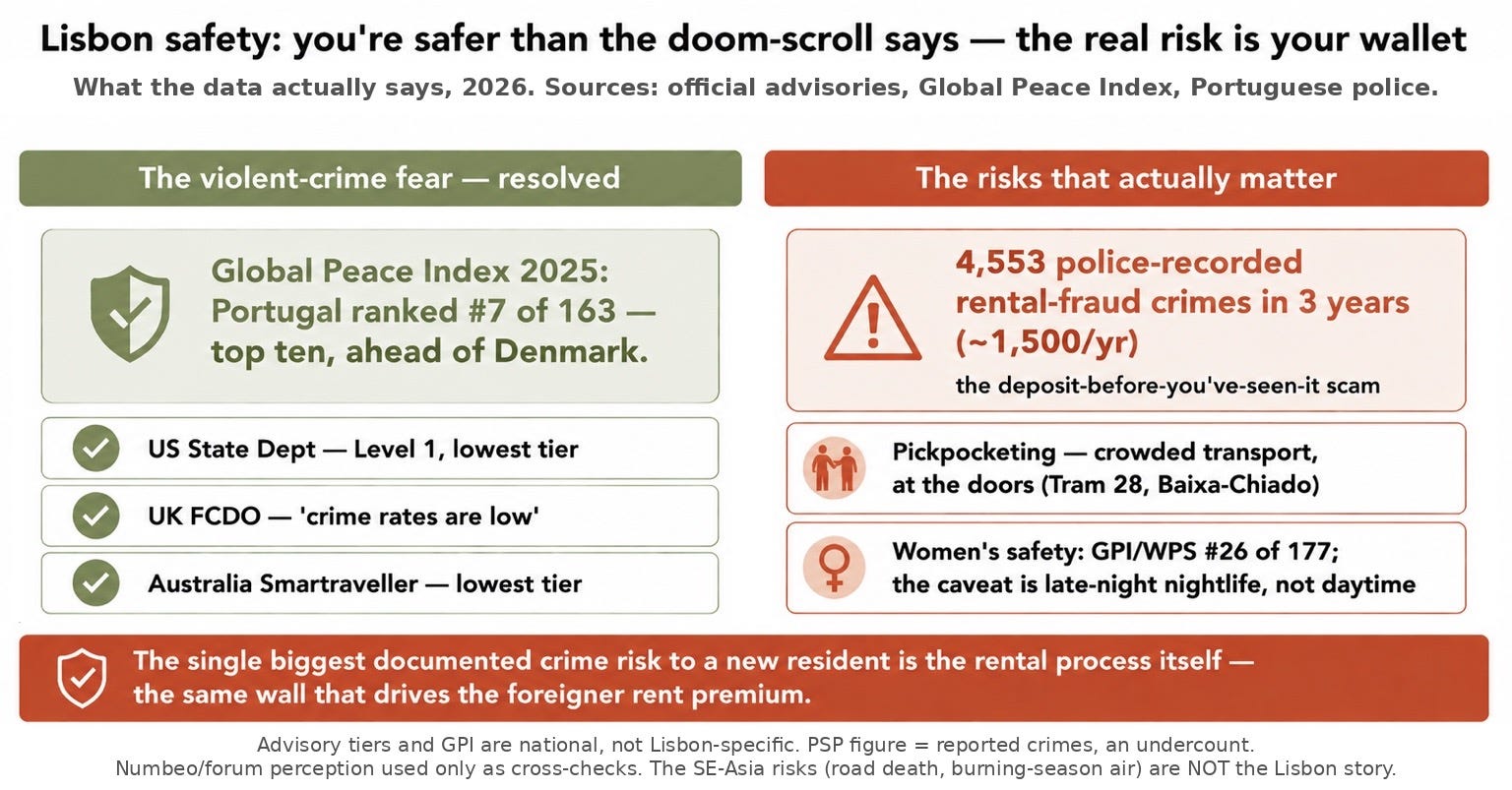
A women’s-safety read, because it’s a real decision input and this brand is women-led: the picture is reassuring on the macro and carries the standard European nightlife caveat. Portugal ranks 26th of 177 on Georgetown’s Women, Peace and Security Index (upper band). The official advisories note sexual assault is “rare but does occur,” concentrated late at night around nightlife areas (Bairro Alto, Cais do Sodré), paired with drink-spiking precautions. Daytime Lisbon reads as a walkable, low-anxiety city; the caveat is the night-out one, not a structural daytime threat.
(What I deliberately didn’t import: the Southeast-Asia risk frame. Road death and burning-season air pollution were real, sourced lines in my Da Nang and Bangkok teardowns. They are not the Lisbon story, so I’m not going to manufacture them. Lisbon’s one environmental footnote is summer heat and wildfire smoke in the interior, real but not a chronic city-air problem.)
Safety is the reassuring half. The visa and tax rules are where the move really gets decided, and the first question is whether you can even qualify.
2. The visa routes — D7, D8, and the income bar
⚠️ This section is sourced to official Portuguese government portals and dated. Visa and tax rules change: use the live official link, not this paragraph, as your authority. This is analysis, not advice.
If you’re not an EU citizen, two residence routes dominate, and the difference between them is income type:
The D7: the original “passive income / stable means” route, used by retirees and anyone with reliable recurring income. The income floor is benchmarked to the Portuguese minimum wage (€920/month for one person, with the usual per-capita additions for dependants).
The D8, the Digital Nomad Visa (launched Oct 2022): the route for remote workers earning from outside Portugal.
Here’s the bar most people underestimate, so be precise about it: the D8 requires you to prove an average monthly income, over the previous three months, of at least four times the Portuguese minimum wage. That multiplier isn’t consular folklore; it’s written into the law, in plain words: “rendimentos médios mensais… de valor mínimo equivalente a quatro remunerações mínimas mensais garantidas” (Decreto Regulamentar n.º 4/2022, Art. 31.º-A). With the minimum wage at €920 for 2026, four times it works out to about €3,680/month (≈$4,306), and note that’s a computed figure, not a number the statute fixes: the law pegs the bar to the minimum wage, so it rises every time the wage does. Either way it’s roughly a $52,000/year income floor just to qualify, before you’ve paid a euro of Lisbon rent. The popular framing of the D8 as the easy “just work remotely from a café” visa quietly skips how high that threshold sits. Two practical caveats the brochures skip: first, treat €3,680 as a floor, not a target: consulates apply their own discretion (some count base salary only, discounting variable or freelance income), so practitioners commonly advise showing a comfortable margin above it, nearer €4,000 in practice. Second, the documentary specifics (which three months, how income is evidenced) vary by the consulate handling your file, so confirm those with yours.
You can clear that income bar with the right paperwork. The harder question is what Portugal does to that income once you’re a resident: the famous tax deal that made it a remote-work magnet for a decade is no longer open to new arrivals, and what replaced it is far narrower than the brochures admit. That’s the part that decides whether the move works, and it’s below:
The tax bombshell — the break that’s closed to new arrivals, and the narrow successor that replaced it.
AIMA — the permit bureaucracy, with a hard number attached.
Healthcare — the public system you can use as a resident, and where private insurance earns its keep.
Where you’d eat — 10 resident spots, and the tourist trap to skip.
The verdict — who should move, and who shouldn’t.
