

Here is the number that reorganized how I think about Seoul, and it isn’t a rent. To sign a standard lease on a normal Seoul apartment, the landlord may ask you for a deposit somewhere between one hundred and five hundred million won — very roughly US$66,000 to US$330,000, handed over as a single lump sum, in cash, for a home you will never own. And in return, you pay little or no monthly rent at all.
I had to sit with that one. Across the cities I’ve priced in this series, the move-in cash has been a month or three of rent — Bangkok’s three-months-upfront, the kind of number you can save toward. Seoul plays a different game entirely. Here the entry fee can be a house deposit’s worth of capital, and the monthly figure everyone quotes you — the “$1,200 for a studio” you’ll read on the foreigner forums — is almost a distraction. The cost of Seoul isn’t the rent. It’s the capital you have to be able to park. And that single structural fact decides something the English-language internet barely mentions: it decides whether the cheapest way to live in this city is even available to you.
Because here’s the part that stopped me. The system I just described — a giant deposit, near-zero rent — is the cheap option for a Korean tenant. It’s called jeonse, and it has no clean Western analog. And most foreigners can’t use it. So the question Seoul poses isn’t “can I afford the rent?” It’s “can I get to the cheap door, and if I can’t, how much does the door I’m left with cost?” How that works, and what the door you’re left with costs, is the spine of this whole teardown.
First, the part where I tell you how I know. I was in Seoul in 2025, recently enough to trust myself on the shape of the city: how the subway stitches the whole place together, the way Hongdae and Gangnam can feel like two different cities on the same line, how a convenience store anchors what feels like every corner. What I don’t trust, not from a year-old visit, is what any of it costs in 2026 — Seoul’s housing market and the won both move enough that pricing the city from an impression is just a confident way of being wrong. So I rebuilt the number the way I build every city in this series: from the Korean-language rental platforms and the national housing statistics residents actually use, the monthly jeonse-and-wolse series filed from real transactions, the listing apps, the conversion rates the banks quote, then set against the English-language foreigner-facing sites to size the gap. The deposit story isn’t a feeling I brought home; it’s what the Korean-language numbers say plainly and the English ones round off. That cross-check is the moat, and it’s why Seoul earned a two-part teardown: this Saturday is the cost layer (the real numbers), and next Wednesday is the decision layer: safety, healthcare, the visa landscape, and the honest verdict. Today is the free preview of both. (Seoul’s on the page this month because a reader asked for it — you know who you are.)
Is Seoul even your city?
Already have Seoul circled? Skip ahead to the puzzle of the rent that isn’t rent.
Seoul is, by a distance, one of the most functional big cities a foreigner can land in, and in 2026 it’s more accessible than it’s ever been, for one specific reason I’ll get to. The honest pitch: a subway system that quietly shames most of the world, fast cheap internet as a birthright, a health system that’s excellent and genuinely affordable to use, food culture with extraordinary range and depth, and a level of day-to-day safety that reads as almost unreal to anyone coming from a large Western city. The trade-offs are just as real: a deposit system built for people with Korean capital and Korean credit, winters that bite and a heating bill to match, spring air that turns genuinely hazardous on the bad weeks, a work-and-status culture that can feel airless, and a language barrier that’s steeper than the K-content makes it look. Who thrives here: remote workers and professionals with enough savings to clear the deposit wall, who want a world-class city’s infrastructure and will meet the language halfway. Who should look elsewhere: anyone arriving with thin capital who needs a low-friction move-in, or who wants year-round clean air and a slow pace.
If you want the lived-in version — what it’s like to build a life there — that’s the part the AWA site does better than I can. The beginner’s guide to living in Seoul covers the texture from someone who did it; and if you’re still deciding which Korean city, the best places to live in South Korea weighs Seoul against Busan, Jeonju, and the rest. This post is the numbers.
The rent that isn’t rent, and why you can’t have it
Back to the puzzle. A landlord hands you the keys, you hand them two or three hundred thousand dollars, and they charge you nothing monthly. Before I give you the mechanism, try it yourself: how does that arrangement make money for the landlord? Nobody in this chain is a charity, and nobody is being defrauded. The answer is dull, financial, and sitting in plain sight.
Your deposit is a loan. An interest-free loan, from you to your landlord, for the length of the lease, and at the end, you get every won of it back. What the landlord does in the meantime is the rent: they park your hundreds of thousands in interest, or roll it into the deposit on a property of their own, or leverage it into the next purchase. Your rent is the interest you forgo by handing over the lump sum instead of keeping it invested. That’s jeonse, and for a Korean tenant with savings or access to a state-backed jeonse loan, it’s the cheapest housing in the city, because forgone interest costs you less than a year of monthly rent would. There’s no Western equivalent, which is exactly why English-language guides skip past it to the monthly number they can recognize.
Now the second turn, the one that decides your actual budget. To do jeonse you need the lump sum, or a Korean bank’s jeonse loan, which generally wants the credit history, the visa stability, and often the guarantor that a newly-arrived foreigner simply doesn’t have yet. So most foreigners are quietly routed to the other product: wolse, a monthly-rent lease with a smaller, but still serious, deposit, often the equivalent of ten thousand dollars or more. And the less deposit you can put down, the more monthly rent you pay, on a fixed conversion the whole market runs on. Nobody’s ripping you off. The cheapest door in Seoul is just one most foreigners can’t open in year one, and the cost of the door you’re left with is the real subject of Saturday’s post. The exact deposits, the conversion math, the table by district — that’s the cost layer.
One neighborhood, if you take nothing else from today: Mapo
If I were moving to Seoul on a remote income, I’d start my search in Mapo-gu — the western swathe that holds Hongdae, Yeonnam-dong, and Mangwon, threaded by Line 2 and the airport line. It’s the part of Seoul that reads as livable rather than corporate: low-rise side streets, the densest independent-café-and-restaurant culture in the city, a young creative population, and walkable in a way the big Gangnam grid isn’t. It’s not the cheapest district and it’s not the priciest; it’s the one where the most “I could picture my life here” version of Seoul is available without paying the Gangnam premium for an address. The exact deposit-and-rent band for a Mapo studio is Saturday’s, but it’s the anchor I’d build a budget around.
Is Seoul safe? Almost unnervingly so, and that’s not the risk to watch
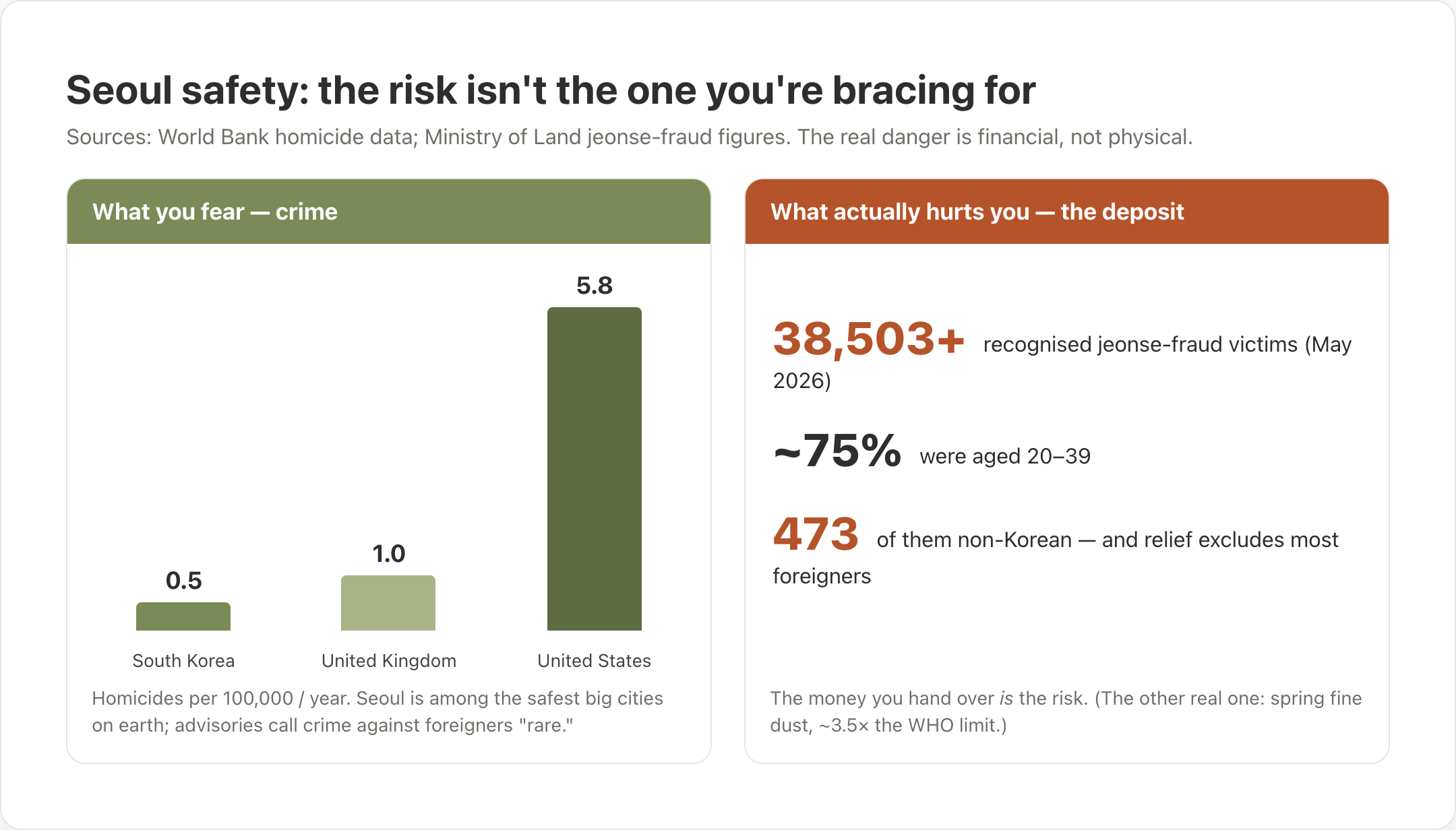
This is Part 2’s territory, but the headline belongs in the free post because it inverts the whole genre. Seoul is one of the safest large cities on earth. South Korea’s homicide rate is around 0.5 per 100,000 people a year, roughly a tenth of the United States’, and the lived expression of that is a city where people leave laptops on café tables to hold a seat and where a woman walking home alone at 3 a.m. is an ordinary, unremarkable thing. On violent crime, the thing you’re bracing for, Seoul will likely be safer than wherever you’re reading this.
The risk that matters to a resident is the one this whole post has been circling: the deposit. Korea spent 2022 through 2025 working through a wave of jeonse fraud — landlords taking deposits they could not return, leaving mostly-young tenants out their entire life savings, at a scale serious enough to force new tenant-protection law. The money you hand over is the risk in Seoul, which is a stranger kind of danger than a pickpocket and a far more expensive one. (The other real one is the air — Seoul’s spring fine-dust season is a genuine health line, with numbers, not a vibe.) Part 2 puts the protection mechanics and the real figures on all of it.
The visa that quietly opened the door, and the clock hiding inside it
For years, living in Seoul without a Korean employer or a Korean spouse meant a student visa or a gray-zone shuffle. That changed at the start of 2024, when Korea launched a proper digital-nomad (”workation”) visa for remote workers employed by a company outside Korea — a real, legal year-plus basis to live here on foreign income. What Part 2 adds is the strategic layer the how-to guides skip, including the clock inside the good news: spend enough days here and Korea’s tax system starts to take an interest in your income, and the visa that invites you to stay a year interacts with that threshold in a way almost nobody mentions. The numbers, the income bar, and the honest “who is this actually for” are next Wednesday.
Saturday, then Wednesday.
This Saturday — Part 1, the cost layer: the real jeonse-versus-wolse math, the deposit-and-rent table by district, the line-by-line ~$1,450 monthly budget, the move-in-cash reality that breaks every other city in this series, the first cross-city comparison placing Seoul against Taipei, Bangkok, Da Nang, and Lisbon, and a daily-living finding I didn’t expect, because the place the cost bites isn’t the rent or the subway. It’s closer to your dinner plate, and it has to do with how much an apple costs.
Next Wednesday — Part 2, the decision layer: the full safety breakdown (including the protection steps that would have saved the fraud victims), the national-health-insurance math in real numbers — including the bill foreigners are now required to pay — the complete visa menu and the tax-residency clock inside it, where residents actually eat once you get past the tourist districts, and the honest verdict: who should choose Seoul over Taipei or Tokyo or Bangkok, knowing what the deposit asks of you.
Seoul isn’t the cheapest city in this series, and it isn’t the most expensive. It’s the one where the sticker price and the real cost are the furthest apart, and closing that gap is the most useful thing I can do for anyone deciding on it. This Saturday and next Wednesday are where I do it in full.
If you’ve lived in Seoul and cleared the deposit wall some way I haven’t described, or you’ve watched a jeonse deal go wrong — reply and tell me. The readers who live these cities are always my best fact-checkers.
A note on format, since the regulars will spot it: I write these free previews as a staged reveal — the surprise up front, the mechanism held back like a puzzle, and keep the paid teardowns played straight. Reply and tell me whether it landed. That’s a vote I’ll actually count.
— Wei
You've put your finger on exactly what these are about, Erica. The structural systems stay invisible precisely because locals navigate them on autopilot. Jeonse is just "how renting works" to a Korean, and alien to everyone else. That gap is the whole reason I write these.
This was fascinating. I had heard of the jeonse system before, but I'd never seen it explained in a way that made the economic trade-offs so clear. It also highlights something I think about often when I travel that the biggest barriers to living somewhere aren't always the obvious monthly costs, but the structural systems that locals navigate almost without thinking.