

If you read Wednesday’s free post, you saw the headline: Taipei can still be a comfortable US$1,100–1,400/month city for a single resident, depending mostly on rent choice.
This is the paid layer — the district-level math underneath that number.
Most readers who write in about Taipei are choosing between staying somewhere familiar and getting on a plane. I’ve been to Taipei multiple times — long enough to know which neighborhoods English content gets wrong, and where the generic guides point the wrong way. The five districts below are the ones where my lived experience and the 591 listings line up.
I pulled 591.com.tw rental listings across five Taipei City districts, excluded misleading stock (social housing, rooftop add-ons, lofts, oversized “studios”), then normalized the remaining units by 坪 — the local unit that actually makes Taipei rent comparable. I pulled current transit, utility, internet, mobile, and NHI figures directly from official Taiwan sources (Taipower, Metro Taipei, Chunghwa Telecom, the National Health Insurance Administration). I cross-checked Chinese-language local recommendation sources against Taiwanese blogs to find the twelve places Taipei residents actually send friends to. Then I assembled all of it into one worked monthly budget for a realistic single-resident expat.
The result is more specific than “Taipei is cheap” and more useful than Numbeo’s city-center average: where the Da’an premium is real, where it’s overstated, why Xinyi’s median is misleading, and what a comfortable month actually costs once rent, food, transport, healthcare, and daily living are all counted.
This is the first Taipei deep-dive. A later Taipei post will cover the remaining districts and the New Taipei affordable-alternative tier; this one focuses on the five districts most likely to matter for a first move. The promise is cumulative depth: each paid post becomes a layer in a growing comparison file, and each refresh makes the earlier work more useful. The full roadmap sits at the end.
A note on currency: NT$31.50 ≈ US$1 as of publish day; I’ll refresh the conversions when the rate shifts more than 5%.
1. The methodology (and why it matters)
The dominant English source for Asian cost-of-living is Numbeo. Numbeo’s “rent in city center” for Taipei is an aggregation of unverified user submissions, often two or three years out of date, with no methodology disclosed. That figure ends up cited in every “moving to Taipei” guide on the internet. It often describes nothing well for the decision you’re actually trying to make.
Here’s what I did instead:
· Rent data: pulled directly from 591.com.tw — Taiwan’s primary rental platform — across five Taipei City districts. I captured both promoted-card listings (which lean toward agent-paid placement and newer stock) and the regular listings grid (closer to real market mix). I excluded social housing (社宅 / shèzhái — allocation-gated, not market-rate), rooftop add-ons (頂加 / dǐngjiā — unpermitted construction, priced as their own sub-market), lofts (樓中樓 / lóuzhōnglóu — different unit type, often mislabeled as a standard studio), and oversized units mismarketed as studios. After exclusions, I worked in rent per 坪 (the local unit, 1 坪 ≈ 3.3 m²) — normalizing for unit size gives a cleaner comparator than raw rent.
· Transit and utilities: pulled from Taipower’s official rate schedule (effective October 1, 2025), Taipei Metro’s published Frequent Passenger Program (updated January 2026), YouBike Taipei’s rate page, and Chunghwa Telecom’s consumer landing page.
· Healthcare: National Health Insurance Administration’s English eligibility and copayment pages, cross-checked against the supplementary premium rules.
· Restaurants: Chinese-language local recommendation sources, cross-verified against Taiwanese blogs (PIXNET, 食尚玩家 / Shi Shang Wan Jia — “Trendy Travel & Food,” 窩客島 / WalkerLand). I prioritized spots where local users say “從小吃到大” (eaten here since childhood) or “我每周都去” (I go every week) — not places where tourist listicles cluster.
Every figure below traces to a specific source. Where I’m uncertain, I flag it.
The advantage here is bilingual sourcing. English guides rarely surface the listing details that change the headline number — like whether utilities are bundled in, or whether you’re looking at a legal building. A few Chinese rental terms with no clean English equivalent: 含水電 (utilities included), 頂加 (unpermitted rooftop add-on — cheaper but legally precarious), and 限女性 (women-only listings — a real category, typically NT$3-5k below comparable units). This post does the cross-walk so you don’t have to.
A note on units. Taiwan apartments are advertised in 坪 (ping), the local unit of floor area. One 坪 ≈ 36 sq ft (3.3 m²). Throughout this post I’ll use sq ft as primary, with 坪 in parentheses for context on first mention per district. Quick mental conversions for studios: 6 坪 ≈ 215 sq ft (compact studio), 8 坪 ≈ 285 sq ft (standard), 10 坪 ≈ 355 sq ft (generous), 15 坪 ≈ 535 sq ft (1-BR territory).
2. The headline: typical studio rent across five districts
Here’s the single most useful chart in this post. Five Taipei City districts, median rent for a typical self-contained studio (套房 / tàofáng — studio with private bathroom):
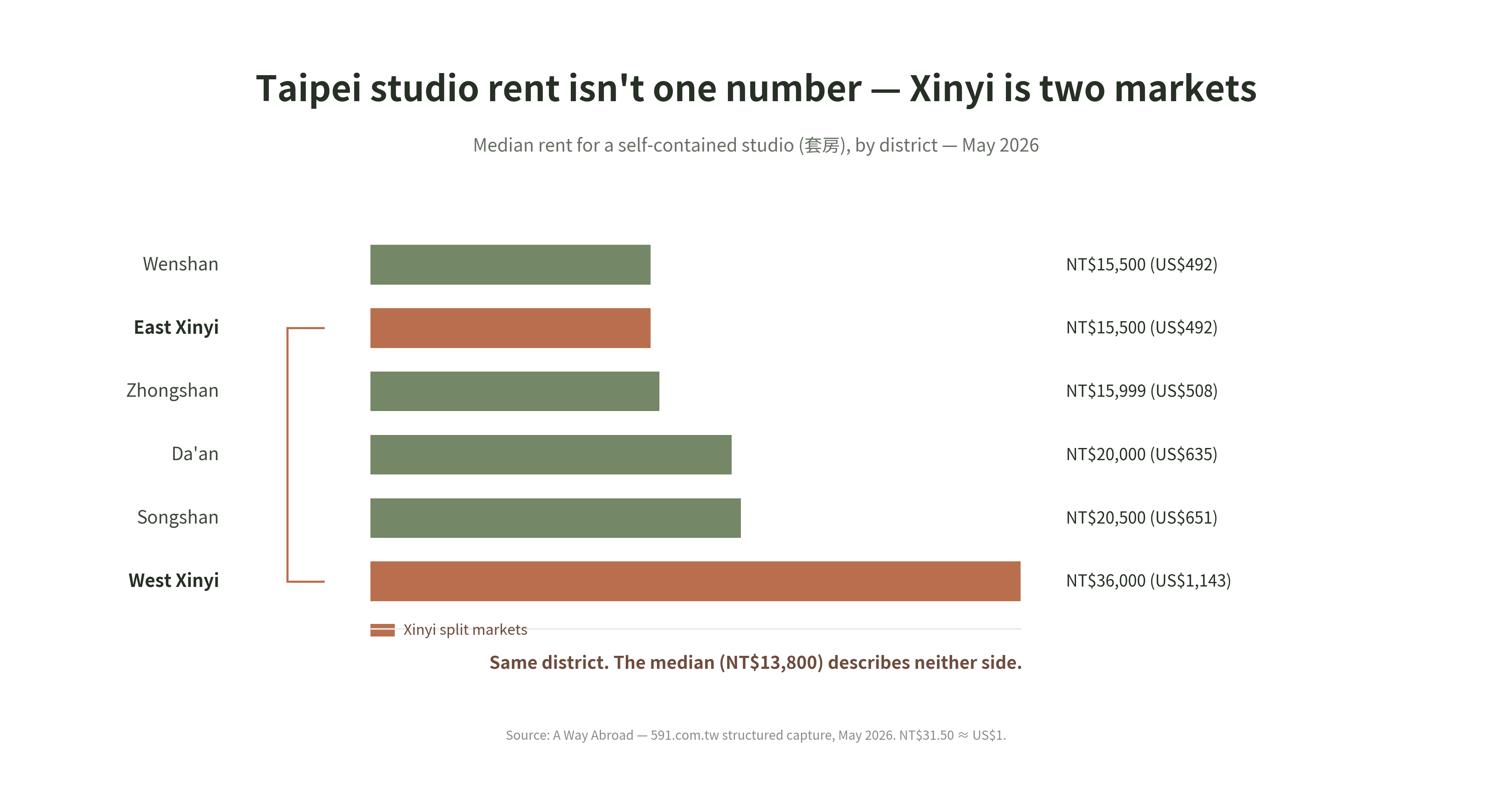
Da’an is only about 30% pricier than Wenshan at the median — not the 2× premium English content implies. A typical small studio runs roughly NT$15,500 / $490 in Wenshan and NT$20,000 / $632 in Da’an. Meaningful, but a ~$140/month difference. The Da’an “expensive Taipei” reputation only kicks in at the top end: a nice renovated 8 坪 (~285 sq ft) studio in Da’an can run NT$30,000+ / $950+, while Wenshan caps closer to NT$20,000 / $632. Even when you normalize for unit size — comparing $/sq ft, not $/month — the spread across all five districts stays under 20%.
If you’re choosing a neighborhood inside Taipei City, the right question is rarely “can I afford Da’an?” It’s “which of these five gives me the right MRT line, building age, and noise profile?” — because the rent gap is small compared to a 20-minute longer commute or a 5-floor walk-up versus a building with an elevator.
