

A quick note before we start on Tokyo: from this week it's one post a week, with the free preview and the paid research in a single article instead of split across multiple sends. Each city arrives whole, in one place, and your inbox gets one email instead of three. The format is better this way.
A comfortable single month in Tokyo costs about ¥204,100, or US$1,276. Taipei is near US$1,175 and Bangkok US$1,600, so Tokyo lands between them rather than winning a cheapest-city title the data does not support. The harder number is the arrival bill: a normal ¥85,000 apartment can require about ¥429,000 before move-in, roughly five months of rent and only partly recoverable. That is the useful contradiction: Tokyo can be reasonable to live in on foreign income and punishing to enter on a standard lease.
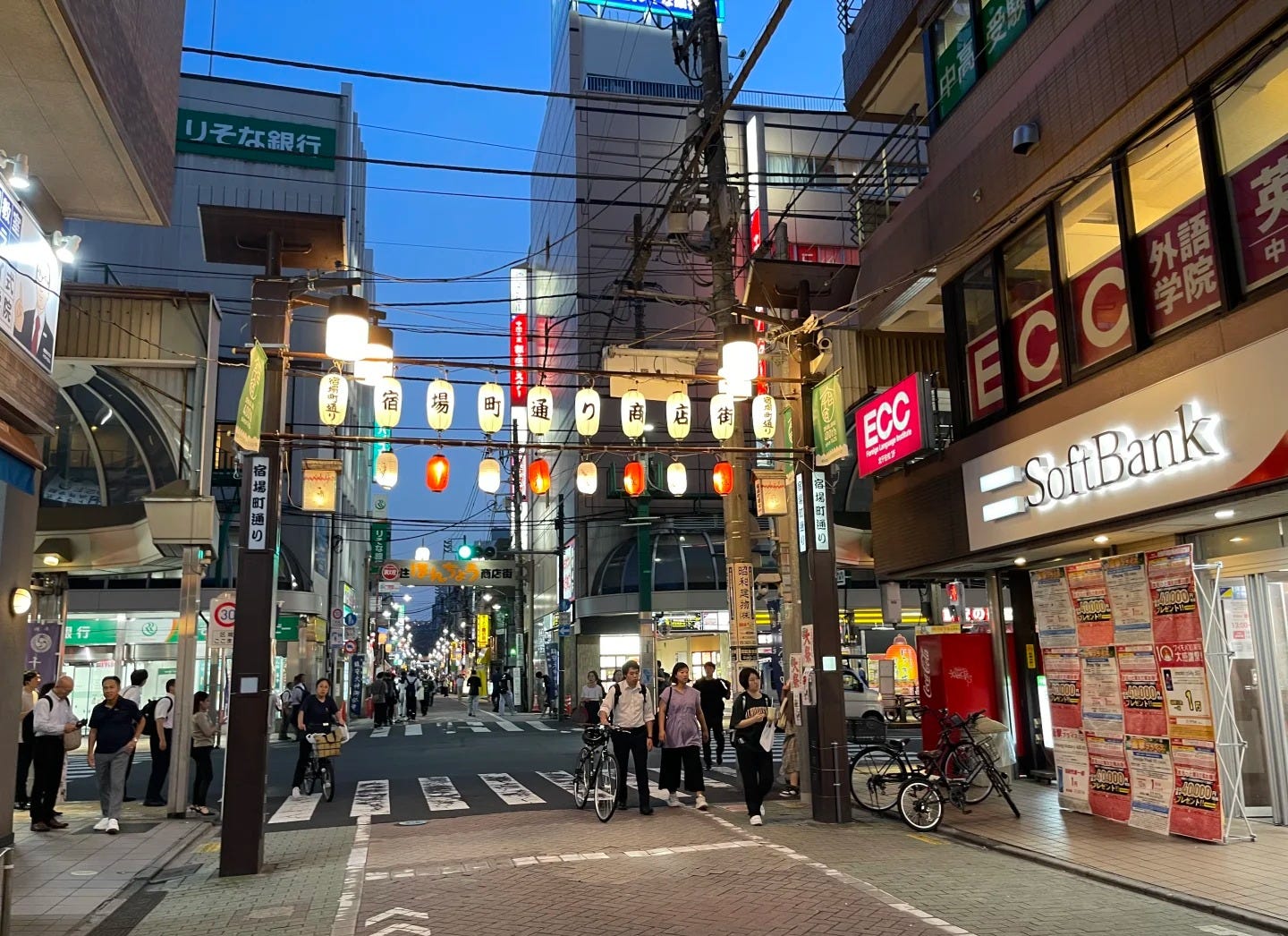
Tokyo offers exceptional safety, high quality of life, and a strong job market. It excels in safety and infrastructure but can be difficult for expats to fully integrate due to language barriers, cultural nuances, and a demanding work culture. The Japanese capital has high scores on healthcare, affordability and work-life infrastructure.
For Tokyo expats, the cost of living is moderate to high. Since space is limited but demand is high, monthly rent for an apartment or house can cost thousands of dollars. Rent is expensive, so it is important to budget carefully and have money saved before moving.
Some apartments, especially for singletons, can be as small as 10 square meters. Despite how pricey housing can be in Tokyo, things like healthcare and groceries are relatively affordable, helping to offset the cost of living. Tokyo consists of 23 wards and people tend to reside wherever makes their commute to work the easiest.
This means taking into consideration how crowded trains are during rush hour, the commute time, and the number of transfers. Living inside the 23 wards in Tokyo can be expensive, though, especially along the JR Yamanote Line, the most often-used train line that circles the inner part of the city.
Is Tokyo even your city?
Most expats come to Japan on a working status, which is sponsored by their employer. Some also come to Japan on a spousal visa or a dependent visa. There are visas for specific purposes such as research, cultural activities, or skilled labor as well.
The JET Program is a Japan Exchange and teaching program. One caveat to working in Japan, however, is that the older you are, the harder it can be to find a job. While Japanese culture can be super different than what most are used to, the work-life balance is one of the biggest culture shocks I’ve noticed that foreigners face when moving to Tokyo for work. Depending on what you’re studying at university, you may be required to already speak Japanese as a pre-req for the visa. Japan attracts people from all over the world to live and work in its unique culture but with its strict visa laws, it can be a difficult path.
The Employment Service Center for Foreigners in Tokyo, Osaka and Nagoya, and HelloWork (similar to Centrelink in Australia) provide assistance to job-seekers in Japan. While Japan is one of the friendliest and safest countries to travel, navigating the job and work formalities when you don’t speak the language can be tricky. It is complex to navigate but deeply rewarding for those who make the commitment.
This paired with Tokyo being a major tourist destination is why it’s easier for people who can’t speak Japanese to live in Tokyo. Universities such as the University of Tokyo, Waseda, and Keio also have strong international divisions and focus on providing several classes in English. There’s also lots of helpful information about living in Japan in various languages online. This is why it is important to learn some Japanese before moving to the country.
It’s important to have a level of understanding about a city’s cost of living before moving, to reduce the chances of any unwanted surprises. Book at least the first two weeks in a hostel or Airbnb to give yourself time to look for a share-house calmly. Most people who move to Tokyo start with temporary housing such as a long-term hotel or Airbnb.
Tokyo fits the foreign earner who accepts a compact home in exchange for dense transit, services and urban choice; it fits less well when space, mild summers or effortless permanent residence are non-negotiable.
That makes the decision more specific than a generic pros-and-cons list: if your income is not in Japanese Yen you will benefit from the weak yen. You’ll need enough liquid cash to cross the lease wall, a visa that matches the intended length of stay, and a willingness to trade domestic space for an unusually functional city outside the front door.
Expats in Tokyo typically work as English teachers, professors at universities, teachers at international schools, engineers, IT professionals, interpreters or translators, as well as staff in the tourism or service industries. Those with high Japanese language skills have plenty of other job opportunities available to them but the options above are most common for those that only speak English or are native English speakers. The work culture can also be hard for expats due to cultural differences and language barriers.
There is a tendency for people to work long hours due to demanding schedules, sometimes even sleeping at the office. This leads to poor work-life balance and is one key reason why people don’t want or can’t have families. The good news is that this practice is slowly changing and more companies are starting to prioritize the well-being of their employees.
Other industries will have a need for foreign employees, especially at international companies that have offices throughout Japan, but the most common way to work in Japan is by teaching English, either at a public school, private school, or university. By opting for a work visa, your employer should handle the visa application for you; you need to provide the paperwork they ask for and meet the requirements set by immigration and the Japanese government. If you plan to live in Japan on a work visa, you may also get benefits such as local health insurance, help with a local bank account, paid travel expenses to Japan and, in some cases, an apartment included in your contract.
There are two options where you can work as an English Teacher in Japan: teaching at public schools as an Assistant Language Teacher or at private schools, or Eikawa, as the main English Teacher. Many of these job platforms mention that they are hiring within Japan only but if you keep looking you will find some that hire from abroad and sponsor your work visa, too. If you dream of living in big cities, like Tokyo or Osaka, you will be able to find some jobs but those are usually very competitive and the cost of living is much higher than in the countryside.
There are also plenty of job opportunities in less well-known places in Japan and they offer much more affordable living costs. Language Exchanges: Most cities in Japan will have a Language Exchange event setup that you can find on Facebook. Hello Talk App: a language exchange app, you can meet Japanese people who want to learn English. However, the language barrier can be significant for non-Japanese speakers. While the language barrier can be challenging, many expats value Japan’s reliability, healthcare quality, and overall stability. Japan offers a vibrant culture, strong job markets in technology, engineering, and teaching English, and a high standard of living.
Unlike other cities in Japan, many signs and menus in Tokyo are in English. In this day and age, translation apps like Google Translate are very useful when it comes to understanding text on a package or communicating with someone. However, despite this, the language barrier can prove to be difficult for some people. Having a strong grasp of the language can help significantly when it comes to job opportunities as well as adapting to everyday life in Japan and making local friends.
The city is home to many events and festivals as well as world-famous theme parks like Tokyo DisneySea and Sanrio Puroland. You can never run out of things to do.
How the weak yen changes the foreign-income calculation
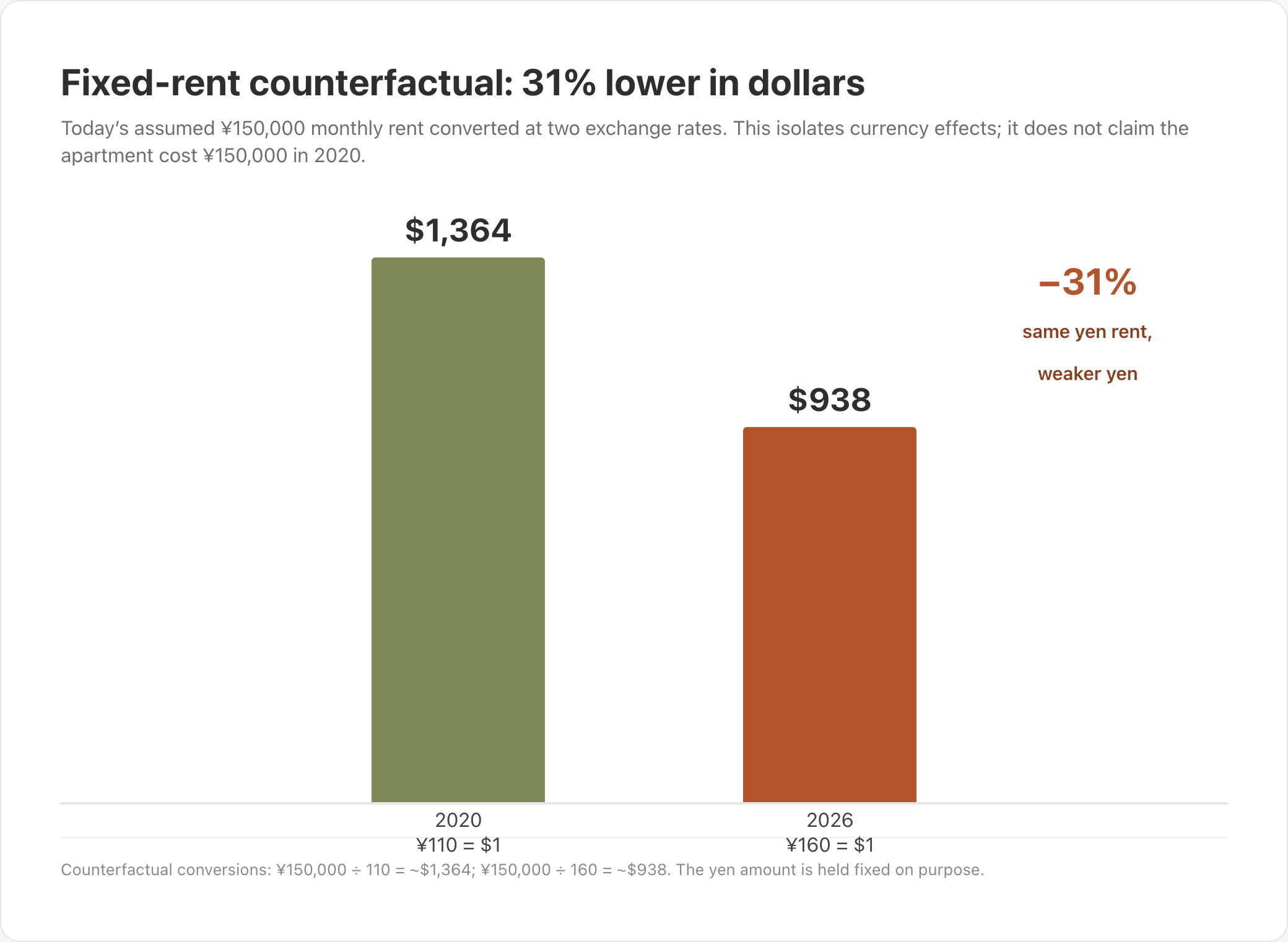
At ¥110 to the dollar, a ¥150,000 apartment cost about US$1,364; at ¥160 it costs about US$938, a 31% dollar discount without any reduction in the yen rent. This is not a claim that Tokyo became cheaper for people earning yen; it is a purchasing-power change for readers paid in stronger foreign currencies.
It is also vital to set a realistic budget and moving timeline. From visa application fees and legal and advisory fees, to shipping and relocation services and accommodation deposits, the price of moving abroad can add up quickly, so budgeting is essential. Don’t forget to plan for initial expenses, like visa application fees and housing deposits.
Homes are small: If you like spacious accommodation, Japan may not be the best place for you. In a country where space is limited, houses and apartments are designed to take up as little space as possible.
For a first search, Nakano remains the practical anchor: the research puts a comfortable one-room unit in the high ¥70,000s to ¥80,000s, with fast access to Shinjuku and a less performative residential feel. The safety case is strong, but the risk analysis cannot stop at street crime because seismic exposure affects the building, construction year and emergency plan a renter should choose.
You may encounter cultural differences as a foreigner, but generally the local people are polite, respectful, and welcoming. Learning the language and getting involved in hobby-based groups such as music, dance, tech, or sports clubs can help bridge cultural gaps and foster genuine friendships. As an expat, understanding the cultural and social etiquette of your new home is important so you don’t commit a grievous faux pas.
Healthcare is another qualified advantage: card-bearing residents generally enter Japan’s public insurance system, while the six-month Digital Nomad status has no residence card and requires private cover.
Immigration laws can change, so it’s crucial to stay updated by regularly checking reliable sources like government websites, news outlets, and legal resources. Moving to Japan is a dream for many but before you get your heart set on living here, know that getting a visa can be challenging or stricter than other countries. Luckily, there are a few great options for long-term visas in Japan. The level of difficulty to get a work visa in Japan will greatly depend on the type of job you’re looking for.
Behind the paywall, the argument is tested against the resident rental market, the complete move-in stack, a line-item budget, healthcare, safety, visa status, tax residence and the four-city comparison.
