

Last week I broke down the general pros and cons to both working abroad in-person and online.
Missed it? Read it now before it hits the archives.
Today, I want to dive a little deeper into working online. I’ll cover a lot of the good stuff, like:
Getting a remote job
Remote job red flags
Your options to live abroad
More interested in working in-person? I’ll cover that one next week.
Now, for working remotely. I made the switch to working from my computer back in 2019 and since then I’ve taught English online, worked as a freelancer, ran my own websites (obviously), and in 2022 started working full-time as a digital marketing manager.
I say this for 2 reasons:
To build credibility if you’re new around here 😉
To show you that it can take stepping stones to get where you want to go (but more on this specific one later).
First up…
Some Ideas for Online Jobs
The good news is that most jobs can now be done remotely. Pretty much any office job can now be taken on the go, giving you a wider range of professions to choose from than ever before.
If you have work experience, I highly suggest you try to utilize that to transfer to remote work. Even if your current company doesn’t let you work online, if you spend most of your day in front of your computer screen, that means it can be done remotely. So instead of looking for a new industry, I suggest you look for new companies hiring.
If you're starting from scratch though, I suggest looking into:
Digital Marketing (my focus here, if you’re curious, is on organic search traffic but there are loads of focuses under this umbrella)
Content Creation (this article is a little outdated but the base steps should be the same, I just recommend topping off your research with something brand new as this world is constantly shifting)
Social Media Manager
This is by no way a totally inclusive list. There’s a lot more options - these are just the ones that I feel have the lowest threshold to enter. But, that said, they can also be the most saturated industries. In order to get a good job here, you’ll need to find a way to stand out from the crowd.
Gaining Experience
You may be wondering how I went from teaching 5 year olds English to working full-time as a digital marketing manager.
I gained experience.
For me, I didn't know what industry I wanted to work in. I only had skills that felt very "in-person" and really was at a loss as to how I could transition them.
Honestly, I was starting at zero. I didn't realize it at the time but by starting my own website, I was forced to learn a wide variety of skills (social media management, blog writing, SEO, project management, graphic design, digital marketing...). I actually started the site to keep me sane during an ankle operation but turns out, I loved it!
While I still do all of these on a daily basis to run AWA, SEO + digital marketing really clicked for me. After 2 years, I realized I had the skills people were looking for and even a tangible thing (the site) to show as proof I could do it.
Here's what this all means for you:
You don't need to be given an opportunity. You can create one. Maybe for you, you don't know where to begin and you'd like to cast a wide net like I did and see what sticks. Maybe you already know what it is but don't have the experience yet to sell it.
Create the experience.
This can be translated into any field - not just digital marketing.
You just might need to be a little creative with how you get there but you can get there. Stop waiting for the right opportunity to come along and make your own.
Remote Job Red Flags
Let’s say you have the skills needed and you’re ready to start applying to online jobs. There are some things you need to look out for if you plan on taking your job abroad:
That your boss is actually cool with you working from a different country. Some digital nomad visas will require a document stating you’re allowed to work from a different country.
That you don’t have to be on a certain timezone. Unless you plan to stay within your same timezone, it’s smart to know what hours you’re expected to work. For example, my team is all in the US but I’m allowed to work from anywhere, so long as we have a few hours overlap each day.
That you won’t be expected to be in-person anytime. Make sure office time isn’t “recommended” because that could easily mean that either A) that’s the real expectation or B) they hold in-person meetings from time-to-time that you’ll be expected to be part of.
That you still get holidays. This is something I wish I had checked a little closer when I started my job. I don’t even get Christmas Eve off? Sometimes, because you’re working for home, companies think that means you can work every day. Make sure they still respect your time off.
Your Options to Live Abroad
When working remotely, you have 2 main options:
Moving to 1 country on a digital nomad visa
Bouncing around as a digital nomad
Let’s talk about both so you can choose which lifestyle you’d prefer.
Moving to 1 Country
More often that not, in order to move to 1 country while working remotely, you’ll need to be on a digital nomad visa.
There are some loopholes to this - if you can get citizenship, are from the EU and want to live in the EU, or you move as a spouse and the country you choose let’s you work online (that’s how I’m able to do it from Italy).
But, I think for most, it’ll mean a digital nomad visa.
As of now, there are 47 countries that offer digital nomad visas (organized by region):
Albania
Belgium
Croatia
Cyprus
Czechia
Estonia
Germany
Greece
Hungary
Iceland
Italy
Latvia
Malta
Montenegro
Norway
Portugal
Romania
Spain
Türkiye
Anguilla*
Antigua & Barbuda*
Barbados
Bermuda
Cayman Islands*
Curaçao
Dominica
Montserrat
The Bahamas
Argentina
Belize
Brazil
Colombia
Costa Rica*
Ecuador
Mexico
Panama*
Uruguay
Georgia*
Japan
Malaysia
South Korea
Taiwan
UAE
Cape Verde
Mauritius
Namibia
Seychelles
One of these sound good? Dig into this mega guide so you can get the specifics. Each visa will have a different set of requirements, how to apply, and your benefits, so read carefully!
Digital Nomad Lifestyle
A big perk about working online is that you can really skip over the visas and simply bop around from country to country.
This is really, really fun for the right person and for the right amount of time.
Most digital nomads stay in a country for 1-3 months before heading off to the next one. For this lifestyle to really work, you'll need minimal stuff (packing up again and again and physically carrying it all around can get tiring), be pretty decent at planning, and incredibly flexible.
You’ll have to ditch the second screen and get pretty good at working where and when you can.
You’ll also likely pay Airbnb prices and depending on where you are, that can add up fast.
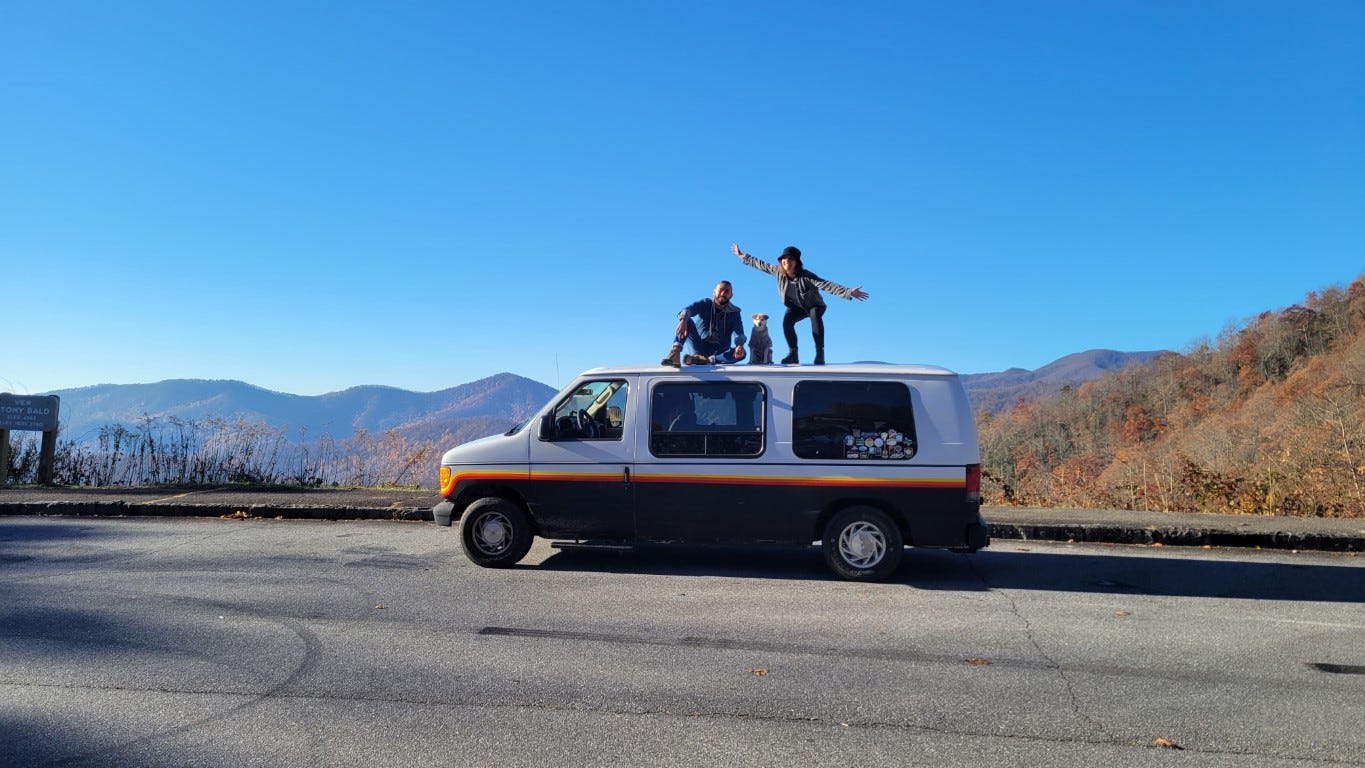
I’ve spent a couple of years as a digital nomad and man oh man did we have fun. This was somehow accomplished with a dog and a cat along for the ride. Trust me, pets are added hurdles but not impossible in this lifestyle.
There are days that I dream of getting back out there but I know that other than extended trips places, I think the constantly looking towards the next destination lost it’s charm a bit for me.
Plus, the cat and dog meant ground travel which is cool but did hinder my desire to just completely fuck off.
Just know that this lifestyle really falls into a legal grey zone. So long as you’re not making any money in the country (working with clients there) and not trying to stay long-term, you should fall between the cracks. I just wouldn’t rock up to immigration and state that you plan to work while in the country.
& that, my friend, is working online in a nutshell 👩💻
