

Part 1 left us examining two versions of life in Chiang Mai.
Life for a single adult in either version is very comfortable. One version is set at about US$870 a month, while the other, more catered to digital nomads, is set at about US$1,830 a month. A lot of that difference is up to you, how you choose to live, and what you consider convenient and accessible.
These two versions represent different ways of life in the same city. Comfort can look quite similar between the two lifestyles, whether that be from the grocery store to the rental market and even to what your daily life looks like. However, the ways to achieve that comfort can be completely different.
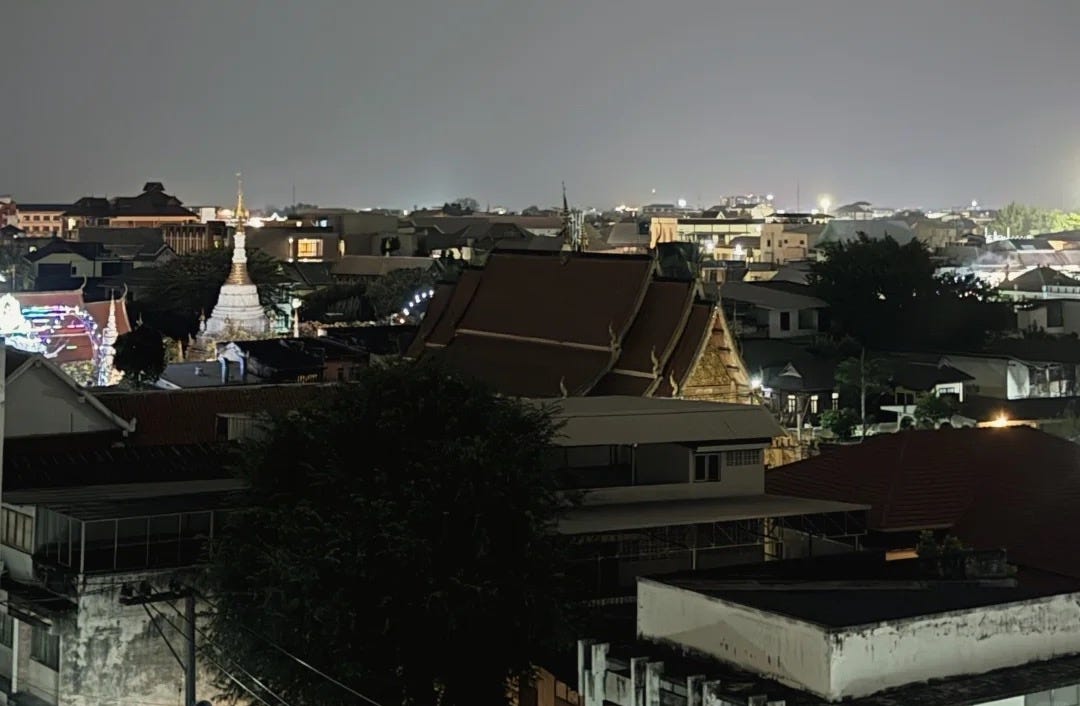
The lower cost of living in Chiang Mai made it tie for the lowest cost of living in this series (along with Da Nang) and has the lowest rent I have seen. However, budgets of this format won’t account for the true cost of living during burning season and completely miss the question of whether you are free to leave in March, what your options are in year 2, and what the law says. The cost of living needs to be considered on an annual basis.
The lower cost of living is a reality, so the rest of this post will focus on non-cost-related questions. What risks are you willing to take during burning season for safety concerning health care and living like a local by eating at local prices? What will the final guidance on your taxes and visa look like? I will describe the choice between the two costs of living in Chiang Mai, US$870 and US$1,830, and explain how each represents a different way to achieve comfort in this city.
Currency used throughout: ≈33.5 THB = US$1, current as of 17 July 2026. Rent and full monthly budgets are from Part 1.
1. March can price you out of town
For eight to ten weeks a year, roughly late February through April, Chiang Mai’s air quality can become among the worst on Earth.
This isn’t a small detail in the $870 lifestyle. During burning season, you have a real choice: leave town for a while, invest in air purifiers and masks, or try to cope as best you can until the rains arrive. Each option comes with its own costs and trade-offs.
That smoke comes from a mix of several sources. Farmers across northern Thailand and countries further upwind burn agricultural residue; there are forest fires; and Chiang Mai is closely ringed by mountains, so all that pollution collects in the city’s bowl under a temperature inversion. Think of a lid on the city.
Looking at peak days from 2026, Chiang Mai hit number one globally as the most polluted major city on Earth on one of the worst days. The fine-particulate (PM2.5) reading hit around 188 µg/m³. That’s an Air Quality Index score of 263. The WHO guideline for 24-hour exposure is 15 µg/m³. So “bad” was more than ten times the level the WHO considers safe to breathe for any 24-hour period, and we’re still talking about a single day’s reading. The episode didn’t last a day. The number was a peak inside a much longer season.
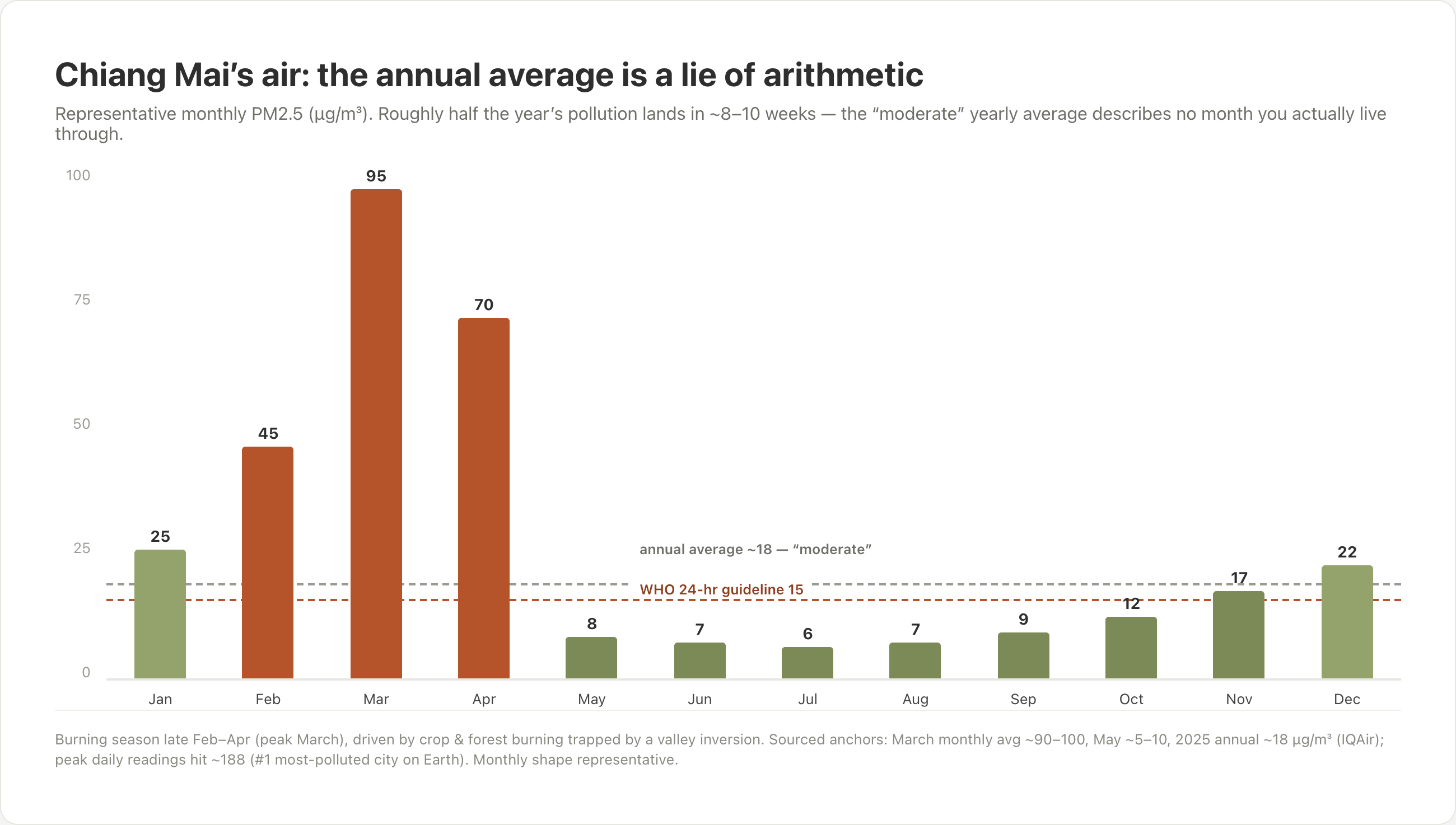
The annual average, shown at left, masks this season. Chiang Mai recorded roughly 18 µg/m³ in a recent year. Doesn’t sound too bad, right? Until you realize that number masks a month-by-month swing. Biomass burning contributes close to half of Chiang Mai’s annual PM2.5 pollution; in April it contributes more than 70 percent. Once May hits and the rains arrive, those figures plunge to 5–10 µg/m³. Near the WHO annual guideline and below its 24-hour guideline. Ten months are genuinely clean. Two are decidedly not. This is a seasonal exposure problem, not a stable yearly average.
That’s why the annual average doesn’t tell the full story. It smooths out the extremes—both the bad and the good. While Bangkok’s pollution is more constant, mostly due to traffic, Chiang Mai faces sharp seasonal spikes that can be much harder to manage.
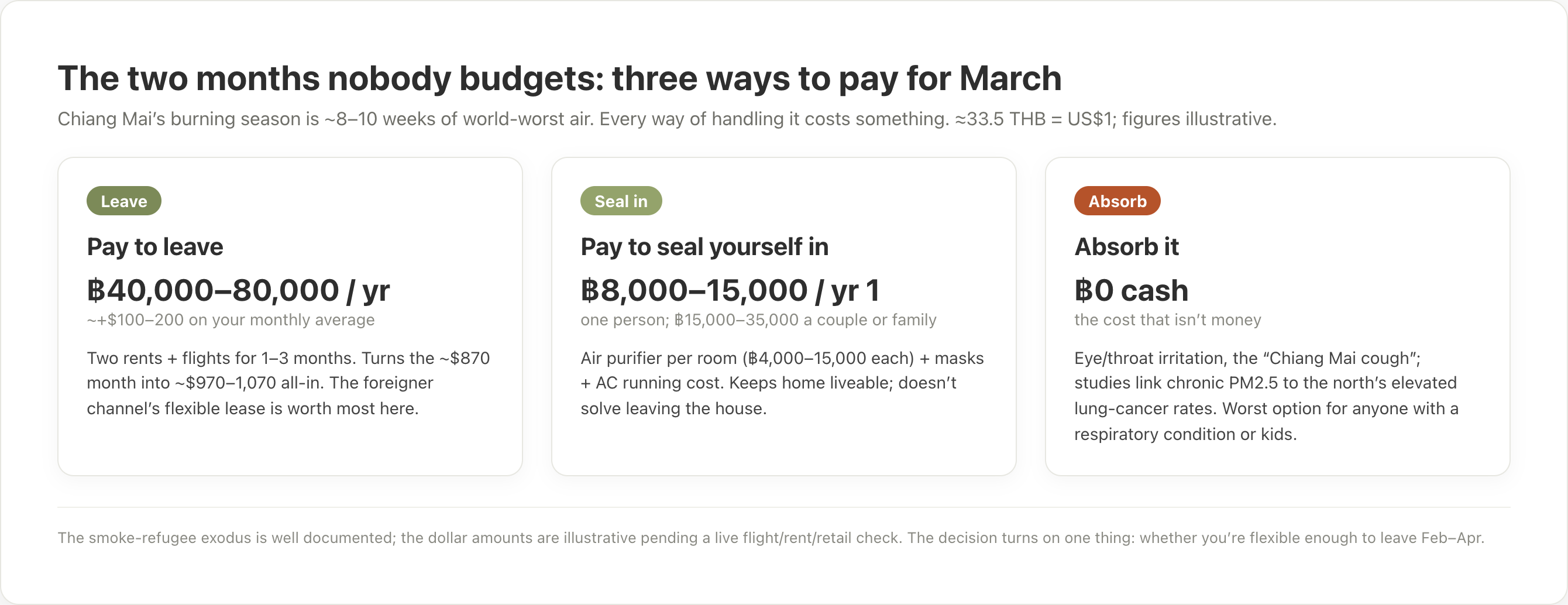
The chart turns the three responses into money: leave, filter the indoor air, or accept the exposure.
