

The last time I was in Lisbon I stopped at Fábrica Lisboa on Rua da Madalena around 9:30 in the morning. A pastel de nata and a cortado came to €3.20; locals were reading newspapers at the worn marble tables, the narrow street buzzing quietly with people heading to work, the sun catching the pastel façades just right. It’s the kind of morning that sells you on the city in about four minutes. It’s also, as it happens, in Baixa, the single most overpriced neighbourhood in Lisbon to actually live in. That gap, between what a morning in Lisbon feels like and what a month in it costs, is the whole reason I went and pulled the numbers.

Because what I don’t trust myself on, not for a second, is pricing this city from memory. A €3.20 coffee I can vouch for; the rent is a different matter. Lisbon’s rental market moves fast and it moves up, and quoting a 2026 number from a year-old impression is a confident way to be wrong. So I didn’t. I pulled 122 real rental listings (93 from the Portuguese-language platforms locals actually use, 29 from the English-language furnished sites the rest of the internet quotes) across five neighbourhood bands, and I priced everything else (transit, power, groceries, the lot) against official sources.
And the first thing the data did was confirm something you can see on foot. Walk two blocks of Arroios and you’re in exactly what every “best value Lisbon” listicle promises now: third-wave coffee, renovated façades, the hum of people who arrived in the last three years. Turn the corner, four minutes on, and you’re on an ordinary residential block where the cafés have plastic chairs and the rents are a different number entirely. Same neighbourhood, two markets. That four-minute walk is most of the story of what Lisbon costs in 2026, and almost nobody prices it.
Two teardowns come out of it. This Saturday (June 6) is the money: what a month actually costs and where the foreigner premium really hides. The following Wednesday (June 10) is the harder half: whether you can actually move here, what changed in the tax law that most guides haven’t caught, and the wall that stops you renting the cheap flat even when you find it. Both are for paying subscribers; today’s preview is free. Here’s the case for both.
But first, in case you haven’t seriously pictured yourself there yet.
Is Lisbon even your city?
Already have Lisbon circled? Skip down to the number that surprised me.
Lisbon is one of the most genuinely livable capitals in Western Europe for a remote worker, and the draws aren’t the ones the brochures lead with. The honest pitch: a city you can live in car-free. A public health system you can actually use as a resident. A violent-crime risk among the lowest in the world. Food that’s world-class and still cheap, if you eat where locals eat. And the rest of Europe three hours away.
The trade-offs are just as real, and the locals will name them louder than I will. A housing crisis severe enough that average rents now run above 167% of the national minimum wage — the second-worst ratio of any EU capital. Wages that are low. A residency bureaucracy that has buckled. And a tax picture that turned sharply less friendly to newcomers in 2024.
Who thrives here: a remote worker or self-employed professional earning in a stronger currency, who wants a walkable European base and can ride out a slow, paperwork-heavy first six months. Who should look elsewhere: anyone who needs to live on a Portuguese salary (the math is brutal), anyone whose plan hinges on the old tax break Portugal no longer offers new arrivals, and anyone still expecting “cheap Europe” — Lisbon left that category a few years ago, and Saturday’s rent section is why.
If you want the lived-in version (what it’s actually like to build a life there, the texture the numbers can’t carry) that’s the part the AWA site does better than I can. Our beginner’s guide to living in Lisbon covers the feel of the place; how to move to Portugal walks the logistics; and if you’re still deciding where in the country, the best places to live in Portugal weighs Lisbon against Porto, Cascais and the rest. This post is the numbers.
The number that surprised me — and where the premium actually lives
Here’s what the careful pull turned up, and it overturns the standard advice. Nearly every Lisbon cost of living 2026 guide quotes the rent as one scary number: a furnished one-bed somewhere around €1,300–1,500. That number isn’t fake, but it hides the structure, and the structure is the finding: the gap between what locals pay and what foreigners pay is not spread evenly across the city. It’s concentrated almost entirely in the two neighbourhoods foreigners get steered toward first — and it nearly vanishes everywhere else.
In the historic centre (Baixa, Chiado) a foreigner renting through the furnished platforms pays roughly 1.5× per square metre what a local pays for the same space. In Arroios, the nomad-favourite “value” zone every listicle now pushes, it’s about 1.4×. But in the long-residential districts where Lisbon’s settled foreign residents actually live, the two markets have quietly converged to nearly the same price — and in the modern professional districts, there’s no consistent premium at all.
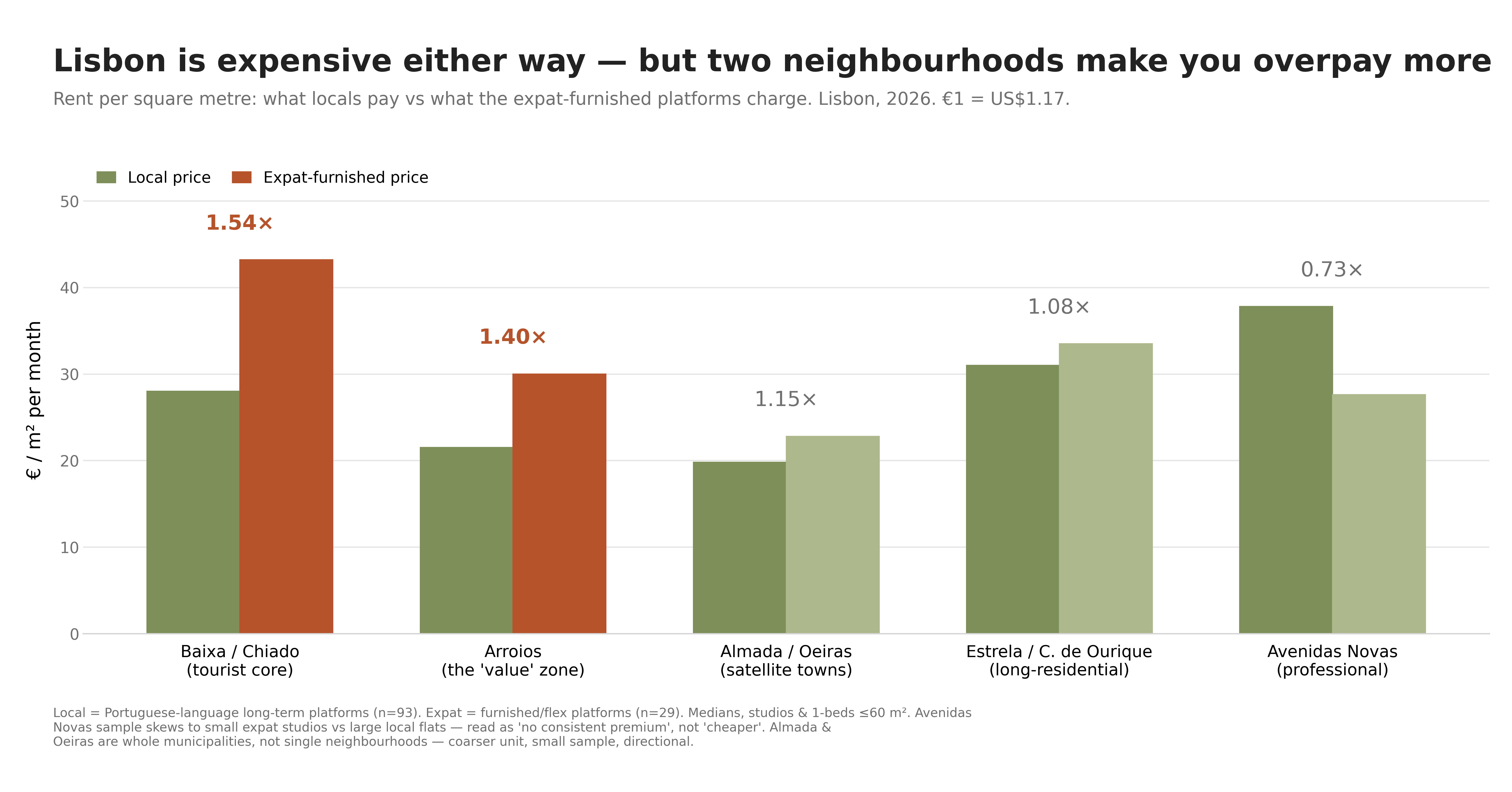
So here's the sharper way to hold it: Lisbon is expensive — that part is not in dispute, and the body of Saturday's post prices it out at more than double the local minimum wage. But on top of an already-high market, two neighbourhoods make foreigners overpay even more — the English-language rental sites steer you straight into them. Avoiding the premium doesn't make Lisbon cheap; it just stops you paying a surcharge on top of expensive. (Regular readers of this series will recognise the shape: the same concentrated-foreigner-premium pattern I found in Da Nang, milder here, and for a mechanical reason that turns out to be the most important thing in either post.)
The wall nobody warns you about
Because here’s the catch, and it’s the thread that runs from Saturday’s post straight into Wednesday’s. A new arrival looks at that and thinks: easy, I’ll just rent like a local in the no-premium districts and pocket the difference. You usually can’t. And the reason is a Portuguese word most moving-to-Lisbon guides barely mention: fiador.
To sign a standard local lease, landlords overwhelmingly want a guarantor — and not just anyone. The one piece of this I’ll give away free, because it reframes everything: that guarantor generally has to be a Portuguese-resident taxpayer. A person who landed four weeks ago doesn’t know anyone who qualifies. So the cheap local flat is real, and, for a new foreigner, often unsignable on arrival. A meaningful slice of that “foreigner premium” you saw above isn’t a markup at all; it’s the price of buying past a wall you genuinely can’t climb yet. How you climb it (what it costs, what the workarounds are) is the spine of Saturday’s post.
One neighbourhood, if you take nothing else from today: Arroios
If I were moving to Lisbon on a remote income, I’d start my search in Arroios — and then, specifically, four minutes off its trendiest streets. It’s central, it’s on the Metro, it’s genuinely mixed rather than an engineered expat strip, and it sits right at the seam where the foreigner premium is real on the listicle blocks and much thinner a short walk away. It’s the most “I could actually live here, like a resident, not a tourist” neighbourhood Lisbon offers a Western remote worker. (The honest caveat I’ll detail Saturday: “Arroios” on the furnished platforms and “Arroios” on the local platforms are almost two different price worlds, and which one you end up in comes back to that wall.)
So what does a month actually cost — and can you even move there?
Saturday’s paid teardown (June 6) is where the money gets counted properly: the full five-band rent picture, the worked line-by-line monthly budget, the daily-living math, the grocery finding that’s the opposite of what you’d guess (one aisle where Lisbon is startlingly cheap, one where the “cheap Europe” story quietly breaks), and the single number that reframes the whole thing: what a comfortable foreign-income month costs measured against what a local actually earns.
Then the following Wednesday’s post (June 10) is the decision layer, and it’s the one with the landmines: the safety data (more reassuring than the doom-scroll, and pointing at a completely different real risk than you fear), the public health system you’re entitled to as a resident, twelve places residents actually eat plus the famous one to skip — and the visa and tax reality the guides keep getting wrong. The short version of that last one, free, because getting it wrong is expensive: the famous Portuguese tax break you’ve read about is closed to new arrivals. What replaced it, and who it does and doesn’t cover, is on Wednesday.
That’s the pair. If you’ve rented in Lisbon recently: did you hit the fiador wall, and how did you get past it? Reply and tell me. The readers who actually live these cities are always my best fact-checkers, and the next round of cities in this series is reader-driven, so tell me which one to tear apart next, too.
— Wei
New here, or just browsing the archive? A batch of A Way Abroad’s earlier posts — including the founder essays from before this cost-of-living series began — are now free to read. Worth a scroll if you want the story behind the publication before Saturday’s first teardown lands.
“It’s the most ‘I could actually live here, like a resident, not a tourist’ neighbourhood Lisbon offers a Western remote worker.”
As an American who lives in Lisbon, I would say that Arroios might be the currently-in-vogue-with-Western-remote-worker neighborhood where you can most “live like a resident,” but there are other neighborhoods that are more livable and less expensive. Some may be slightly further out but easily accessible to the center on the metro.
Additionally, while Almada may be across the river, Oeiras is not. Both are large areas that contain many different neighborhoods so it’s weird to compare them with individual neighborhoods in Lisbon given. E.g., housing options and price and general neighborhood vibe in Oeiras are very different between, say, Algés and Caxias, the same way that Arroios and Campo de Ourique are different.
This just isn’t correct. Lisbon is extremely expensive (and not just when it comes to rent), the entire city along with many of the suburbs are over-inflated. I live in a city about 45 minutes to the south of Lisbon and people are moving here because they can no longer afford Lisbon. It's not only locals who are being priced out (and they are, in large numbers) it's also wealthy expats.
Painting it any other way isn't helpful to anyone, least of all locals.